

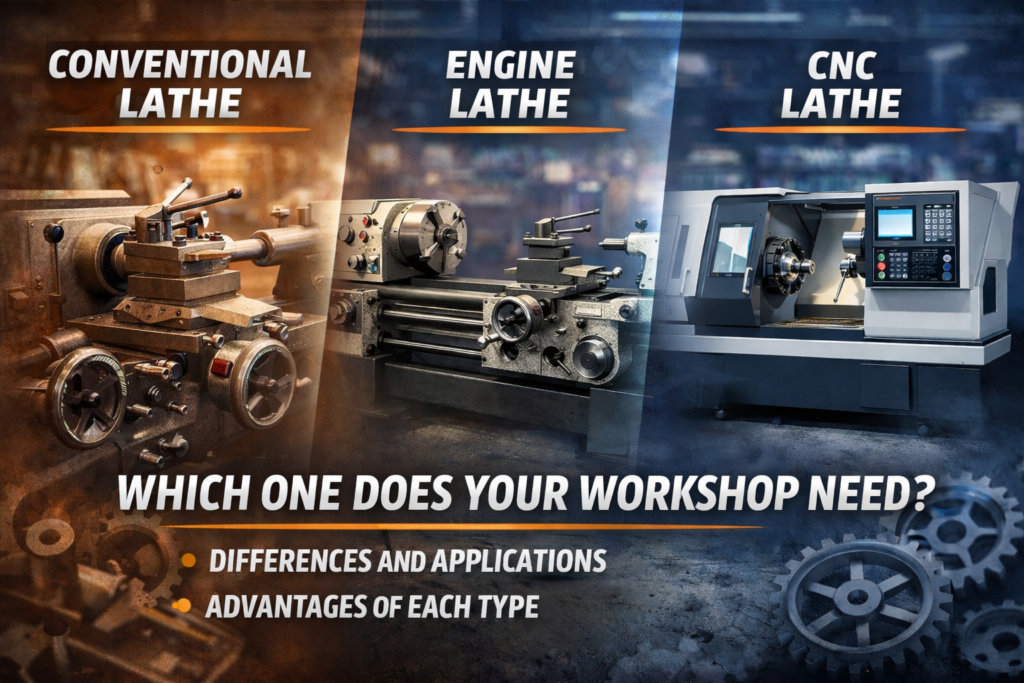
In the machining industry, terms like conventional lathe, engine lathe, and CNC lathe are often used interchangeably. However, there are important technical differences that directly impact productivity, accuracy, and workshop profitability.
In this article, we explain what each type of lathe is, their real advantages, and when it makes sense to choose one over another.
What Is a Conventional Lathe?
A conventional lathe is a manually operated machine tool where the operator controls movement using handwheels and mechanical levers.
It is mainly used for:
- One-off parts or small batches
- Maintenance and repair work
- Custom manufacturing
- Technical training
Advantages of a Conventional Lathe
- Lower initial investment
- Simple maintenance
- High flexibility for unique parts
- No programming required
Limitations
- Strongly dependent on operator skill
- Lower repeatability in long production runs
- Limited productivity in continuous manufacturing
It is ideal for maintenance workshops and companies focused on custom or repair work.
What Is an Engine Lathe?
In practical terms, the engine lathe is the classic horizontal conventional lathe with a fixed headstock and prismatic bed.
In other words:
👉 Every engine lathe is conventional, but not every conventional lathe is necessarily an engine lathe (there are vertical lathes, copying lathes, etc.).
The engine lathe is the most common manual lathe found in traditional industrial workshops and typically features:
- Prismatic bed
- Longitudinal and cross slide carriage
- Gearbox for feeds and threading
- Wide speed range
It is the standard reference when discussing manual industrial lathes.
What Is a CNC Lathe?
A CNC (Computer Numerical Control) lathe automates movements through programmed instructions.
The operator inputs a machining program, and the machine executes:
- Feed movements
- Cutting depths
- Threading cycles
- Repetitive machining operations
Advantages of a CNC Lathe
- High precision and repeatability
- Ideal for medium and large production runs
- Reduced human error
- Faster manufacturing cycles
Limitations
- Higher initial investment
- Requires programming knowledge
- More complex electronics and maintenance
It is the right choice when production is continuous and tight tolerances are required.
Direct Comparison: Conventional vs CNC
| Factor | Conventional / Engine Lathe | CNC Lathe |
|---|---|---|
| Initial investment | Lower | Higher |
| Long production runs | Less efficient | Highly efficient |
| Flexibility for single parts | Very high | Moderate |
| Repeatable precision | Operator-dependent | Very high |
| Maintenance cost | Low | Medium to high |
Which Lathe Does Your Workshop Need?
The answer depends mainly on three factors:
1️⃣ Type of Work
- Repair and one-off parts → Conventional lathe
- Repetitive production → CNC lathe
2️⃣ Production Volume
- Small batches → Manual
- Medium/high series → CNC
3️⃣ Budget
- Limited investment → Industrial used conventional lathe
- Long-term productivity focus → CNC
In many industrial workshops, the best solution is combining both: an engine lathe for flexibility and a CNC lathe for production efficiency.
What About Used Industrial Lathes?
A critical point many companies realize too late:
A high-quality used industrial conventional lathe can offer greater rigidity and durability than a low-end new machine.
The same applies to properly maintained refurbished CNC machines.
When evaluating a used lathe, always check:
- Geometric accuracy
- Bed wear
- Backlash and play
- Included equipment (DRO, steady rests, chucks, etc.)
- Service and usage history
Conclusion
There is no universally “better” lathe. There is only the lathe that best fits:
- Your production type
- Required volume
- Precision level
- Investment capacity
If you are considering adding a lathe to your workshop, professional technical advice can help you avoid costly mistakes and choose the most profitable option.
At Valcomaq, we help industrial clients select the right machine based on real operational needs.