

Choosing a used industrial shear is not a decision to take lightly, especially when this machine will be responsible for sheet metal cutting in your shop for years to come. Unlike other equipment, a shear combines very high mechanical demands (cutting forces of dozens of tonnes) with a need for geometric precision that, if not checked properly before purchase, can translate into out-of-tolerance parts, material waste and production downtime. In this guide we review the technical parameters that really matter when evaluating a used shear: cutting capacity, sheet length, power, drive system, back gauge and general mechanical condition. We will also look at the most common mistakes buyers of second-hand machinery make and how to avoid them, along with a comparison table of the different shear types by application.
By the end of this guide, you should be able to assess any used shear listing with real technical criteria, rather than relying solely on brand name or asking price, and instead focus on the data that actually determines productivity and service life.
What is an industrial shear and what is it used for?
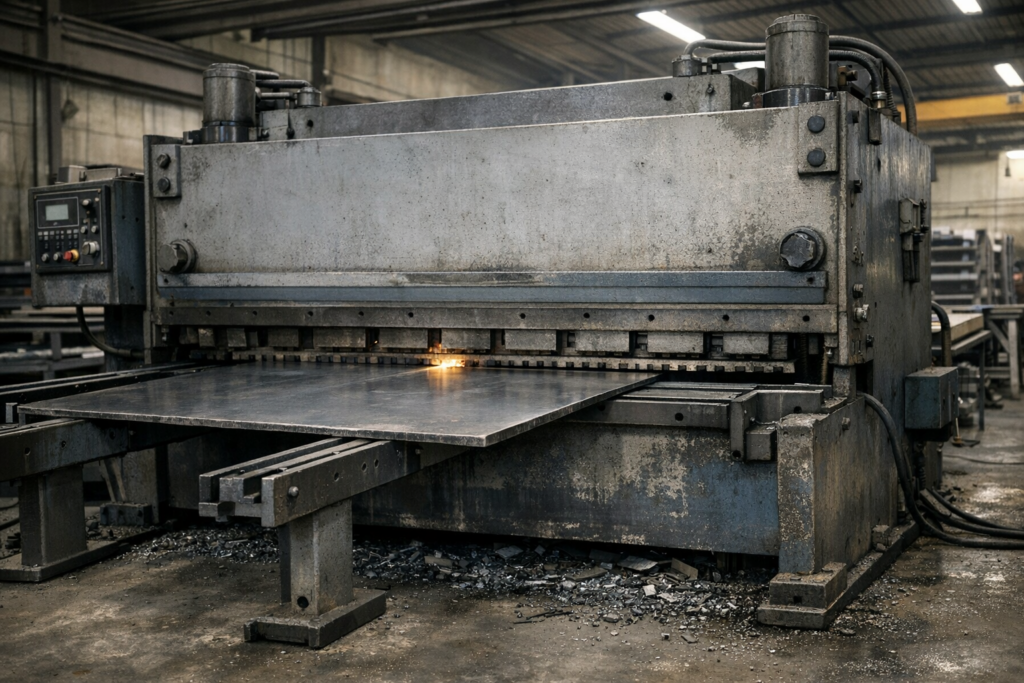
An industrial shear is a machine tool designed to cut sheet metal by moving an upper blade (or cutting beam) against a fixed lower blade, generating a shearing force that separates the material without chip removal. It is used in boilermaking, metal fabrication, structural manufacturing, tank construction, profile production and, generally, in any shop working with steel, stainless steel or aluminium sheet. There are mechanical guillotine shears, hydraulic shears and hydraulic shears with CNC control, each designed for a different production volume and precision level.
Choosing the right type of shear does not depend only on available budget, but also on the typical sheet thickness, the material type (stainless steel requires more power than carbon steel for the same thickness) and the level of repeatability the shop needs. A high-volume parts manufacturer does not have the same requirements as a repair shop handling occasional jobs, and that difference directly determines which type of used shear is worth buying.
What technical parameters should you check before buying a used shear?
The first figure to look at on any spec sheet is cutting capacity, usually expressed in millimetres of thickness on a reference steel grade (typically 400 N/mm² tensile strength). A shear capable of cutting 6 mm is very different from one built for 20 mm, and that difference shows up in bed thickness, cutting beam rigidity and installed power. The second essential figure is cutting length, i.e. the maximum sheet width the machine can handle, which typically ranges from 2000 mm in small shops to 4000-6000 mm in higher-production facilities.
Beyond these two values, it is worth checking the cutting angle (the smaller it is, the less sheet distortion, but the higher the force required), the blade gap (adjustable on most hydraulic models), and the sheet hold-down system using pneumatic or hydraulic clamps. A well-maintained used shear should allow these parameters to be adjusted without excessive play or visible wear on the beam guides.
Cutting capacity and length: the figures you cannot ignore
Many buyers focus solely on price or manufacturing year, but the combination of cutting capacity and length is what really determines whether a shear will handle a shop’s daily workload. For example, a hydraulic shear with a 4080 mm cutting length and 20 mm capacity, fitted with CNC and 45 kW of power, is built for medium-to-heavy boilermaking shops that regularly work with thick plate. On the other hand, a shear with a 2000 mm length and 6 mm capacity is more than enough for light sheet metal work or metal fabrication shops that never exceed that thickness.
It is important not to over- or under-size the purchase: a shear with far more capacity than needed means higher power consumption, more floor space and higher maintenance costs, while an undersized shear will force you to subcontract cuts or push the machine beyond its limits, accelerating wear on blades and hydraulic components.
Mechanical, hydraulic or CNC hydraulic shear? How to choose the right system
es Mechanical shears (flywheel-driven) were the standard for decades and remain valid for thin gauges and low production volumes, thanks to their mechanical simplicity and low maintenance. However, they have been largely replaced by hydraulic shears, which offer better control of cutting force, allow thicker material to be cut, and run more quietly. Among hydraulic models, those fitted with CNC control add programmable cutting dimensions, stored cutting-list programs and a motorised back gauge that significantly speeds up series production.
The choice between systems depends on the volume of repetitive parts cut daily. If a shop constantly cuts the same dimensions for different orders, a CNC shear quickly pays off its extra cost through time saved on gauge positioning. If, on the other hand, cuts are variable and rarely repeated, a conventional hydraulic shear with a manual or semi-automatic gauge may be more than sufficient.
Power, back gauge and other elements that drive productivity
The installed power of a shear, expressed in kW, is directly related to cutting capacity and cycle speed. Motors between 5.5 kW and 15 kW are common on medium-capacity shears, while machines built to cut 20 mm or more usually run 30 to 45 kW motors or larger, paired with higher-flow hydraulic power units. An underpowered motor relative to the machine’s rated capacity is a red flag when assessing a used shear, as it may indicate later modifications or a poor original design.
The back gauge is another key element: it can be manual, motorised or CNC-programmable, and its repeat accuracy (ideally below ±0.1 mm on quality machines) directly affects the consistency of cut parts. It is also worth checking the condition of the cutting beam guides, the hold-down clamp system (pneumatic or hydraulic), and the presence of safety guarding compliant with current regulations, an aspect that is sometimes overlooked on older reconditioned machines lacking the necessary updates.
| Shear type | Typical capacity | Precision | Maintenance cost | Recommended use |
|---|---|---|---|---|
| Mechanical (flywheel) | Up to 6-8 mm | Medium | Low | Small shops, thin sheet, low production |
| Conventional hydraulic | 6-20 mm | High | Medium | General boilermaking, medium production |
| Hydraulic with CNC | 10-25 mm or more | Very high | Medium-high | Series production, variable and repetitive cutting lists |
| Long-bed shear (4000-6000 mm) | Depends on model | High | High | Metal structures, tanks, large-format sheet |
What should you physically inspect before buying a used shear?
Before closing the purchase of any second-hand shear, a physical inspection that goes beyond the spec sheet is essential. The first point is the condition of the blades: nicks, uneven wear or multiple regrindings may mean they are close to their dimensional limit and will need replacing soon. You should also run a test cut on different thicknesses, checking whether the sheet comes out clean, without excessive burr or edge distortion, which would indicate poor blade gap or cutting angle adjustment.
Another critical aspect is the condition of the hydraulic system: oil leaks, unusual pump noise or slower-than-normal cycle times usually foreshadow costly failures. It is also worth checking the bed for cracks or repair welds, and verifying that the electrical cabinet and safety devices (photoelectric barriers, emergency stops) work correctly and comply with CE regulations applicable to reconditioned machinery.
What are the most common mistakes when buying used machinery?
One of the most common mistakes is focusing only on the asking price without considering the total cost of ownership: transport, installation, electrical adaptation, possible blade replacement and maintenance during the first months of use. Another frequent mistake is buying a shear without checking the technical documentation (manual, electrical diagram, CE marking) or the maintenance history, which makes diagnosing future failures much harder.
It is also common to underestimate the space and foundation requirements needed to install a large shear, or to skip checking the available voltage and electrical power in the shop before buying a high-power machine. Finally, many buyers rely solely on photographs or the seller’s word without requesting a real test cut or an inspection report, something we at Valcomaq consider essential before any transaction.
How much does a used industrial shear cost?
The price of a used industrial shear varies enormously depending on capacity, length, drive system and overall condition. A small mechanical shear up to 2000 mm can be found for just a few thousand euros, while a medium-capacity hydraulic shear (up to 3000 mm and 10-12 mm thickness) usually falls in a mid-range bracket, and long-bed hydraulic CNC units with capacities above 15-20 mm reach considerably higher figures, especially when they come with a full overhaul, new blades and start-up warranty.
Buying from a specialised dealer such as Valcomaq, compared to buying directly from a private seller or a shop liquidation, usually involves a somewhat higher cost but comes with the advantage of receiving a fully inspected machine, with blades in good condition, a tested hydraulic system and, in many cases, a start-up warranty once installed at the buyer’s facility.
Maintenance and service life: how to protect your investment
A well-maintained industrial shear can have a service life of several decades, since its mechanical structure is robust and critical components (hydraulic pump, motor, blades) are replaceable. Basic maintenance includes periodic checks of hydraulic oil level and quality, lubrication of guides and shafts, verification of blade tightening torque, and confirmation that safety systems work correctly. Ignoring these tasks is usually the main cause of premature failures on used machines that, otherwise, could have kept running reliably for years.
It is also advisable to keep a log of working hours and cuts performed, especially if the shear is used in intensive production, in order to anticipate the ideal time for blade sharpening or replacement before wear affects cut quality. Well-planned preventive maintenance significantly reduces mid-term repair costs and preserves the machine’s resale value.
Which industries use an industrial shear?
The industrial shear is a machine used across multiple sectors: it is used in boilermaking and structural fabrication to prepare sheet before forming it on press brakes or plate rolls, in tank manufacturing to cut large sheet panels with precision, in metal fabrication and locksmithing for thinner-gauge parts, and in machining shops as a preliminary step before welding or further machining. It is also common in the automotive and components industry, where cutting repeatability makes CNC shears especially valuable.
Each sector requires a different combination of capacity, length and precision, so there is no single ideal shear for every case. Understanding the machine’s intended final use is the first step, even before browsing catalogues or comparing prices between different used machinery suppliers.
Which shear does your shop need? Recommendations by profile
Choose a mechanical shear if: your shop mainly works with thin sheet (up to 6-8 mm), daily cutting volume is low to moderate, and you want a machine with simple maintenance and low acquisition cost. It is a sensible option for light sheet metal shops, locksmiths or small repair jobs where upfront investment is the deciding factor.
Choose a conventional hydraulic shear if: you need to cut medium thicknesses (between 8 and 20 mm), your production is steady but does not require constant program changes, and you value reliability and precise control of cutting force over the mechanical simplicity of a flywheel guillotine. It is the most common choice for medium-sized boilermaking and structural steel shops.
Choose a hydraulic shear with CNC if: your shop works with variable cutting lists, you need to change cutting dimensions frequently, and you want to cut dead time on back gauge positioning. The extra cost pays off quickly in series production environments or when subcontracting sheet cutting for third parties.
Choose a long-bed shear if: your business includes fabricating large structures, tanks or oversized components, where a cutting length of 4000 mm or more is a hard requirement, not just a competitive advantage.
Used shears at Valcomaq: a smart choice for any workshop
At Valcomaq we have specialised for more than 20 years in the purchase, reconditioning and sale of used industrial machinery, and shears are a regular part of our catalogue thanks to strong demand from shops looking for reliable equipment without the cost of a new machine. Every shear that passes through our facilities is thoroughly inspected: we check blade condition, the hydraulic system, back gauge accuracy and the correct operation of all safety systems before making it available to our customers.
In addition, if your shop has a shear, lathe, milling machine or any other industrial equipment you no longer use, at Valcomaq we also buy used machinery, offering a fair valuation after inspecting the equipment. This two-way activity allows us to keep an up-to-date catalogue of inspected, ready-to-work machinery, serving both shops looking for their first shear and companies looking to renew or expand their machine fleet.
If you are considering adding a used industrial shear to your shop, take a look at our catalogue of used industrial machinery and our dedicated section for used shears, where you will find inspected machines of different capacities and lengths. And if what you need is to sell a machine you no longer use, you can do so through our we buy your machine section. In either case, feel free to contact us: we will provide free advice to help you find the shear that best fits your shop’s real needs.