


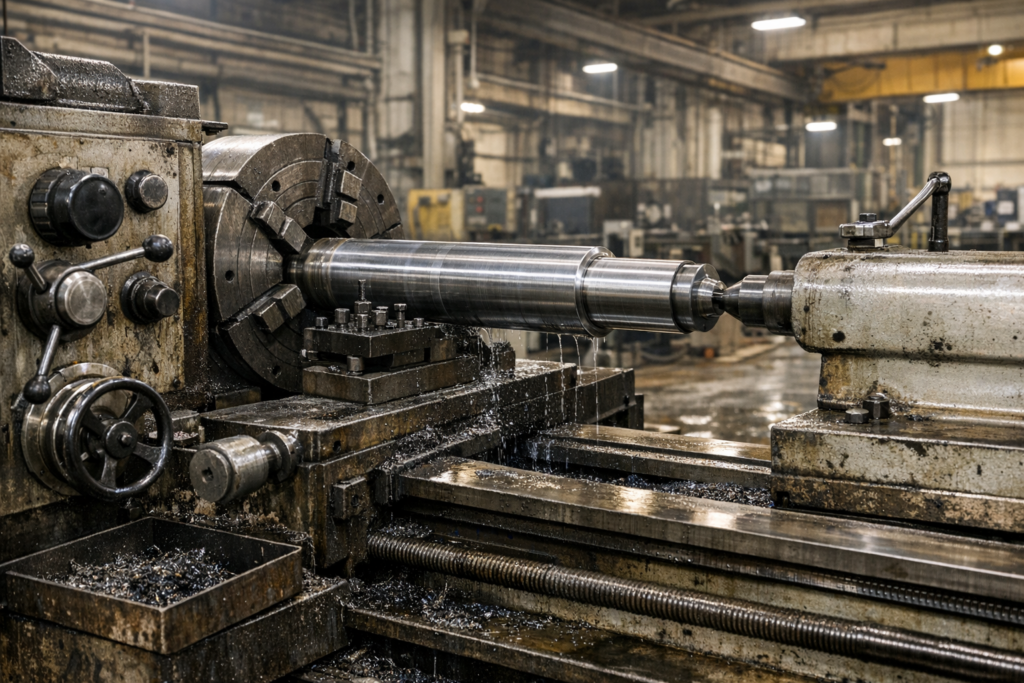
When a workshop needs to machine long or large-diameter parts, not just any lathe will do. It takes a robust, stable machine with enough precision to hold tight tolerances during hours of continuous work. This is where the used Gurutzpe lathe comes in, one of the reference brands in the Spanish machine-tool market for heavy-duty work. In this article we go over the technical features that define these lathes, their advantages over other brands in the sector, what to check before buying one second-hand, and which type of workshop gets the most value out of one.
Throughout the text we will also look at a comparison with other brands available in the used industrial machinery catalog, guidance on pricing and maintenance, and a practical guide to help you decide whether a Gurutzpe is the machine your production needs.
What is a Gurutzpe lathe and why does it have such a strong reputation?
Gurutzpe is a historic Basque manufacturer within the machine-tool sector, specialized in large-scale lathes designed to work heavy, long parts: shafts, rollers, spindles, hydraulic cylinders or components for wind power and shipbuilding. Unlike brands geared toward the serial production of small parts, Gurutzpe builds large cross-section beds, with heat treatments that guarantee geometric stability even after years of intensive use. This design philosophy explains why, on the second-hand market, a used Gurutzpe lathe still retains much of its original precision, something not every brand manages to preserve after decades of service.
Gurutzpe’s reputation has been built in sectors such as forging, energy, shipbuilding and heavy metalworking industry, where tolerances leave no room for vibration or deformation. Models such as the Gurutzpe Super RT-API or the Gurutzpe Super BT are common in workshops that machine parts several meters long, and their presence on the used market is constant because, when properly maintained, these are machines that last for decades without losing performance.
What technical features set a Gurutzpe lathe apart?
The numbers speak for themselves. A Gurutzpe Super RT-API lathe can reach up to 8000 mm between centers, with spindles of Ø360 mm and chucks of Ø800 and Ø1000 mm, figures well above what is typical in conventional general-purpose workshop lathes. This capacity allows large shafts to be machined without splitting the work or resorting to special-purpose machines. In addition, many models feature an automatic thread-cutting system, reinforced steady rests to hold long parts without flexing, and digital readouts from brands such as FAGOR, adding digital precision without giving up traditional mechanical robustness.
Another characteristic feature is swing over bed, which on models such as the Gurutzpe Super BT can exceed 1500 mm, allowing large-diameter parts to be machined without interference. The cast structure of these lathes is designed to absorb vibration during aggressive roughing passes, something essential when machining high-hardness steels or rough forged parts. This combination of large capacity, structural rigidity and finishing precision is what makes a Gurutzpe lathe a heavy-duty workhorse that is hard to replace with lighter alternatives.
Robustness and precision: Gurutzpe’s signature in every lathe
The robustness of a Gurutzpe lathe is not just a matter of size, but of engineering. The beds are made from high-quality cast iron, with internal ribs that distribute machining loads and minimize thermal deformation during long working shifts. This is especially relevant for long parts, where even a minimal deviation results in a noticeable taper error over several meters. The cross and longitudinal slides on these lathes usually feature hardened ways and wipers that extend the life of the sliding surfaces, a detail that makes a real difference when buying a machine with years of use behind it.
As for precision, the fact that many used Gurutzpe lathes come fitted with digital readout systems makes the operator’s job easier without needing to invest in a full CNC retrofit. This is a notable economic advantage: you get part of the convenience of a modern machine while keeping the reliability of a traditional mechanical build, which is far more tolerant of demanding working environments, dust, thick chips and shock loads than a delicate CNC unit might be.
Which workshops are Gurutzpe lathes ideal for?
Gurutzpe lathes find their natural place in heavy machining workshops: manufacturing shafts for agricultural or mining machinery, repairing shipbuilding components, machining rolling mill rollers, producing long-stroke hydraulic cylinders, or subcontracted workshops serving the energy and wind power sector. In these environments, the distance between centers and the spindle bore diameter are the parameters that really determine which jobs can be accepted, so having a large-capacity lathe directly expands the workshop’s potential client base.
They are also highly valued by industrial maintenance workshops that need to repair or rebuild parts for their own or third-party machinery, where the versatility to handle both short, thick parts and long, slender shafts is key. A workshop that combines forging work with precision machining will find in a used Gurutzpe lathe a machine capable of adapting to both scenarios without losing rigidity or surface finish.
How does Gurutzpe compare with other brands in the catalog?
The used lathe market offers very solid alternatives, each with its own application profile. Brands such as Pinacho, Amutio Cazeneuve or TOS are also historic benchmarks, but with different approaches depending on the type of work. The table below summarizes the main differences to help decide which brand best fits each need:
| Brand | Typical capacity | Key strength | Recommended application |
|---|---|---|---|
| Gurutzpe | Up to 8000 mm between centers, large-diameter spindles | Extreme robustness and capacity for very long parts | Long shafts, shipbuilding, energy sector, heavy forging |
| Pinacho | Medium-high, very versatile | Precision and reliability across varied production | General machining workshops and medium runs |
| Amutio Cazeneuve | Medium-high | Good performance-to-maintenance ratio | Multi-purpose workshops with medium-sized parts |
| TOS | Medium | Solid Central European build quality | Standard industrial production |
| Cumbre | Medium | Compact size and ease of handling | Small workshops or training centers |
As shown above, Gurutzpe’s difference from the rest is not in finishing precision, where all the brands mentioned can deliver good results if well maintained, but in the capacity for large-sized parts. A workshop that regularly works with parts longer than three or four meters will find in Gurutzpe a solution that other brands in the catalog, designed for more conventional work, cannot match without resorting to highly specialized and expensive models.
What should you check before buying a second-hand Gurutzpe lathe?
Buying used machinery always calls for a rigorous technical inspection, and in the case of large lathes this is even more important given the cost of transport and installation. Before closing the purchase, it is worth checking the condition of the bed ways, looking for uneven wear or play that could indicate heavy use without proper maintenance. It is also essential to check the condition of the main spindle, verifying there is no axial play or unusual noise when running at different speeds, and to inspect the lubrication system, since on machines of this size poor lubrication significantly speeds up wear on critical components.
Another key point is requesting the maintenance history and, if possible, running an actual machining test on a reference part to measure the taper and surface finish obtained. The associated electronics, whether a digital readout or a CNC system on newer models, should be tested under continuous operation, not just a quick startup. Buying through a supplier specialized in inspected and warrantied used machinery considerably reduces the risk of surprises after installation, which matters even more when dealing with machines weighing several tons.
Maintenance and service life of a Gurutzpe lathe
One of the reasons the used Gurutzpe lathe retains so much value on the market is its longevity when properly maintained. Periodic lubrication of the ways and spindle, regular adjustment of the steady rests, and protection against chips and coolant getting into the internal mechanisms are practices that, kept up over time, allow these machines to keep working with precision more than thirty years after they were built. The relative simplicity of their mechanics, compared to more complex CNC systems, also makes repairs easier, since most components are accessible and do not depend on hard-to-replace proprietary electronics.
In workshops that run structured preventive maintenance, it is common to schedule quarterly checks of the lubrication systems and annual adjustments for play in the slides and bed. This maintenance discipline is what explains why many Gurutzpe lathes that come onto the used market, after working in serious workshops, still hold tolerances very close to the original factory specifications, which is a major advantage over buying new machinery of lower build quality.
How much does a used Gurutzpe lathe cost?
The price of a second-hand Gurutzpe lathe varies widely depending on the model, distance between centers, year of manufacture and condition. As a rough guide, a mid-sized, well-maintained model can sit within an affordable range compared to the investment a new equivalent machine would require, while large-capacity models such as the Super RT-API, with extra equipment such as an automatic thread-cutting system and digital readout, reach higher values due to their production capacity and the scarcity of available units on the market. In any case, the ratio between purchase price and remaining service life is usually very favorable compared to other brands in a similar range, precisely because of the constructive robustness that characterizes Gurutzpe.
It is important not to focus solely on the sale price, but also to factor in the associated costs of transport, foundation work and installation, which on multi-ton machines can represent a significant part of the total budget. Getting advice from a specialist helps anticipate these costs and avoid surprises once the deal is closed.
Which type of workshop should choose a Gurutzpe lathe?
Choose a Gurutzpe lathe if: your workshop regularly works on long or large-diameter parts, such as shafts for heavy machinery, rolling mill rollers or shipbuilding components, and you need a machine capable of holding rigidity and precision during extended machining runs without sacrificing production capacity.
Choose a Pinacho lathe if: your production is more varied, combining medium-sized parts with short runs, and you value a versatile machine that adapts well to both precision work and moderate roughing without needing the extreme dimensions of a Gurutzpe.
Choose an Amutio Cazeneuve lathe if: you are looking for a balance between performance and ease of maintenance for a multi-purpose workshop, where most parts do not exceed two or three meters in length and you prioritize spare parts availability and operational simplicity.
Choose a Cumbre lathe if: your workshop is smaller, has limited space or is also used for training purposes, and you prefer a compact, easy-to-handle machine rather than a large distance-between-centers capacity you would not actually make use of.
Used Gurutzpe lathes at Valcomaq: a safe bet for your workshop
At Valcomaq we have spent more than twenty years selecting, inspecting and commissioning second-hand industrial machinery, and Gurutzpe lathes hold a prominent place in our catalog due to steady demand from workshops that need real capacity for large parts. Every machine we offer goes through a technical inspection process before being put up for sale, ensuring it reaches the customer ready to work, with adjusted play and tested lubrication and control systems.
If your workshop needs to expand its machining capacity with a robust, reliable machine that still has plenty of service life ahead, we invite you to browse our catalog of used lathes, where you will find Gurutzpe models alongside other reference brands such as Pinacho or Amutio Cazeneuve. If you have questions about which model best fits your production, or if you have a Gurutzpe lathe or another machine you would like to sell, contact us: we offer free, no-obligation advice and, if you need it, a valuation of your machinery through our used machinery purchase service.