

When a steel fabrication shop needs to scale up production without blowing the capital budget, used Ficep punching machines are usually among the first options on the table. Ficep is an Italian manufacturer with decades of experience building equipment for structural steel processing, and because its machines are built to last, they show up regularly on the second-hand market. This guide covers what sets these machines apart, which ranges and models you will actually find for sale used, which technical points deserve a close inspection before you sign anything, and which type of shop gets the best return from this brand. The goal is to help you make a decision based on engineering, not just on sticker price.
Further down you will find a comparison table of ranges, buying recommendations based on your shop profile, and answers to the questions we hear most often at Valcomaq from customers considering a Ficep punching machine for their production line.
What sets Ficep punching machines apart from other brands in the sector?
Ficep has historically specialized in equipment for full structural steel processing: angles, beams, profiles and medium-to-heavy gauge plate. Unlike manufacturers focused on generic thin-sheet punching, Ficep designs its machines for heavy fabrication shops, structural steel contractors and manufacturers of industrial buildings, electrical towers or agricultural machinery components. That translates into very robust frames, oversized hydraulic cylinders and clamping systems built for long, heavy workpieces.
Another defining feature is the integration with CNC controls, either proprietary or from third parties such as Fagor, Siemens or Fanuc depending on the era and model, which allows complex punching and drilling sequences to run with competitive cycle times. In the used equipment market this matters because many units still run on their original control after fifteen-plus years of service, provided they have been properly maintained. Long-term mechanical reliability is probably the single most repeated argument from shops that have already worked with this brand.
Which Ficep punching machine ranges and models are most common on the used market?
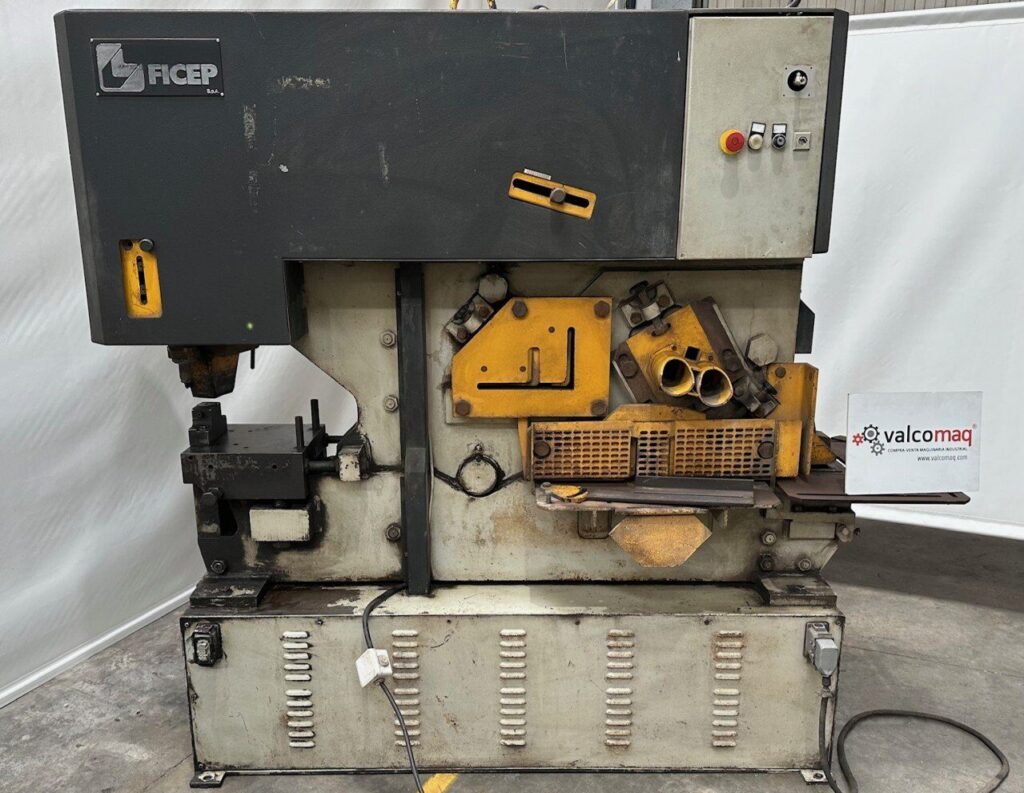
Two main families dominate the second-hand inventory: column or monobloc punching machines, aimed at mid-sized shops working sheet and flat bar up to 12-15 mm thick, and CNC gantry lines, designed for long profiles (angles, IPE, HEB beams) with automatic feed and multiple integrated punching and shearing stations. These gantry lines are often part of what the manufacturer calls profile processing lines, where the punching unit works alongside saws or shears in a single continuous workflow.
Among the models that most frequently turn up reconditioned on the domestic and international market are mid-range versions with punching forces between 60 and 120 tons, built for interchangeable tooling and series production of parts for metal carpentry work. High-end units are also common, capable of handling carbon steel up to 20-25 mm thick and equipped with quick punch-and-die changeover systems. The average age of available units tends to fall between 10 and 25 years, a range in which Ficep mechanics generally keep performing well as long as maintenance records are in order.
What should you check before buying a used Ficep punching machine?
The first mandatory inspection point is the condition of the punches and dies. Wear on the cutting edge causes excessive burring, deformation of the pierced material and extra strain on the hydraulic system. It is worth requesting a test punch on sheet of the thickness your shop normally works with, checking the finish of the hole and confirming there is no misalignment between punch and die. If the machine has been idle for a long time, it is also worth checking the guides and centering columns, since surface corrosion can affect positioning accuracy.
The second area to review is the hydraulic system: oil condition, leaks at fittings and cylinders, pump performance and the response time of the main ram. A punching machine whose hydraulic pump is slow to build working pressure, or that produces abnormal motor noise, can mean a significant repair bill shortly after purchase. Finally, on CNC versions it is essential to check the condition of the electrical cabinet, the age of the control display and the availability of electronic spare parts, since some older-generation controls can be difficult to replace once they fail for good.
Hydraulic system and CNC control: the two critical inspection points
Beyond a visual check, it is worth asking the seller for a maintenance history covering hydraulic oil changes, seal replacements and electrical cabinet servicing. At Valcomaq, when we recondition a punching machine, our standard protocol includes a full drain and flush of the hydraulic circuit, replacement of worn seals, recalibration of limit switches and verification of positioning accuracy on CNC-controlled axes. This type of overhaul is what separates a machine that performs from day one from one that will generate unplanned downtime within its first few months on the shop floor.
On the control side, it is worth distinguishing between machines with full CNC control (coordinate programming, nesting, automatic rotation) and semi-automatic versions with manual positioning or mechanical stops. For shops producing repetitive parts in long runs, the investment in a CNC version pays for itself quickly through reduced changeover time. For shops with highly variable production and short batches, a well-maintained semi-automatic punching machine may be more than enough, and represents a notably lower upfront cost.
Comparison of used Ficep punching machine ranges
| Range | Approx. punching force | Typical max. thickness | Recommended shop profile |
|---|---|---|---|
| Basic column / monobloc | 60-80 tons | Up to 12 mm | Metalworking and metal carpentry shops |
| Mid-range CNC with quick change | 80-120 tons | Up to 18 mm | Fabrication shops and mid-size structural work |
| Gantry line for profiles | 120-180 tons | Up to 25 mm | Heavy structures, construction and industrial buildings |
| Combined punch-shear unit | Depends on module | Up to 20 mm | Shops running series production of repetitive parts |
What type of workshop is a Ficep punching machine best suited for?
Ficep punching machines are a particularly good fit for shops manufacturing structural steelwork, lattice towers, civil engineering components and parts for agricultural or industrial machinery, where angles, flat bars and medium-to-heavy gauge plate are processed on a recurring basis. They are also a common choice for fabrication subcontractors handling short-to-medium runs with frequent reference changes, thanks to the fast tooling changeover available on mid-range and high-end versions.
They are not, however, the most efficient option for shops focused exclusively on decorative thin sheet or precision electronics enclosures, where other brands specializing in high-speed, low-gauge punching can deliver better throughput. Knowing the typical material and thickness your shop works with is therefore the first filter before evaluating any specific model.
Maintenance and expected service life of a second-hand Ficep punching machine
Properly maintained, these machines can comfortably exceed thirty years of service. Basic preventive maintenance includes periodic lubrication of columns and guides, monthly checks and cleaning of the hydraulic oil, and an annual inspection of the pump and solenoid valves. On CNC versions it is also worth backing up the control program and checking the backup batteries that protect the memory, a detail that is often overlooked and can lead to the loss of calibration parameters.
Before listing any unit for sale, Valcomaq carries out a full service that includes replacing fast-wear components such as seals, filters and hydraulic hoses, plus a real production test to verify positioning repeatability. This gives buyers a reliable starting point and reduces the risk of issues during the first months of operation after the machine is installed in its new shop.
What are the most common mistakes when buying a used punching machine?
One of the most frequent mistakes is focusing exclusively on the purchase price without factoring in the total cost of getting the machine running: transporting a multi-ton machine, leveling it, arranging a suitable three-phase electrical connection and, if needed, upgrading the CNC control. Another common mistake is not checking the availability of compatible punches and dies, especially on older models where certain tooling formats may have been discontinued by the manufacturer.
It is also common to underestimate the importance of a real demonstration under load. A machine that runs fine with no load can hide hydraulic pressure or structural rigidity problems that only show up when punching at its maximum rated thickness. Whenever possible, insist on a test using material similar to what your shop will actually process before closing the deal.
How much does a used Ficep punching machine cost in 2026?
Prices on the used market vary considerably depending on age, condition, the presence of CNC, and the punching force range. As a general guide, a basic semi-automatic column punching machine tends to sit in a more affordable bracket, while a CNC gantry line for profiles with automatic tool changeover represents a considerably larger investment, justified by labor savings and the ability to run long series without constant manual intervention. Either way, final price should always be weighed against the cost of any reconditioning work needed, since a cheaper unreviewed machine can end up costing more than one already serviced by a specialized supplier.
Which model should you choose based on your workshop profile?
Choose a basic-range Ficep punching machine if: your shop mainly works sheet and flat bar up to 12 mm, batch sizes vary, budget is tight, and you need a robust machine without complex programming requirements.
Choose a mid-range CNC version if: you manufacture parts in medium-sized series with frequent reference changes and want to cut setup time through quick tooling changeover and coordinate-based programming.
Choose a gantry line for profiles if: your core business is heavy structural steelwork, towers, beams or long angles, and you need to process thicknesses up to 25 mm with maximum output per shift.
Choose a combined punch-shear model if: you want punching and cutting of repetitive parts combined in a single machine, saving floor space and cutting down the number of intermediate manual operations.
PDF manuals for machine tools are available at Instrumachine.
Used Ficep punching machines in the Valcomaq catalog
For more than two decades, Valcomaq has specialized in buying, reconditioning and selling used industrial machinery, including equipment from reference brands such as Ficep. Our catalog is updated constantly and we currently have inspected, production-ready units from this brand in stock, so it is worth checking current availability before ruling out this option for your shop. You can browse the listed units in our used Ficep punching machines catalog and compare technical specifications before making a decision.
If you are considering expanding your punching capacity with a reliable, inspected machine backed by real guarantees, explore the updated catalog of used Ficep punching machines at Valcomaq and contact us to resolve any technical questions, request a running demonstration, or get personalized advice on which model best fits your production needs.