


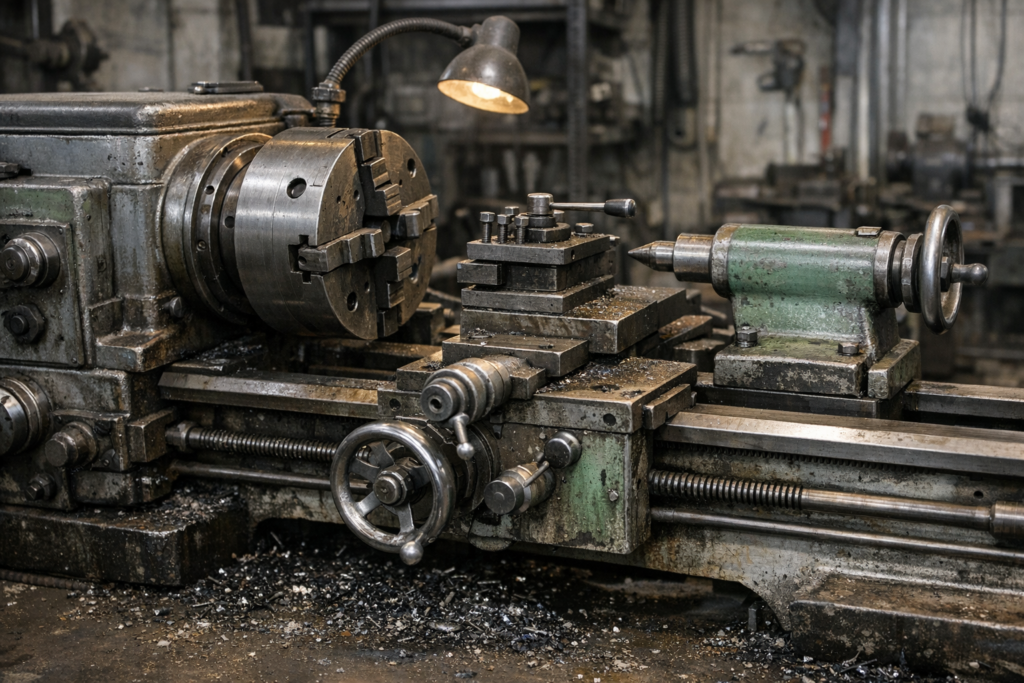
In the world of reconditioned industrial machinery, certain brands have earned a lasting reputation thanks to solid engineering and decades of proven reliability under intensive use. That is exactly the case with the used Amutio Cazeneuve lathe, a machine still highly sought after by machine shops that need power, rigidity and precision without paying the price of a brand-new unit. In this article we take a close look at what makes these lathes special, how they compare to other brands on the second-hand market, what to check before buying one, and which type of workshop gets the most value from them. If you are considering adding a large-capacity lathe to your production line, this guide will help you make an informed decision.
What characterizes a used Amutio Cazeneuve lathe?
Amutio Cazeneuve lathes bring together two long-standing industrial traditions in the machining of large parts: Spanish engineering from Amutio and French know-how from Cazeneuve, a historic benchmark in precision turning. The result is machines built around hardened and ground beds, large-diameter spindles and heavy-duty transmission systems that guarantee stability even during aggressive roughing operations. It is no coincidence that many of these units, with twenty or thirty years of service behind them, are still running in heavy-duty machine shops after proper reconditioning.
What sets a used Amutio Cazeneuve lathe apart from other options on the market is its ability to hold geometric accuracy over time, provided it has received proper maintenance. Its high-density grey cast iron beds absorb vibration better than those of more recent manufacturers geared toward series production, resulting in cleaner surface finishes and tighter tolerances on long parts machined between centres.
What is the construction and robustness of these lathes like?
The construction of these lathes follows a philosophy of structural over-engineering: wide beds, hardened ways with a large contact surface, and headstocks fitted with precision bearings capable of handling high radial loads over long periods of continuous work. Many models feature spindle bores of up to 80-105 mm in diameter, allowing bar-fed operations for medium-volume production and easing the machining of thick-walled tubular parts. This structural robustness is one of the reasons why, even after decades of use, these lathes retain a rigidity that many modern budget machines simply cannot match.
Another defining feature is the mechanical feed and threading system, with wide-range Norton gearboxes that allow the operator to change the thread pitch without swapping change gears. This solution, typical of the French turning tradition, simplifies the operator’s work and cuts downtime between operations, a factor especially valued in workshops that alternate short production runs with one-off parts of varying geometry.
Precision and technical performance for the workshop
In terms of performance, a reconditioned Amutio Cazeneuve lathe typically offers distances between centres ranging from 1,500 mm up to over 4,000 mm on long-bed versions, with swing-over-bed diameters reaching 800-1,000 mm on the larger-capacity models. This dimensional versatility makes them ideal both for machining long transmission shafts and for working large-diameter parts in sectors such as wind energy, steelmaking or shipbuilding. Motor power, usually between 15 and 30 kW depending on the model, ensures aggressive roughing passes without losing stability.
In terms of accuracy, after a professional reconditioning that includes bed regrinding and spindle inspection, it is common to achieve concentricity tolerances below 0.02 mm, more than enough for most general machining applications and for repair work and spare-part manufacturing. Many units also come fitted with digital readouts added at a later stage, which significantly improves productivity without the need to invest in a full CNC lathe.
How does the Amutio Cazeneuve lathe compare to other brands in the catalogue?
Within the used lathe catalogue there are other benchmark brands such as Gurutzpe, Pinacho, TOS or Cumbre, each with a slightly different positioning in terms of capacity, precision and application. While Gurutzpe stands out for its large beds designed for extra-long parts and Pinacho is highly valued in general machining shops for its versatility, the Amutio Cazeneuve lathe sits somewhere in between, combining structural robustness with a level of precision that makes it particularly well suited to medium and large batch work requiring repeatability.
| Brand | Strength | Typical capacity | Ideal workshop profile |
|---|---|---|---|
| Amutio Cazeneuve | Robustness and precision in medium runs | Up to 4,000 mm b.c. | Heavy machining and subcontracting |
| Gurutzpe | Large beds and large-diameter spindles | Up to 8,000 mm b.c. | Extra-long parts, energy sector |
| Pinacho | Versatility and ease of use | 1,000-3,000 mm b.c. | General machining workshops |
| TOS | Long-term mechanical reliability | 1,500-4,000 mm b.c. | Continuous production of medium runs |
What should you check before buying a used Amutio Cazeneuve lathe?
Before committing to a used Amutio Cazeneuve lathe, it is worth inspecting several critical points that reveal the machine’s real condition beyond its age. The first is the state of the bed ways: uneven wear or play in the saddle usually points to intensive use without proper maintenance. It is also essential to check the play in the main spindle, the concentricity of the chuck, and the condition of the centralised lubrication system, since its deterioration tends to accelerate wear on other components.
Another key aspect is verifying whether the machine has undergone a certified reconditioning process, which should include bed regrinding, replacement of headstock bearings, a full check of the electrical cabinet, and a complete overhaul of the feed systems. Buying through a specialised supplier such as Valcomaq, which inspects every machine before putting it up for sale, drastically reduces the risk of ending up with hidden problems that could lead to unexpected repair costs down the line.
Which sectors best suit this type of lathe?
Given its characteristics, the Amutio Cazeneuve lathe fits particularly well in sectors that machine medium-to-large parts with strict dimensional requirements: capital equipment component manufacturing, ship repair yards, metalworking subcontractors, and manufacturers of agricultural or construction machinery. It is also commonly found in workshops serving the rail sector, where high-precision shafts and bushings are required in runs ranging from single units to medium-sized batches.
Its versatility also makes it an interesting option for vocational training schools and technical training centres, since it allows students to get to grips with mechanical threading and manual control systems before moving on to CNC environments, all while training on a professional-grade machine that can withstand the intensive use typical of a workshop classroom.
How much does a second-hand Amutio Cazeneuve lathe cost?
The price of a used Amutio Cazeneuve lathe varies considerably depending on the year of manufacture, condition, distance between centres, and whether it includes upgrades such as digital readouts or automatic threading units. In general terms, a mid-sized unit (between 2,000 and 3,000 mm between centres), reconditioned and sold with a warranty, will typically cost significantly less than an equivalent new machine, with savings that often exceed 50-60% compared to a factory-new unit with similar specifications.
This economic factor is one of the strongest arguments in favour of reconditioned machinery: it allows SMEs and subcontract machine shops to access high-capacity, proven equipment without straining their cash flow, while also achieving a faster return on investment thanks to the lower upfront cost. That said, it is always worth requesting inspection reports and, where possible, a running test before closing the deal.
What maintenance does it require after purchase?
Once installed in the workshop, maintaining a reconditioned Amutio Cazeneuve lathe is not too different from any conventional lathe of this type: regular lubrication of the ways and spindle, checking the oil level and condition in the Norton gearbox, verifying belt tension, and regularly clearing chips from critical areas such as the cross slide and tailstock. A well-executed preventive maintenance plan can extend the service life of these machines by several more decades, as proven by the longevity of many units still running today in workshops across Spain.
It is also advisable to carry out an annual geometric check using a dial indicator and precision level, particularly if the machine is used for applications with tight tolerances. This check helps detect early wear in the ways before it affects machining quality, avoiding unplanned production stoppages and extending the interval between bed regrindings.
What mistakes should you avoid when buying one?
One of the most common mistakes when buying second-hand machinery is focusing solely on price without considering the total cost of ownership. A cheaper lathe that has not been properly inspected can end up generating repair costs that outweigh the initial savings. Another frequent mistake is failing to check the availability of spare parts and electrical components, especially on older models where certain elements are no longer manufactured and must be adapted or replaced with modern equivalents.
It is also worth avoiding a purchase made without first defining the workshop’s real needs: bar-feed capacity, distance between centres, the type of parts to be machined, and expected production volume. Buying a lathe that is oversized or, conversely, insufficient for regular work, is a decision that will affect the machine’s profitability for years to come.
Which is the best option for your workshop profile?
Choose a used Amutio Cazeneuve lathe if: you need a rugged machine for machining medium-to-large parts with strict precision and repeatability requirements, you work in industrial subcontracting with variable batch sizes, or you are looking for an investment that combines proven reliability with a lower cost than an equivalent new machine.
Choose a Gurutzpe lathe if: your production focuses on extra-long parts between centres, such as large shafts for the wind energy or shipbuilding sectors, and you need large-diameter spindles to accommodate bars of considerable cross-section.
Choose a Pinacho lathe if: your workshop handles general machining of small-to-medium parts, you prioritise ease of use, and you need a versatile machine for a wide variety of jobs throughout the week.
Choose a TOS lathe if: you value long-term mechanical reliability above all else in continuous production environments, with medium-sized runs and a need for near-constant machine availability.
Used Amutio Cazeneuve Lathes at Valcomaq: A Safe Investment
At Valcomaq we understand that choosing reconditioned machinery is ultimately a matter of trust: trust in the seller, in the inspection process, and in the traceability of the equipment. That is why every used Amutio Cazeneuve lathe that passes through our facilities undergoes a thorough inspection and tune-up process covering mechanical, electrical and geometric checks, ensuring it arrives at your workshop ready to produce from day one. With more than twenty years of experience buying, reconditioning and selling industrial machinery, we offer honest advice on which machine truly fits your production needs, helping you avoid unnecessary extra costs.
If you are considering adding a large-capacity lathe to your production line, we invite you to browse our catalogue of used lathes, where you will find a range of brands and capacities, all inspected and ready to work. And if what you need is to sell your own machinery, we can help with that too: check out our used machinery buying page and get a fair valuation. For any technical questions about availability, pricing or purchase terms, contact us through our contact page; we would be glad to help you find the lathe your workshop needs.