

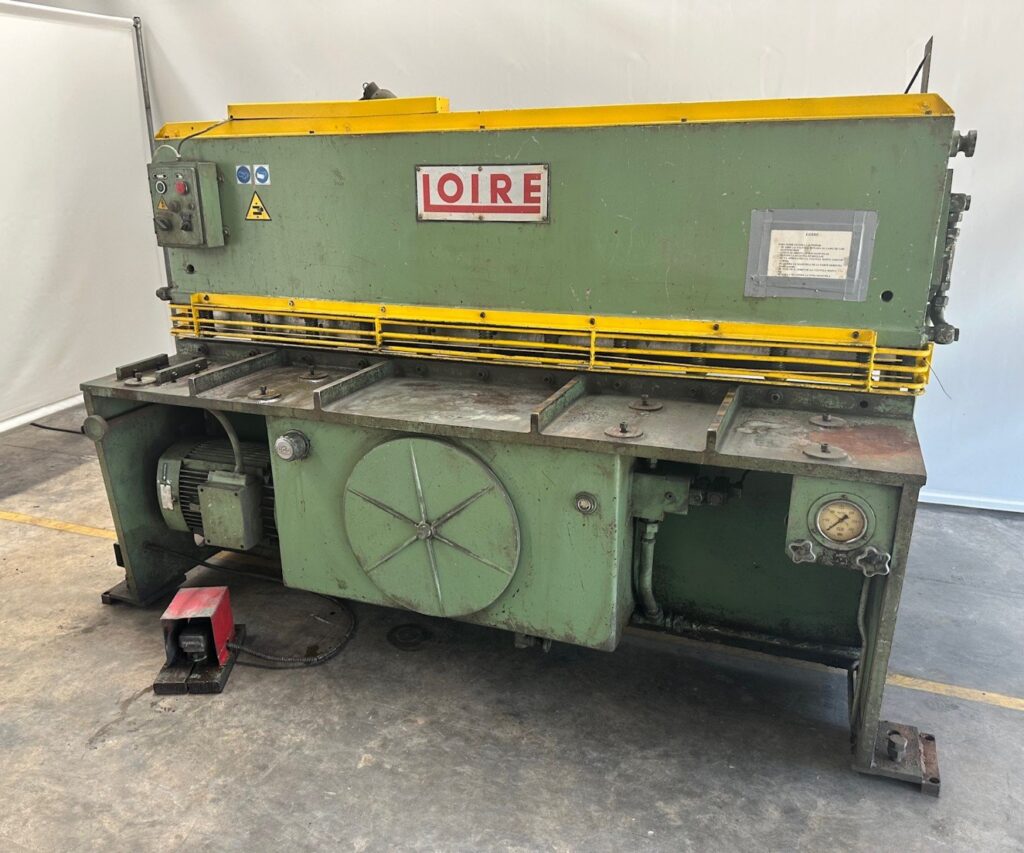
Finding a reliable, heavy-duty shear with a solid service history is one of the most common challenges faced by sheet metal, boilermaking and structural steel workshops looking to expand their cutting capacity without a huge investment. Among the brands that inspire the most confidence on the second-hand machinery market is Loire, a manufacturer with a long tradition in large-format, high-thickness hydraulic shears. In this guide we review what sets used Loire shears apart, which ranges and models are typically available on the market, which technical points you should check before signing the purchase, and what type of workshop they are best suited for. We also include a comparison table, indicative 2026 prices, and the most common mistakes first-time buyers make.
By the end of this guide, you will be able to assess any used Loire shear with real technical criteria, know what questions to ask the seller, and understand whether it matches the volume and type of work in your facility.
What sets Loire shears apart on the used machinery market?
Loire shears are historically known for extremely robust frames, designed to absorb cutting stress on thick plate without losing accuracy over the years. Unlike other brands geared toward thin-gauge sheet metal shops, Loire focused from the start on machines built for medium and heavy thicknesses, with welded, stress-relieved structures that reduce deformation and keep the cutting square stable even after decades of intensive use. This build quality is one of the reasons why, on the used market, well-maintained Loire units still perform at a level comparable to much newer machines.
Another distinctive feature is the rake-angle blade cutting system, which reduces the force required and improves the finish of the cut edge, something especially valued in boilermaking where the cut piece is later welded or machined. Many units from this manufacturer also feature pneumatic or hydraulic plate hold-down via adjustable clamping feet, which prevents the sheet from shifting during the cut and improves repeatability, a key factor when working with batches of identical parts.
Common ranges and models of used Loire shears you will find on the market
Two main families circulate in the used machinery pool: older but extremely long-lasting mechanical flywheel shears, and hydraulic shears, which dominate current supply thanks to better control over cutting speed and pressure. Within the hydraulic range, the most common table lengths run from 2000 mm to 4000-6000 mm, with cutting capacities typically between 6 and 20 mm in carbon steel, depending on the model and installed power. It is common to find units with a motorised back gauge, allowing repetitive cuts to be programmed without manually measuring every piece.
Models with built-in or later-fitted CNC control are the most sought-after on the second-hand market, as they allow cutting programs to be stored, blade angle adjusted, and descent speed managed based on thickness. On older units, however, it is common to find relay-based or first-generation CNC control systems, fully functional but with a different learning curve compared to today’s Cybelec- or ESA-type controls. Before settling on a model, it is worth assessing whether your production requires long runs with frequent program changes, or whether occasional cuts mean a simpler system will suffice.
What should you check before buying a used Loire shear?
The first inspection point should be the upper and lower blade: the edge should be free of deep nicks and show even wear along its entire length. A blade that has already been reground several times can still perform well, but it is important to ask how many cutting edges remain, since Loire blades typically offer four usable faces and replacement is a significant cost. You should also check the clearance between blades, which must be adjustable and remain consistent across the full cutting length; uneven clearance is a sign of wear in the guides or the frame.
Second, inspect the hydraulic unit: oil condition, absence of leaks in cylinders and hoses, and pump behaviour under load. A noisy hydraulic unit or one with noticeable pressure loss may indicate it will need servicing in the short term. It is also important to check the back gauge (manual or motorised), its positioning accuracy, and the condition of the rack or lead screw that moves it. Finally, always request a real cutting test on plate at the maximum thickness stated by the manufacturer: it is the most reliable way to confirm the machine truly delivers its rated capacity, not just on paper.
Cutting and control systems: from mechanical shears to CNC
The technical evolution of Loire shears mirrors that of the whole industry: from purely mechanical systems driven by flywheel and clutch, the market moved to hydraulic systems with proportional valves, which allow the cutting stroke speed to be regulated and matched to material thickness and hardness. This control is particularly useful when a workshop works with carbon steel as well as stainless steel or aluminium, materials that require different speed and blade-angle settings for a clean cut without excessive burr.
CNC units add the ability to program complete cutting sequences, which is highly valuable for workshops producing repetitive parts in medium or large batches. The numerical control manages the back gauge, stores thickness and square programs, and in more advanced models can automatically compensate for blade wear by slightly adjusting the cutting clearance. For a used machinery buyer, verifying that the control panel responds correctly and that no keys or displays are missing is just as important as checking the mechanics, since replacing a damaged CNC can significantly increase the cost of the deal.
Comparing Loire shear ranges by workshop needs
| Range / type | Typical cutting length | Indicative cutting capacity | Recommended workshop profile |
|---|---|---|---|
| Mechanical flywheel | 2000-3000 mm | Up to 6-8 mm | Locksmith shops and thin-gauge workshops on a tight budget |
| Standard hydraulic | 2500-4000 mm | 8-13 mm | General boilermaking and medium structural steel work |
| Hydraulic CNC | 3000-5000 mm | 10-16 mm | Repetitive series and production with demanding quality control |
| Large format / heavy thickness | 4000-6000 mm | 16-20 mm | Heavy structure manufacturers, industrial buildings and steel construction |
What type of workshop suits a used Loire shear?
A used Loire shear fits particularly well in boilermaking and structural steel workshops that need to cut medium-to-heavy gauge plate on a regular basis, without taking on the cost of a new large-format machine. It is also a very sensible option for industrial locksmiths and metal fabricators that have grown in volume and need to move up from a small shear to equipment capable of processing thicker plate batches with a motorised back gauge, gaining accuracy and cutting setup time for each job.
Subcontract workshops for the shipbuilding, agricultural or heavy machinery sectors find in these shears an interesting balance between cutting capacity, frame robustness and acquisition cost, especially when production levels do not justify investing in a brand-new, latest-generation machine. In every case, the common thread is the need for a clean, repeatable cut at thicknesses that many entry-level shears simply cannot handle reliably.
What maintenance does a Loire shear require to keep performing well?
Preventive maintenance on a Loire hydraulic shear is not too different from that of other brands in the same class: periodic checks of hydraulic oil level and condition, lubrication of guides and frame sliding points, and checking blade tightness after the first cutting cycles following each adjustment. It is advisable to keep a record of how many times the blades have been reground, as this figure directly affects the machine’s resale value and future maintenance budgeting.
On units with numerical control, it is also worth regularly backing up stored programs and checking that the CNC memory’s backup batteries are in good condition, avoiding the loss of cutting programs that have already been calibrated. Consistent, if simple, maintenance is what allows many Loire shears over twenty years old to remain fully operational in workshops across the world with their accuracy practically intact.
What are the most common mistakes when buying a used shear?
One of the most frequent mistakes is relying solely on the original spec sheet without checking the machine’s actual condition, particularly regarding blade clearance and frame wear. Another common error is failing to ask for the maintenance and repair history, which makes it impossible to anticipate future costs on components such as the hydraulic pump, clamping cylinders or the electrical control system. Buyers also commonly underestimate the space and electrical installation required, as large-format shears need proper foundations and sufficient installed power for the hydraulic unit.
Finally, many first-time buyers skip requesting an in-person cutting test, relying instead on photos or videos that do not always reflect the machine’s real precision. Seeing the shear in operation, cutting plate of the typical working thickness, is the best guarantee before finalising a purchase, whether from a private seller or a specialised reconditioned machinery supplier.
How much does a used Loire shear cost in 2026?
Prices for used Loire shears in 2026 vary considerably depending on cutting length, maximum thickness, type of control, and the overall condition of the equipment. A mechanical flywheel unit in good condition, with more modest cutting lengths, can be found at clearly lower price ranges than a large-format hydraulic CNC shear, which incorporates more recent technology and greater production capacity. In general, factors such as the age of the hydraulic unit, the number of regrinds left on the blades, and the presence of a fully functional CNC are what most influence the final market price.
Buying through a specialised supplier that inspects, repairs and commissions the machine before delivery usually costs somewhat more than a direct private sale, but it significantly reduces the risk of hidden faults or components near the end of their service life, a particularly relevant concern for mechanically demanding cutting equipment such as shears.
Which Loire shear should you choose for your workshop?
Choose a mechanical flywheel Loire shear if: your production is occasional, you mainly work with thin to medium thicknesses, and you want a low initial investment without giving up the structural robustness the brand is known for.
Choose a standard hydraulic Loire shear if: your workshop cuts regularly on medium-to-heavy gauge plate and you need an accurate back gauge to improve repeatability without relying on a complex numerical control.
Choose a Loire shear with CNC if: your production includes repetitive part series, you work with different thicknesses and materials throughout the week, and you value being able to store and recall cutting programs to save time on every changeover.
Choose a large-format Loire shear if: your activity centres on heavy structural steel, shipbuilding or agricultural and industrial machinery, and you need to cut long, thick plates with full squareness guaranteed.
Looking for the manual of a Loire shearing machine? Instrumachine has PDF manuals for Loire shearing machines.
Used Loire shears in Valcomaq’s catalog
At Valcomaq we have spent more than twenty years specialising in the purchase, reconditioning and sale of second-hand industrial machinery, and used Loire shears are a regular part of our catalog thanks to the reliability they offer over the medium and long term. Every unit that passes through our facilities is thoroughly inspected: we check the blades, the hydraulic unit, the back gauge and, where applicable, the full operation of the CNC, so the machine arrives at your workshop ready to work from the very first cut.
If you are considering adding a used Loire shear to your sheet metal, boilermaking or structural steel workshop, we invite you to browse the used Loire shears available in Valcomaq’s catalog, where you will find inspected units backed by full guarantees. You can also explore our wider range of second-hand shears if you are open to other brands. Stock is updated constantly, so we recommend checking current availability, and if you have any questions about which model best fits your production, contact us: our team will offer you personalised advice based on the thickness, cutting length and workload of your workshop.