

Choosing between a used gear hobbing machine from one brand or another is far from a trivial decision when the teeth you cut will end up inside a gearbox, a transmission or a critical drive mechanism. In the Spanish second-hand machinery market, two names come up again and again when gear cutting is discussed: Celta and Bilariz. Both brands have a long track record in the domestic metalworking sector, and well-maintained units from either manufacturer are still running to tight tolerances decades after leaving the factory. In this article we compare both brands honestly: build quality, accuracy, spare parts availability, resale value and indicative pricing, so you can decide with real technical criteria which used gear hobbing machine best fits your production.
This is not about crowning an absolute winner, but about understanding which type of shop each brand suits best. A repair shop cutting occasional one-off parts has very different needs from a gearbox manufacturer that requires repeatability across long production runs. Throughout this article we break down those differences with concrete technical data, a comparison table and clear recommendations based on the kind of work you do.
What’s the difference between Celta and Bilariz gear hobbing machines?
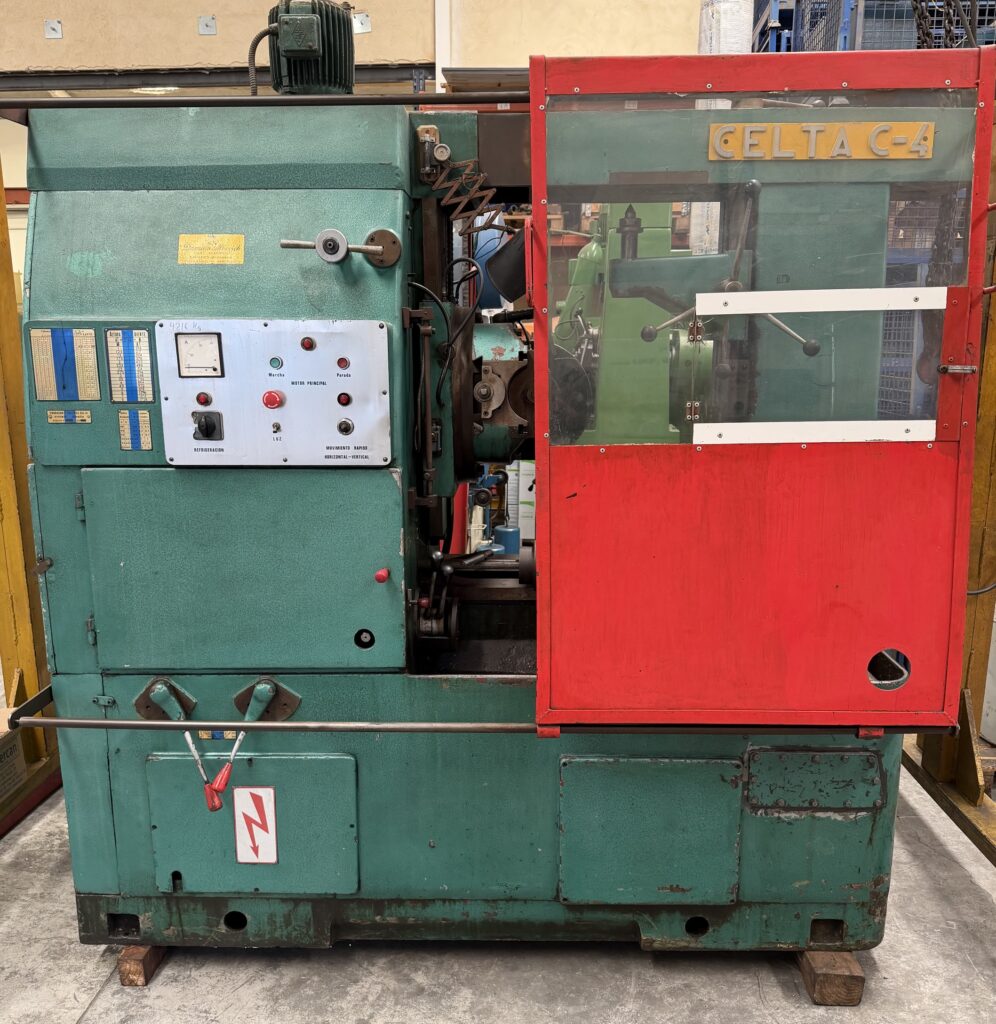
The Celta brand is historically known in Spain for building hobbing machines with very robust beds, designed to work medium and large modules for gearbox workshops, industrial pinion manufacturing and spare parts for agricultural and industrial machinery. Its most common models on the second-hand market cover workpiece diameters from 300 mm up to over 1000 mm, with automatic feeds and a swivelling hobbing head that allows both straight and helical gears to be cut on the same machine. The casting on Celta beds tends to be particularly thick, which reduces vibration when cutting coarse modules and improves the surface finish of the tooth flank.
Bilariz, for its part, has established itself as a strong alternative for mid-sized workshops, with somewhat more compact machines built around a versatility-first philosophy: many of its models include universal dividing heads that make it easy to cut pinions, gear wheels and, in some cases, splined shafts. Factory accuracy on Bilariz machines is comparable to Celta in the low-to-medium module range, although on large-diameter parts Celta generally holds structural rigidity better during aggressive roughing passes. Both brands share the same hobbing-generation principle, so the real difference lies more in build robustness and size range than in cutting technology itself.
Bed construction and rigidity: the factor that ages best
When buying used machinery, the bed is the element that determines whether an overhaul is worth the investment or whether the machine has already lost its accuracy beyond recovery. On Celta hobbing machines, the ribbed cast-iron bed and the hob carriage guided along hardened, ground slideways usually retain very good geometry even after thousands of hours of use, provided lubrication maintenance has been respected. It is common to find units over 25 years old that, after regrinding the ways and replacing the hob spindle bearings, return to commercial-grade tolerances without issue.
Bilariz hobbing machines are also built solidly, although on mid-range models the bed thickness is somewhat lower, which translates into slightly greater sensitivity to vibration when cutting modules above 6 or 8 mm with aggressive feeds. This does not make them fragile machines: for small and medium modules, fine pinion work or replacement part repair, their rigidity is more than sufficient, and their mechanics are generally somewhat easier to adjust for a technician with average skills, since access to the drive components tends to be more direct than on heavier-tonnage Celta models.
How does precision affect gear cutting?
The accuracy of a gear hobbing machine is mainly measured by the quality of the generated tooth profile, the pitch between teeth and the eccentricity error of the dividing plate. On well-preserved Celta machines, the division error typically stays within DIN 8 to DIN 9 quality for industrial replacement work, which is more than enough for the vast majority of gearboxes and transmission cases that do not require high-precision certification. The hob spindle, when it retains its original clearance, delivers clean flank finishes without the need for subsequent gear grinding.
On Bilariz units, division accuracy depends heavily on the condition of the dividing plate and its internal worm wheel, a point that should always be checked before buying, since wear on this component is the most common cause of pitch inaccuracy. When this element is in good condition, Bilariz delivers results very similar to Celta for modules up to 5 or 6 mm, with the added advantage that changing the exchange gears for different tooth counts is, on several models, faster thanks to well-documented change tables in the original factory manuals.
Spare parts and maintenance: the real key to buying used
Buying a used hobbing machine without thinking about spare parts is the most expensive mistake a buyer can make. In Celta‘s case, since the brand has a large installed fleet across Spain built up over decades, specialised workshops and suppliers still manufacture or supply replacement hobs, specific bearings and exchange gears compatible with most of its models. This significantly reduces downtime in the event of a mechanical failure and makes a full refurbishment of a used unit much easier before putting it back into production.
For Bilariz, original spare parts availability is somewhat more limited on certain older models, although most of its mechanical components — bearings, belts, electrical parts — correspond to standard industrial specifications that any general mechanical supplier can provide without difficulty. The truly brand-specific components, such as the dividing assembly or certain internal gears in the feed gearbox, are best sourced second-hand or custom-manufactured when a failure occurs, which can extend repair times somewhat compared to Celta for that specific type of component.
What types of gears can each brand cut?
The largest Celta hobbing machines are built for heavy-duty pinion work: gear wheels for industrial gearboxes, large-module chain sprockets, and ring gears for agricultural and public works machinery. Their workpiece diameter capacity, which exceeds one metre on some models, makes them particularly useful for shops that manufacture spare parts for heavy machinery or replacement components for older fleets where no original manufacturer remains. Helical cutting with a variable head angle extends their application range to industrial automotive and textile machinery gears.
Bilariz hobbing machines, on the other hand, fit very well in general machine shops that need versatility: small and medium-batch pinions, splined shafts, gear wheels for packaging machinery, and spare parts for industrial appliances or catering equipment. Their more compact size allows them to be integrated into shops with limited floor space without sacrificing cutting capacity that remains perfectly valid for the bulk of the industrial replacement work demanded by the domestic market. For short runs and frequent part changeovers, handling is agile, making it a very reasonable option.
| Criterion | Celta | Bilariz |
|---|---|---|
| Workpiece diameter range | Medium to large (up to +1000 mm on high-end models) | Small to medium, compact approach |
| Bed rigidity | Very high, thick ribbed casting | High on low/medium modules |
| Typical recoverable accuracy | DIN 8-9 for industrial replacement work | Similar up to module 5-6 mm |
| Spare parts availability | Wide, large installed fleet | Good for generic parts, limited for specifics |
| Recommended shop profile | Gearboxes, heavy pinion work, long runs | General machining, short runs, versatility |
| Indicative used price | Medium-high depending on tonnage | Medium, good value for money |
How much does a used Celta or Bilariz gear hobbing machine cost in 2026?
The price of a used gear hobbing machine depends mostly on the workpiece size it admits, the condition of the dividing head, and whether it includes a set of hobs and exchange gears. In 2026, a medium-capacity used Celta gear hobbing machine, overhauled and accuracy-tested, typically ranges between €9,000 and €22,000 depending on the maximum workpiece diameter and the condition of the CNC or digital readout if fitted. Heavier-tonnage models aimed at heavy pinion work can exceed that range when fully refurbished and tested under real load.
A medium-sized used Bilariz gear hobbing machine in good condition usually sits in a somewhat lower range, between €6,000 and €15,000, especially on models aimed at general shop work without demanding diameter requirements. Keep in mind that these prices are indicative and vary depending on the year of manufacture, the condition of the slideways, whether the machine has been repainted and geometrically checked, and whether it comes with original technical documentation. In both cases, always requesting a cutting test before closing the purchase is the best way to avoid surprises.
Common mistakes when buying used gear hobbing machines
One of the most frequent mistakes is not checking the condition of the dividing plate before buying, since its wear is hard to spot visually and only shows up when cutting a real part and measuring the pitch with a comparator. Another common error is not requesting the full set of exchange gears: without them, the machine loses much of its versatility, and sourcing the missing ones can significantly raise the cost of the operation, especially on Bilariz models where certain combinations are hard to find loose on the spare parts market.
It is also common to underestimate the condition of the main motor and the forced lubrication system for the slideways, two elements that cause extended production stoppages if they fail. Finally, many buyers skip requesting a cutting test on a part with a module similar to what they will regularly work with, which makes it impossible to genuinely verify flank finish and the absence of vibration. At Valcomaq we always recommend requiring this test before closing any deal, on both Celta and Bilariz hobbing machines, regardless of the unit’s age.
Which brand holds its resale value better?
In the used industrial machinery market, the resale value of a used Celta gear hobbing machine tends to stay somewhat more stable over the years, especially on medium-to-high tonnage models, thanks to steady demand from heavy-machinery replacement parts shops and the spare parts availability mentioned above. A well-documented unit, with an inspection certificate and cutting test, can recover a very significant share of its purchase price after several years of productive use, making it a relatively safe investment for shops planning to amortise the equipment and eventually upgrade it.
Bilariz hobbing machines, while also maintaining solid demand in the mid-sized shop segment, tend to depreciate slightly faster on older models, partly because the market places more value on the versatility of a newer machine fleet than on a machine several decades old. Even so, mid-range models with well-documented maintenance retain notable commercial appeal, especially among workshops looking for a first hobbing machine without the outlay of a heavy-tonnage unit.
Which one should you choose based on your shop’s production?
Choose Celta if: your shop regularly works with medium or large modules, you manufacture replacement parts for agricultural machinery, public works equipment or industrial gearboxes of a certain tonnage, and you need a machine capable of running long series without losing accuracy. It is also the more sensible choice if you value long-term spare parts availability and want an investment that keeps good resale value a few years down the line.
Choose Bilariz if: your production focuses on small or medium-module parts, you work with short runs and frequent changeovers, or you need a compact hobbing machine that won’t take up too much floor space. It is also a good choice if you are taking your first steps in gear cutting and want a well-priced machine before moving up to heavier-tonnage equipment.
Choose either if: what really matters to you is the specific condition of the available unit, rather than the brand itself. In used machinery, a poorly maintained Celta can perform worse than a well-cared-for Bilariz, and vice versa. That’s why a technical inspection before purchase should always carry more weight than brand preference.
Need the documentation for a Celta gear cutting machine? You can find it at Instrumachine.
Used gear hobbing machines at Valcomaq: inspected and ready to run
At Valcomaq we have specialised for over 20 years in buying, refurbishing and selling used industrial machinery, and gear hobbing machines are a regular part of our catalogue. We currently have several Celta units available, mechanically checked and tested through an actual cutting trial before leaving our facility, so we recommend checking current stock if you are considering adding one of these machines to your production. We work with both domestic and international clients, offering genuine technical advice so you choose the hobbing machine that best fits the type of gear you need to manufacture, whether Celta, Bilariz or any other reference from our constantly updated inventory.
If you want to see the units available right now, check out our catalogue of used Celta gear hobbing machines, where you’ll find inspected machinery ready to run at the best price. If you have any doubts about which model best fits your type of production, or you want to sell a hobbing machine you no longer use, contact us and we’ll give you an honest, no-obligation valuation.