

Choosing between used Sabi industrial saws and second-hand FAT saws is one of the most common decisions facing cutting workshops and profile warehouses that want to renew their machine fleet without blowing up the initial investment. Both brands have been manufacturing equipment in Spain for decades and enjoy a solid reputation among locksmiths, machining shops and structural steel companies. However, their construction philosophy, cutting technology and spare parts availability show differences worth knowing before you sign the purchase. In this article we break down the robustness, precision, maintenance and resale value of both brands, and give you an honest recommendation based on your shop’s type of production. If your goal is to find the best value for money in 2026, keep reading, because this comparison will save you more than one headache.
What makes a Sabi saw different from a FAT saw in construction and robustness?
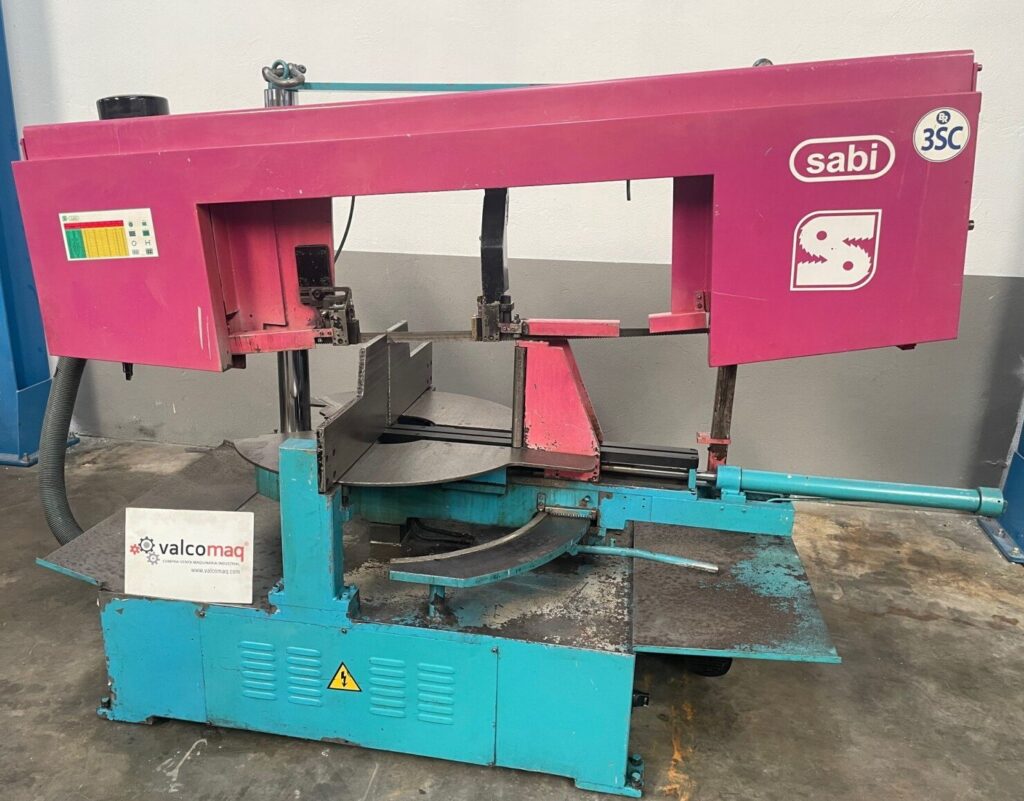
Sabi saws are known for their thick cast-iron beds and a design built for continuous multi-shift production. Models from the PBS range, very common on the used machinery market, feature reinforced carbide guides, hydraulic double-body clamping vices and motors with an electronic speed variator that adjusts the cutting speed to the material without losing structural rigidity. This heavy-duty construction reduces vibration when cutting thick-walled profiles and solid bar stock, something that becomes especially noticeable during long shifts machining carbon steel or hard alloys.
FAT, on the other hand, favours a more compact and versatile design, with high-strength welded frames that make maintenance and access to internal components easier. Their automatic and semi-automatic saws tend to prioritise relative lightness and fast set-up time, which makes them very popular in shops that alternate short runs with pieces of varying section. FAT’s build quality is notable at medium diameters, although for large solid-section cuts some users report more guide wear than on equivalent Sabi units, especially on machines with many hours on the clock.
How do they compare in cutting precision and CNC technology?
In terms of precision, used Sabi saws fitted with CNC control, such as the well-known PBS 250A with touchscreen, stand out for their repeatability on angled cuts and automatic blade feed management, which reduces material waste on long production runs. The built-in speed variator allows fine adjustment of cutting parameters for each type of alloy, achieving tight dimensional tolerances even across batches of hundreds of parts. This is essential for workshops operating under quality standards that need full traceability on every batch produced.
FAT also offers models with numerical control, although its historical strength has been the hydraulically-driven semi-automatic saw, with manual or semi-manual clamping systems that require somewhat more operator intervention to guarantee cut squareness. In shops where angular precision is not critical and speed of changeover between references is the priority, this more direct FAT approach can actually be more productive, since it simplifies programming and shortens the learning curve for new operators.
Spare parts availability and technical service in the Spanish market
One of the factors with the biggest impact on the total cost of ownership of a used industrial saw is how easy it is to source spare parts. Sabi saws benefit from a fairly extensive network of distributors and specialised workshops across Spain, making it easier to find cutting blades, carbide guides, bearings and hydraulic components without long waiting times. This matters especially for wear parts such as clamping vices and lubrication systems, which require periodic replacement on machines with many accumulated working hours.
FAT, being an equally well-established brand in Spain, also has accessible spare parts, although on older or discontinued models it may be necessary to custom-manufacture certain electronic components or adapt compatible third-party parts. In either case, buying through a specialist supplier that inspects the machine before delivery, as Valcomaq does, minimises the risk of acquiring equipment with obsolete components that will be hard to replace in the future.
What resale value do these used saws hold?
Resale value is an argument many buyers overlook when purchasing used machinery, yet it directly affects the real profitability of the investment over the medium term. Used Sabi saws tend to hold their value well on the second-hand market thanks to their reputation for robustness and constant demand from heavy machining shops and structural steel companies. A well-maintained Sabi saw, with a crack-free bed and a leak-free hydraulic system, can retain most of its purchase price for several years, especially if it includes a working CNC unit.
FAT saws also retain an interesting residual value, although their depreciation tends to be somewhat more sensitive to the condition of electronic components and guide wear, since replacing these parts can be costly on certain models. In any case, both brands sit well above generic manufacturers with no spare parts network, making Sabi and FAT safe options both to buy and to resell later if your shop changes its production line.
| Criteria | Used Sabi saws | Used FAT saws |
|---|---|---|
| Construction | Heavy cast-iron bed, high rigidity | Welded frame, compact and versatile design |
| Batch precision | Very high with CNC and variator | Good, more manual on semi-automatic models |
| Spare parts | Wide distribution network across Spain | Available, some custom parts on older models |
| Best suited for | Continuous production and large-section cutting | Short runs and frequent reference changes |
| Resale value | High and stable | Good, somewhat more sensitive to electronics condition |
What type of production best suits each brand?
If your shop mainly works with solid bar stock, thick-walled profiles or high-hardness steel, the structural robustness of Sabi saws offers a clear advantage in terms of stability and blade life. Their ability to absorb vibration and keep the cut square over long shifts makes them especially suitable for heavy machining shops, machinery manufacturers and companies supplying parts to the naval or capital goods industry, where dimensional tolerance is a constant requirement.
On the other hand, if your shop’s activity centres on cutting thin-walled profiles, small-to-medium diameter tubes, or if you work with varied batches that change section several times a day, the agility of FAT saws can translate into less downtime between reference changes. Their more accessible design also makes preventive maintenance easier for in-house staff, without always relying on a specialised technician, which reduces downtime costs in small and medium-sized workshops.
Indicative prices of used Sabi and FAT saws in 2026
The price range for a used Sabi industrial saw in good condition, inspected and with a working CNC unit, usually runs between €6,000 and €18,000, depending on the year of manufacture, the maximum cutting diameter and whether it includes a chip extractor and automatic lubrication system. More basic models without numerical control can be found below that figure, while large-capacity automatic saws with touchscreen and electronic variator sit at the top of the range.
Used FAT saws fall within a similar range, although their entry-level semi-automatic versions tend to be somewhat more affordable, with prices starting from around €3,500 for units with moderate hours of use. In both cases, the final price depends heavily on the real condition of the machine: an inspection of guides, hydraulic vices and the electrical system can mean a difference of several thousand euros compared with a unit with no recent maintenance, which is why buying through a supplier that guarantees prior servicing is always the safer option.
What mistakes are most often made when buying a used industrial saw?
One of the most common mistakes is failing to check the real condition of the cutting guides, since advanced wear can cause cutting deviations that are not always visible during a quick inspection. It is also common to overlook the condition of the hydraulic workpiece clamping system, where leaks or pressure loss reduce precision and can cause unexpected stoppages in the middle of production. Buying without requesting a test run with real material is another recurring mistake that should be avoided whenever possible.
Another common error is not verifying electrical and numerical control compatibility with current standards, especially on machines over fifteen years old, where some electronic components may be discontinued. That is why buying a used Sabi saw or a FAT unit through a specialist who inspects, repairs and guarantees proper operation before delivery drastically reduces the risk of surprises, while also making transport and installation at the destination workshop much easier.
How to extend the service life of a used Sabi or FAT saw?
Preventive maintenance is key to extending the life of any industrial saw, regardless of brand. On Sabi saws, it is recommended to periodically check blade tension, clean the coolant system and check the hydraulic oil level of the clamping vices every few weeks under intensive use. Greasing the linear guides and checking the cutting square at regular intervals prevents deviations that, if left uncorrected, end up damaging the blade itself.
On FAT saws, maintenance focuses mainly on the feed system and the pulley bearings, components that are usually the first to show wear on machines with many accumulated hours. Checking the condition of the drive belts and replacing the coolant regularly prevents overheating that shortens motor life. In both cases, a documented maintenance plan and timely replacement of carbide inserts and guides ensure that an investment in a used saw pays off over many years of service.
Which one should you choose based on your shop’s profile?
Choose Sabi if: your production is intensive, you work with large-diameter sections or high-hardness steel, you need millimetre repeatability thanks to CNC, and you value a machine that holds its resale value well over the years. It is also the recommended option if your shop runs multiple shifts and needs a bed capable of absorbing vibration without losing precision.
Choose FAT if: your activity combines short runs with frequent section changes, you are looking for a more compact machine with accessible maintenance, and you prefer a somewhat lower initial outlay without giving up the reliability of a well-established brand in the Spanish metalworking machinery market.
Choose Sabi if: you also want to integrate the saw into an automated workflow, since models with touchscreen and variator make it easy to program different cutting types without manually resetting every parameter between production batches.
Choose FAT if: you have in-house technical staff capable of handling basic maintenance without relying on an external service, taking advantage of the mechanical simplicity that characterises much of its catalogue of used semi-automatic saws.
The PDF manuals for Sabi sawing machines are available at Instrumachine.
Valcomaq, your ally for finding the right industrial saw
At Valcomaq we have spent more than twenty years buying, refurbishing and selling used industrial machinery, and we know the practical differences between brands like Sabi and FAT first-hand because we work with both every day. Every saw that passes through our facilities is thoroughly inspected, repaired if necessary, and tested before being shipped to its destination workshop, guaranteeing that what you receive works from the very first cut. We currently have several Sabi saws in stock, along with available FAT models, so we recommend checking current stock to find out the specific technical features, manufacturing year and price of each unit.
If you are considering adding a used Sabi industrial saw to your workshop, you can browse the catalogue of used Sabi saws available at Valcomaq, or explore our full range of used industrial saws to compare models, cutting capacities and overall condition. Our team can also help if you are looking to sell your own equipment through our we buy your machine service. Don’t leave this decision to chance: contact us and we will help you find the used industrial saw that best fits your workshop.