

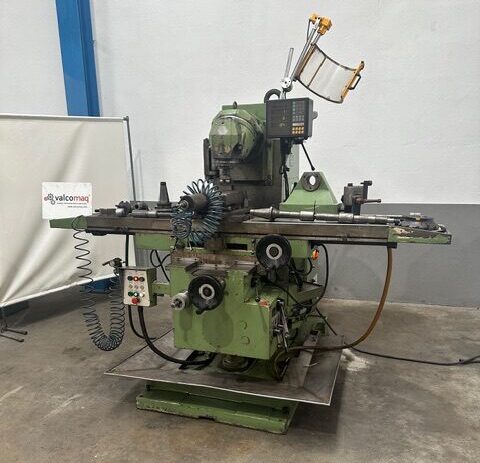
When a machine shop needs to expand its machining capacity without blowing the budget, used CME milling machines quickly become one of the most searched-for options in the reconditioned industrial machinery market. This Spanish-built brand has earned a solid reputation thanks to heavy-duty beds and mechanical reliability that holds up after decades of intensive work. In this article we take a close look at what defines CME milling machines, how they stack up against other well-known brands in the catalogue such as Fexac, MRF, Lagun and Zayer, and the factors you should check before making a purchase. By the end of this guide, you will know exactly which milling machine best fits your production needs and your budget.
Throughout the article you will find concrete technical data, a brand comparison table, buyer-profile recommendations and a maintenance guide designed to maximise the service life of a reconditioned machine. We will also cover the most common mistakes made when buying a second-hand milling machine and answer the questions we hear most often from workshops that contact Valcomaq.
What is a used CME milling machine, and why does it stand out in the second-hand market?
CME is a Spanish manufacturer specialised in universal and fixed-bed milling machines built for general machining shops, industrial maintenance work and small production runs. Its design is defined by thick cast-iron columns, hardened and ground ways, and a mechanical architecture engineered to absorb vibration even during aggressive roughing passes. This structural robustness is precisely what explains its constant presence on the used machinery market: after a proper reconditioning process, these machines retain precision tolerances very close to their original factory specifications.
Unlike manufacturers focused exclusively on high-end CNC equipment, CME has kept a catalogue built around conventional universal milling machines for years, typically featuring worktables between 1,200 and 2,000 mm in length with cross travel sufficient for medium-to-large parts. This makes them a highly valued tool in industrial maintenance shops, metalworking subcontractors and companies producing tooling or spare parts, where manual versatility still outweighs full automation.
What technical features define CME milling machines?
CME milling machines typically feature universal swivelling heads, allowing angled machining without repositioning the workpiece – a notable advantage for tool-and-die work or complex fixture manufacturing. Main motor power usually ranges between 5.5 and 15 kW depending on the model and year of manufacture, with spindle speed ranges covering everything from fine finishing to roughing of carbon steel and cast iron. In many models, the feed system includes power feeds on all three axes, reducing operator fatigue on medium production runs.
Another distinctive trait is the rigidity of the bed, a critical factor when machining hard materials or taking deep cuts. Reconditioned CME milling machines entering the used market have usually undergone way grinding, bearing replacement and spindle verification – processes that restore repeatability precision to around 0.02-0.03 mm, more than enough for the vast majority of industrial applications that do not require the extreme tolerances typical of the aerospace or medical sectors.
How do CME milling machines compare with other brands in the catalogue?
Within the used milling machine catalogue, several brands coexist with distinct technical personalities: Fexac, known for its versatility in general-purpose workshops; MRF, valued for its precision in medium-tolerance work; Lagun, with a range more geared towards semi-industrial production; and Zayer, a benchmark in fixed-bed, large-format machines with Heidenhain CNC control. Comparing these brands helps clarify where CME really sits in the market and why it can be the most balanced option for certain buyer profiles.
| Brand | Key strength | Recommended production type | Indicative price range |
|---|---|---|---|
| CME | Robustness and universal versatility | Industrial maintenance, short runs and tooling | Mid-range |
| Fexac | Versatility in general-purpose shops | Varied parts, technical training | Low-Mid |
| MRF | Precision in medium-tolerance machining | Medium-precision parts, metal sector | Mid-range |
| Lagun | Continuous semi-industrial production | Medium runs, multi-shift work | Mid-High |
| Zayer | Large formats and CNC control | Large parts, heavy industry | High |
Which industries use used CME milling machines?
Reconditioned CME milling machines find their natural home in industrial maintenance shops, where the ability to manufacture custom spare parts matters more than serial-production speed. They are also common in tool-and-die and fixture-making companies, thanks to the flexibility of the universal head for machining angles and complex shapes without CNC programming. Workshops repairing agricultural machinery, companies building metal structures, and small foundries needing to true up or adjust cast parts also frequently rely on this type of milling machine for its proven reliability.
A third highly relevant niche is vocational training schools and technical colleges, which particularly value the fact that a conventional CME milling machine allows students to learn the fundamentals of manual machining before moving on to CNC control. This dual life – real-world production and technical training – explains why used units from this brand maintain steady demand on the second-hand market, even against the growing supply of more automated CNC machines.
How much does a used CME milling machine cost?
The price of a reconditioned CME milling machine depends on several combined factors: table size, motor power, the condition of the ways and spindle, the age of the model, and whether it includes a digital readout or not. As a general reference, a medium-sized universal CME milling machine with a full overhaul can fall into a notably lower price bracket than an equivalent new machine, offering savings that in many cases exceed 50-60% compared with the price of a new model with similar performance. This price differential is one of the main reasons why small and medium workshops choose the used machinery market instead of taking on the investment of a brand-new machine.
It is important to understand that price should not be the only deciding factor. A cheap milling machine without proper reconditioning can generate hidden costs down the line – repairs, production downtime and defective parts caused by a lack of precision. That is why, at Valcomaq, every machine goes through an inspection process that includes spindle checks, way adjustment, electrical verification and a start-up test before it leaves our facility for the customer’s workshop, ensuring the price paid corresponds to a genuinely operational machine.
What mistakes do buyers make when purchasing a used industrial milling machine?
One of the most common mistakes is focusing only on the machine’s outward appearance while ignoring the actual condition of the spindle and ways – the components that ultimately determine machining precision. It is also common not to request a real-load running demonstration, which prevents buyers from spotting abnormal vibration, play in the carriages, or bearing noise that only appears under strain. Buying without checking the availability of original or compatible spare parts is another frequent error, especially with older models where certain electrical components are no longer manufactured.
Another common mistake is failing to compare the total cost of ownership between different brands and models. A seemingly cheaper milling machine may require additional investment in repairs, while a professionally reconditioned CME or Zayer unit, even with a slightly higher upfront price, can prove more economical in the medium term thanks to lower corrective maintenance needs. Working with a specialised supplier that offers a post-purchase warranty, such as Valcomaq, drastically reduces this risk.
How do you keep a reconditioned CME milling machine in good condition?
Preventive maintenance is key to preserving the precision of an industrial milling machine for years. Regular lubrication of ways and spindle with the oils recommended by the manufacturer prevents premature wear and keeps movements running smoothly. It is advisable to check belt tension and head bearing condition monthly, and to clean chips and coolant residue from sliding surfaces after every intensive workday, preventing metal chip abrasion from damaging ground surfaces.
It is also worth carrying out an annual check of bed alignment using a precision level, especially if the machine has been relocated or has sustained heavy workloads over long periods. A solid maintenance plan, combined with a quality initial reconditioning, allows a CME milling machine over twenty years old to keep offering competitive tolerances – something we have repeatedly confirmed on the units that pass through our inspection workshop.
What should you check before buying a used CME milling machine?
Before closing the purchase, it is essential to request a running demonstration under real load, checking for abnormal vibration or unusual noise in the head or gearbox. It is also worth visually inspecting the condition of the ways, looking for irregular wear marks or noticeable play when moving the carriages by hand. Asking about the maintenance history, and whether the machine has undergone bed regrinding or replacement of key components, provides very valuable information about its true condition.
| What to check | Why it matters |
|---|---|
| Spindle condition | Determines machining precision and repeatability |
| Play in ways and carriages | Indicates wear and the need for regrinding |
| Electrical system | Prevents downtime and unexpected repair costs |
| Maintenance history | Reflects how the machine was cared for over its working life |
| Seller warranty | Protects your investment against hidden faults |
Which used milling machine does your workshop need?
Choose CME if: you need a robust universal milling machine for varied industrial maintenance work, tooling manufacture or spare parts production, and you value mechanical reliability proven over decades above full automation. It is also the ideal choice if your production combines short runs with occasional medium-precision work, and you are looking for a solid balance between price and performance.
Choose Fexac if: your workshop is general-purpose and you need a versatile machine for a wide range of tasks, including technical training or occasional low-demand machining, prioritising an affordable acquisition cost over highly specific performance.
Choose MRF if: your production regularly requires medium-precision machining and you need a machine with a strong reputation for repeatability on metal-sector parts that cannot tolerate wide tolerances.
Choose Lagun if: your operation involves semi-industrial production across multiple shifts, with continuous-use durability requirements higher than those of a conventional maintenance workshop.
Choose Zayer if: you work with large-format parts, need advanced Heidenhain-type CNC control, and your budget allows for a larger investment in exchange for maximum capacity and automation.
Used CME milling machines at Valcomaq: quality and warranty on every machine
At Valcomaq we have spent more than twenty years selecting, reconditioning and commissioning second-hand industrial machinery, and CME milling machines hold a prominent place in our catalogue thanks to the well-balanced mix of robustness, versatility and price they offer. Every unit that leaves our facility has been thoroughly inspected – spindle, ways, electrical system and working precision – so the workshop receiving it can put it to work from day one without surprises.
If you need to expand your machining capacity with a reliable machine, we invite you to browse our catalogue of used milling machines, where you will find CME, Fexac, MRF, Lagun and Zayer models available in different configurations and price ranges. And if what you are looking for is to sell your own used industrial machinery, you can also check out how our service works in the we buy your machine section. If you have any technical questions about which model best suits your production, contact us and we will provide free, no-obligation advice to help you find the milling machine your workshop really needs.