


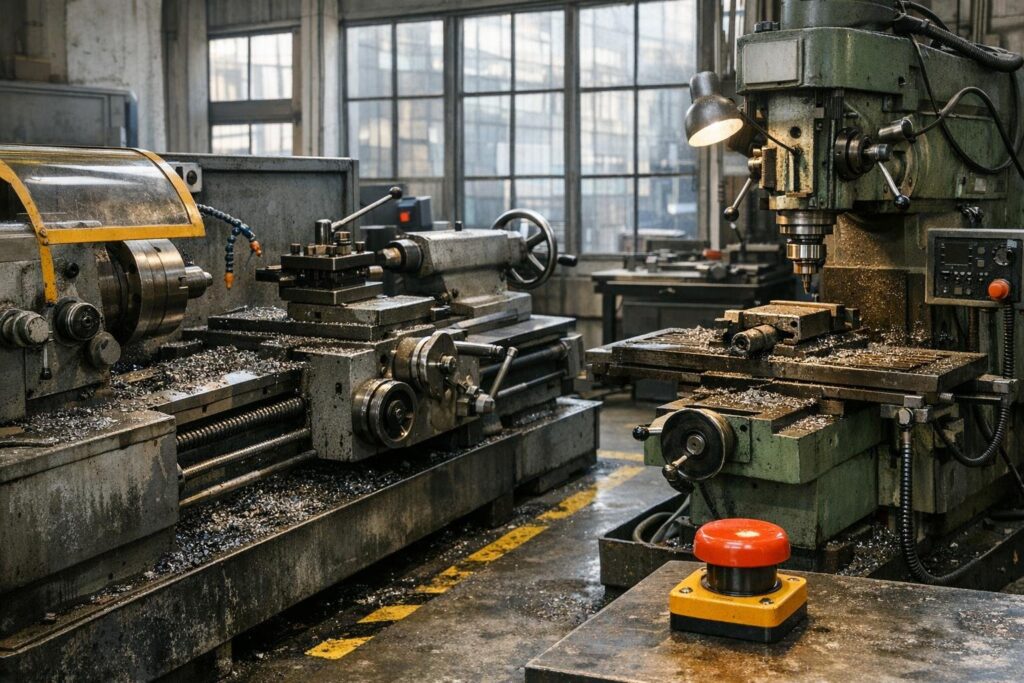
Machine shop safety is not a bureaucratic box to tick — it is the foundation on which the productivity of any business working with lathes, milling machines, saws or shears is built. When the equipment in question is second-hand industrial machinery, the challenge doubles: you need to guarantee that the machine runs correctly and that the operator has the right training and protective gear. In this article we run through the safety protocols, the essential personal protective equipment and the best practices that reduce accidents when operating used machines. We also explain why a thorough prior inspection, like the one Valcomaq carries out before putting any equipment up for sale, is the best investment for extending machine life and protecting the person operating it.
Why is machine shop safety a non-negotiable priority?
Conventional and CNC machining both involve high-speed rotating elements, powerful spindles, sharp chips and hydraulic pressures capable of causing serious injury in a matter of seconds. A lathe with an 800 mm chuck spinning at several hundred RPM, or a 45 kW hydraulic shear like the ones in our catalogue, will not forgive carelessness. Machine shop safety therefore demands an integrated approach that combines staff training, machine maintenance and the correct use of personal protective equipment.
Beyond the immediate physical risk, there are cumulative hazards such as prolonged noise exposure, mechanical vibration or inhalation of cutting-fluid mist. A shop that builds safety into its working culture reduces sick leave, improves machining quality and extends equipment life, since well-trained operators tend to handle machinery with greater precision and less unnecessary wear.
What PPE is essential when operating used lathes, milling machines and saws?
Personal protective equipment is the last barrier between the operator and the hazard. In machining, full-frame safety glasses are mandatory against chip projection, especially on lathes and milling machines without full enclosures. Gloves must be used with caution: never near rotating elements, since they can be caught by the spindle, but they are recommended when handling sharp parts or changing tooling. Safety footwear with reinforced toe caps and non-slip soles is essential on any shop floor with oil or coolant residue.
On industrial saws such as Mep or Sabi models, the risk of cutting from the blade or band means the manufacturer’s original guards must always stay in place and should never be removed to «save time». Hearing protection is necessary in shops where several machines run simultaneously, since sustained noise levels above 85 decibels can cause progressive hearing loss. Finally, snug-fitting workwear, free of loose sleeves or dangling cords, prevents one of the most common accidents: clothing being caught in moving parts.
How does the condition of used machinery affect operator safety?
Buying used machinery without any guarantees is one of the biggest hidden risks to machine shop safety. A lathe with a worn spindle, a deteriorated electrical system or a bed with excessive play can generate abnormal vibration, tool breakage or even catastrophic failure during machining. That is why every machine at Valcomaq goes through a reconditioning process that includes spindle inspection, testing of emergency-stop systems, verification of electrical cabinets and adjustment of mechanical guards before it is offered for sale.
An inspected machine not only runs better — it eliminates risk factors that a private buyer can rarely spot at a glance: hydraulic leaks in shears, worn gearing in milling machines or misalignment in band saws. That is the real difference between buying equipment «as is» and buying used machinery with genuine guarantees, inspected by professionals with over twenty years of experience in the sector.
Key rules for safely operating used industrial lathes
When working with a used lathe or a second-hand CNC lathe, such as the Gurutzpe, Pinacho or Cumbre models available in our catalogue, it is essential to check before every shift that the headstock brake works correctly, that the steady rests are in good condition and that the chuck is firmly secured. A workpiece should never be measured, cleaned or adjusted while the spindle is turning, and long chips must be removed with a hook or brush — never by hand. The automatic threading unit and emergency-stop systems should be tested periodically to guarantee an immediate response to any unexpected event.
It is also advisable to set a safety perimeter around the lathe and mark the area with visual signage, especially in shops with heavy foot or forklift traffic. Model-specific training — operating a short-bed conventional lathe is not the same as operating a large-capacity lathe with an 8000 mm distance between centres — drastically reduces accidents caused by unfamiliarity with the equipment.
Best practices when working with used milling machines and radial drills
Fixed-bed milling machines, such as Zayer or Lagun models, carry risks associated with cutter changes, high-speed chip projection and handling large tables. It is essential to secure the workpiece properly before starting the cut, check tool clamping in the spindle and always keep telescopic guards in position. On large-capacity radial drills, such as Soraluce units capable of boring up to 80 mm in steel, the weight and swing radius of the arm require a clear working area and correct anchoring of the piece to the table or block.
Using the right coolant not only extends cutting-tool life but also reduces the risk of burns from high temperatures in the machining zone. Regularly checking the condition of the ways and automatic lubrication systems is also part of machine shop safety, since a poorly lubricated milling machine can seize dangerously during operation.
What specific risks do industrial saws and shears present?
Band saws and hydraulic shears concentrate some of the most severe risks in the shop: cutting, crushing and entrapment. On automatic saws such as the Sabi PBS 250A with CNC, the cutting cycle must always start with the guards closed and the material firmly secured in the vice. On shears such as the Durma VS 4020 CNC, the motorised back gauge and photoelectric barriers must be operational at all times, and hands should never be placed in the cutting zone — even with the machine stopped — without first locking out the hydraulic system.
Risk comparison and preventive measures by machine type
| Machine | Main risk | Recommended PPE | Key preventive measure |
|---|---|---|---|
| Lathe | Entanglement in rotating elements | Safety glasses, snug clothing, safety footwear | Check headstock brake and guards before start-up |
| Milling machine | Chip projection and burns | Full-frame glasses, handling gloves | Proper workpiece clamping and active coolant |
| Industrial saw | Cuts from blade or band | Hearing protection, cut-resistant gloves | Never remove original casings or guards |
| Hydraulic shear | Crushing and cutting | Sheet-metal handling gloves | Lock out the hydraulic system before any manual work |
What common mistakes put machine shop safety at risk?
The most frequent mistake is removing or disabling a machine’s original guards to «work faster», a practice that multiplies the risk of serious accidents and can also void warranties. Another common failure is buying used machinery with no prior inspection, relying only on a low price — which can result in electrical faults, worn spindles or leaking hydraulic systems that compromise safety. It is also common to underestimate operator-specific training: not every lathe, milling machine or saw works the same way, and each model has particularities that require a supervised adaptation period.
Finally, many shops neglect preventive maintenance due to lack of time, which allows small faults — an unlubricated way, a misaligned safety sensor — to turn into serious incidents over the following weeks. Preventing these mistakes is just as important as training staff, since both factors work together to strengthen machine shop safety.
Preventive maintenance: the silent ally of workplace safety
Scheduled preventive maintenance — checking oil levels, verifying belt tension, cleaning ways and inspecting electrical systems — is the most effective tool for staying ahead of the failures that cause accidents. On used machinery this maintenance becomes even more important, since the equipment has already had a previous working life and may show wear that is not always visible at first glance. Setting a quarterly inspection schedule, documenting every intervention and appointing a maintenance lead within the shop are practices that noticeably reduce the number of incidents.
A well-executed maintenance plan also extends equipment life, improves machining accuracy and reduces the costs of unplanned downtime. In short, it is an investment that translates directly into more safety and more profitability for the shop.
Which safety protocol suits your shop’s profile?
Choose reinforced basic protocols if: your shop is small, has few operators and works mainly with conventional lathes and milling machines. In this case, prioritising initial training, daily guard checks and consistent use of basic PPE is usually enough to maintain an adequate safety level without unnecessary extra cost.
Choose an advanced protocol with sensors and automatic stops if: your shop runs high-power CNC machinery, such as hydraulic shears or automatic saws with numerical control. This equipment requires photoelectric barriers, redundant emergency stops and periodic checks certified by a specialised technician.
Choose an ongoing training plan if: you regularly bring in used machinery or renew your machine fleet. Every model has its own handling quirks, and continuous training ensures staff adapt quickly without compromising safety during the learning period.
Choose periodic external audits if: your shop runs multiple shifts or has high staff turnover. An external review picks up blind spots that in-house teams may overlook after months of routine, and reinforces a safety culture across the whole plant.
Inspected used machinery: Valcomaq’s commitment to shop safety
At Valcomaq we understand that machine shop safety starts long before the machine reaches your facility — it starts with the inspection and reconditioning process we apply to every piece of equipment. With over twenty years of experience buying, repairing and commissioning lathes, milling machines, saws and shears, we can guarantee that every machine leaves our facility with fully operational safety systems and thoroughly checked critical components.
If you are looking to add used industrial machinery with genuine guarantees, inspected and ready to work safely from day one, visit our used machinery catalogue, browse our selection of used lathes and used industrial saws, or, if you would rather sell your current equipment, check out our industrial machinery buying section. Either way, contact us and we will advise you with no obligation so your shop can work with maximum safety and efficiency.