


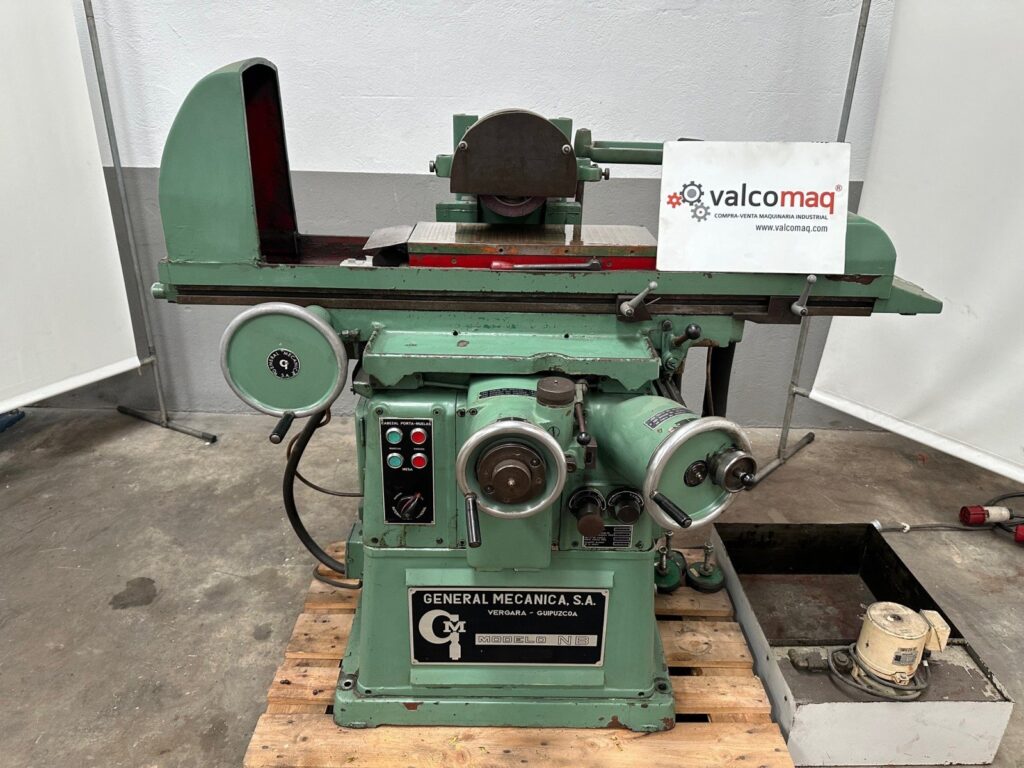
When a machine shop needs to add precision to its production process without blowing up the initial investment, used Txurtxil grinding machines usually make the shortlist. This brand, with a long track record in the Spanish and international machine tool market, has built a solid reputation based on the robustness of its beds and the reliability of its grinding systems. In this guide we cover what sets Txurtxil apart from other manufacturers, which ranges and models most commonly appear on the second-hand market, which technical points you should check before signing the purchase, and which type of workshop gets the most value out of this kind of equipment. By the end, you should be able to evaluate a used grinder with your own criteria and no unpleasant surprises down the line.
Throughout the article you will also find a comparison table of buying criteria, a section of recommendations by buyer type, indicative 2026 pricing, and the questions workshops most frequently ask us about buying a used Txurtxil grinder. All the information is aimed at anyone approaching the purchase of second-hand grinding machinery for the first time, but it is equally useful for buyers who already know the sector and want to confirm their criteria before deciding.
What makes Txurtxil grinding machines stand out in the used machinery market?
Txurtxil is a Basque manufacturer specialising in cylindrical and surface grinding, built on a design philosophy focused on bed rigidity and thermal stability during long work cycles. Unlike other brands that concentrate on very compact series, Txurtxil has maintained a range oriented towards medium-to-large workpieces, making it a common reference point for workshops repairing shafts, hydraulic cylinders, industrial rollers and heavy machinery components. This focus on larger parts is precisely why, on the second-hand market, a large share of the available units feature generous distances between centres and admission diameters above the sector average.
Another distinctive feature is the durability of its mechanical components: many Txurtxil machines built fifteen or twenty years ago are still working in workshops across Spain with their original spindle and no major rebuilds, which speaks well of the design and materials used in manufacturing. This doesn’t mean a used unit requires no inspection, but the starting point is usually more favourable than brands with a history of recurring failures in the wheelhead or cross-feed system. For a buyer who values long-term reliability over cutting-edge features, Txurtxil is a sensible bet within the segment of inspected, ready-to-work used machinery such as the ranges you’ll find in our used industrial grinding machines category.
Which Txurtxil ranges and models are most common on the second-hand market?
In the pool of used machinery circulating around Spain, the most frequent Txurtxil grinders fall into two main families: universal cylindrical grinders, designed to machine shafts, pins and other round parts between centres, and surface grinders with fixed or moving tables, aimed at finishing flat surfaces on moulds, dies and tooling. Among the cylindrical models, machines with distances between centres of 1000, 1500 and up to 2000 mm are the ones most commonly found on the used market, paired with admission diameters in the 300 to 400 mm range depending on the series. These figures place them in a mid-to-high segment, suitable for parts that many compact grinders simply can’t handle.
As for surface grinders, you’ll typically find tables ranging from 400×1000 mm to 600×1500 mm, with hydraulic or mixed hydraulic-mechanical feed systems depending on the machine’s age. Units built from the 1990s onward usually already carry digital readouts added later, while more recent second-hand models may come with basic numerical control for repetitive grinding cycles. It’s important not to confuse the absence of CNC with an obsolete machine: many purely mechanical Txurtxil grinders still deliver precision levels that comfortably exceed the tolerances needed by a general machining or industrial repair workshop.
What should you check before buying a used Txurtxil grinder?
The first inspection point should always be the grinding spindle, the real heart of any grinder. Check that it rotates without noticeable axial or radial play, that there are no abnormal noises at different speeds, and that the lubrication system -whether grease or pressurised oil- works correctly. A spindle with play requires an expensive rebuild that can equal or even exceed the price of the used machine itself, making it a dealbreaker in negotiations. Asking the seller for a maintenance history or, at the very least, a grinding test on a sample part is the best way to verify this before closing the deal.
The second critical point is the bed sliding ways, both the longitudinal and cross-slide guides. Wear on these guides translates directly into loss of parallelism and uneven surface finishes. A visual inspection can reveal deep scoring or shiny patches from excessive friction, but the definitive test is an actual grinding pass on a control part, then measuring the resulting geometric deviation with a precision comparator. Beyond spindle and guides, you should also check the condition of the grinding wheel and its mounting, the balancing system, the coolant pump, the limit switches, and, on models with added electronics, that the digital readouts respond steadily without reading jumps.
How do you compare different used grinding machine options by brand and criteria?
Before settling on a specific unit, it’s worth systematically comparing the criteria that genuinely affect performance and the short-term investment required. The table below summarises the most relevant aspects when evaluating a used Txurtxil grinder against other common alternatives on the used machinery market, including practical implications for the buyer.
| Criterion | Txurtxil Grinder | Implication for the Buyer |
|---|---|---|
| Bed rigidity | High, oriented to medium-large parts | Less vibration and better finish on long runs |
| Typical distance between centres | 1000-2000 mm | Suitable for long shafts and round parts |
| Spindle durability | High with basic maintenance | Lower risk of short-term rebuild |
| Spare parts availability | Good within the domestic market | Faster, more affordable repairs |
| Automation level | Variable: from purely mechanical to basic CNC | Lets you match the investment to actual production needs |
| Indicative used price | Mid-to-high within the used segment | An investment that pays off through long-term reliability |
What type of workshop benefits most from a Txurtxil grinder?
Industrial repair and maintenance workshops are probably the profile that gets the most out of this type of machine. Grinding pump shafts, hydraulic cylinders, rolling mill rollers or agricultural machinery components demands wide centre-to-centre capacity and a bed rigidity that not every brand offers in its mid-range. For this kind of activity, a used Txurtxil grinder allows a shop to recover parts that would otherwise need to be replaced entirely, delivering savings for the end client and a clear competitive edge over workshops that outsource grinding work.
Tooling and die-making workshops are also a strong fit, especially when working with short runs or precision parts that require tightly controlled surface finishes. Here, Txurtxil’s value lies less in large-part capacity and more in the geometric stability of the bed, which keeps tolerances tight through long working shifts. Finally, technical training centres and vocational schools looking to equip their facilities with real, reliable machinery at a controlled cost find that a used Txurtxil grinder is just as valid a teaching tool as a new machine, at a fraction of the price.
How can you extend the service life of a second-hand Txurtxil grinder?
Once the machine is in the workshop, preventive maintenance makes all the difference between a grinder that keeps running for another decade and one that starts accumulating problems within months. Regular lubrication of the guides and spindle according to the manufacturer’s instructions, routine checks on wheel balancing, and cleaning the coolant circuit are basic tasks that prevent most premature failures. It’s also worth checking belt tension periodically where the drive isn’t direct, and verifying that safety systems -guards, limit switches, emergency stops- remain fully operational after years of intensive use.
One aspect many workshops overlook is environmental control of the workspace: because grinders operate to very tight tolerances, they’re sensitive to thermal variation and airborne abrasive dust. Keeping the machine away from direct drafts and heat sources, and in a reasonably clean environment, helps preserve its original precision for longer. Scheduling a general overhaul every one or two years, depending on usage intensity, lets you get ahead of wear that would otherwise only be noticed once it’s already affecting finished part quality.
What mistakes do buyers of used grinding machinery make?
One of the most common mistakes is focusing only on the sale price without factoring in transport, installation and commissioning costs, which for heavy machines like grinders can represent a significant chunk of the total budget. Another frequent error is buying without ever seeing the machine actually run, relying solely on photos or the seller’s word. A grinder can look flawless visually and still have a spindle with play that only shows up while running or under real grinding load.
It’s also common to underestimate the importance of technical documentation and machine history. Knowing the year of manufacture, approximate hours of use, whether it has undergone any major repair, or whether it comes from a harsh working environment (high temperatures, abrasive metal dust, humidity) helps anticipate the real condition of the equipment beyond its outward appearance. Buying through a specialist supplier that inspects, documents and, if necessary, refurbishes the machine before sale drastically reduces the risk of ending up with a grinder with hidden problems.
How much does a used Txurtxil grinder cost in 2026?
The price of a used Txurtxil grinder depends on multiple factors: age, condition of the spindle and guides, grinding capacity, automation level, and whether the machine has been refurbished before sale. In the Spanish market in 2026, mid-size universal cylindrical units in good condition typically sit in an intermediate price range within the used machinery segment, while models with greater distance between centres or added numerical control can reach the upper band of second-hand pricing. In any case, the cost is always noticeably lower than an equivalent new machine, which in mid-to-high-end cylindrical grinding can cost several times more than a well-inspected used unit.
Beyond the purchase price, it’s worth calculating the total cost of ownership: transport and installation, any initial adjustments, specific consumables such as grinding wheels and coolant, and preventive maintenance during the first few years. A slightly more expensive machine that’s properly inspected and backed by a working guarantee is usually more cost-effective in the medium term than a cheaper option that ends up requiring unexpected repairs shortly after purchase. That’s why buying from a supplier that offers machinery already inspected and ready to work is, in most cases, the sensible decision.
Frequently asked questions about used Txurtxil grinders
Is it worth buying a Txurtxil grinder without CNC in 2026? Yes, as long as production volume doesn’t require repetitive automated cycles. Many repair and maintenance workshops work with one-off parts or very short runs, where an operator’s expert manual control is more flexible than a CNC programme, and the savings compared with a numerically controlled model can be considerable.
How long does it take to pay off a used grinder compared with outsourcing the grinding work? In workshops with regular grinding needs -more than two or three parts a month- payback usually occurs within a reasonable timeframe, especially when compared with the cost and lead times of subcontracting the process to a third party. Owning the machine also means direct control over turnaround times and final finish quality.
Recommendations by buyer profile
Choose a Txurtxil cylindrical grinder if: your workshop regularly works with shafts, pins or round parts of medium-to-long length and you need a bed capable of maintaining precision through extended grinding cycles without losing rigidity or generating unwanted vibration in the final finish.
Choose a Txurtxil surface grinder if: your main activity is manufacturing or repairing moulds, dies and tooling that require perfectly flat surfaces, and you value the table’s geometric stability more than large-part capacity between centres.
Choose a model with a digital readout or basic CNC if: your workshop produces medium runs of similar parts and you need to cut setup time between cycles, gaining repeatability without taking on the cost of a brand-new fully CNC-controlled machine.
Choose a purely mechanical, more affordable unit if: your workload is variable, your parts differ from one job to the next, and you’d rather put the money saved towards operator training or quality wheels and accessories to broaden the machine’s range of applications.
Looking for the manual of a Txurtxil grinding machine? Instrumachine has PDF manuals for Txurtxil grinding machines.
Txurtxil grinding machines in the Valcomaq catalogue
At Valcomaq we’ve spent more than twenty years buying, refurbishing and selling used industrial machinery, and Txurtxil grinders hold a prominent place in our catalogue thanks to the direct relationship between reliability and price they offer machining workshops, industrial repair shops and tooling manufacturers. Every unit that passes through our facilities is thoroughly inspected -spindle, guides, electrical system and grinding precision- before it goes up for sale, so buyers receive a machine ready to work from day one, with full confidence in its real condition and not just its outward appearance.
If you’re considering adding a used Txurtxil grinder to your workshop, take a look at the catalogue of available Txurtxil grinding machines at Valcomaq, where you’ll find inspected units backed by full guarantees. Stock is updated continuously, so we recommend checking current availability before you decide. If you’re unsure which model best fits your production needs, need technical advice on spindle, guides or grinding precision, or want to find out what your own used machinery could be worth, contact us and we’ll help you find the right solution for your workshop.