

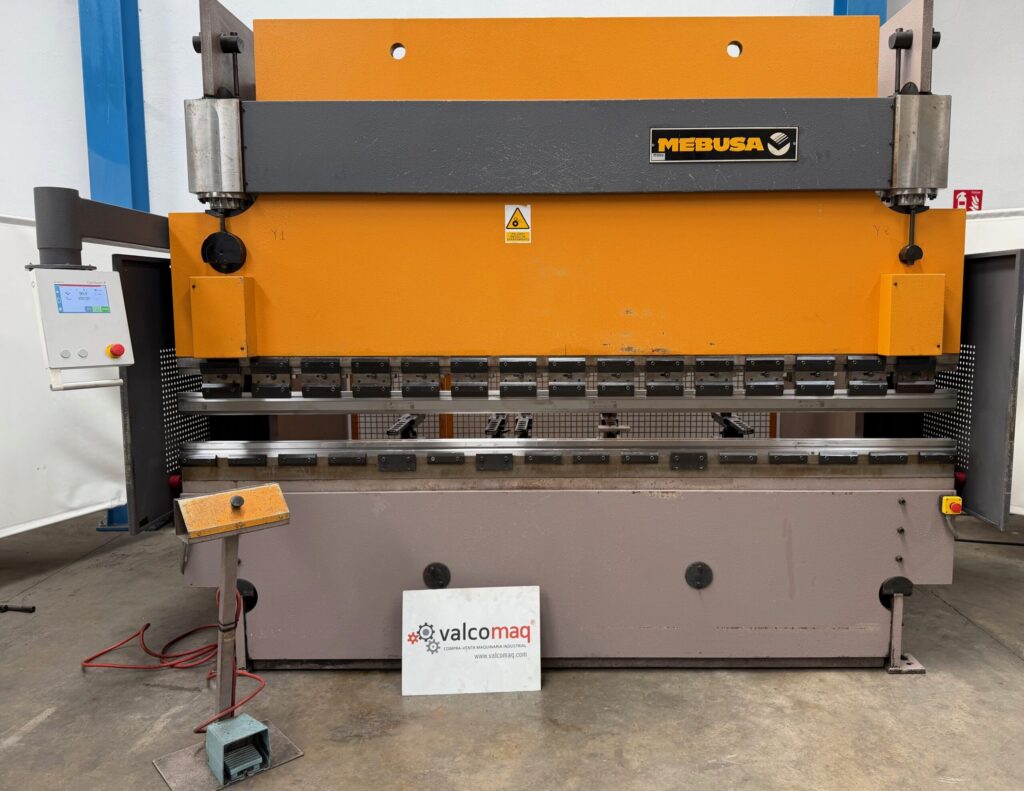
Buying a used press brake is one of the most important decisions for any sheet metal, boilermaking or metal fabrication workshop, because it determines bending accuracy, daily productivity and operator safety. Among the historic brands of the Spanish market, Mebusa holds a prominent place thanks to its rugged construction and the reliability of its hydraulic systems. In this guide we review the most common ranges and models of used Mebusa press brakes found on the second-hand market, the technical points you need to inspect before signing the purchase, the most frequent buying mistakes, and the type of workshop that best suits each configuration. The goal is for you to reach a final decision based on clear technical criteria, not just on the price tag.
Throughout this article you will also find a comparison table of ranges, indicative 2026 price references and practical recommendations depending on your type of production. If you decide a used Mebusa press brake is the right fit for your workshop, at Valcomaq we have inspected units ready to work from day one.
What is a Mebusa press brake and why is it still a reference in sheet metal work?
Mebusa is a Spanish manufacturer with a long track record building hydraulic press brakes aimed at both medium-production workshops and industrial plants with continuous bending needs. Its design philosophy is based on welded, stress-relieved steel frames, heavy-duty hydraulic cylinders and synchronisation systems that guarantee uniform bending along the full length of the sheet. This solidity is precisely why, decades after manufacture, many of these machines are still operating in workshops across Spain, which explains the steady demand for used Mebusa press brakes on the used machinery market.
Unlike other brands more focused on entry-level ranges, Mebusa built much of its catalogue with demanding applications in mind: bending thick plate, long working lengths and extended production cycles. This translates into machines with greater thermal inertia in the hydraulic system, frames that are more rigid against deflection, and more robust backgauges. Buying a well-maintained second-hand unit gives you access to that build quality at a fraction of the price of an equivalent new machine.
What ranges and models of Mebusa press brakes are available on the used market?
On the second-hand market you will mainly find three large families of Mebusa press brakes: conventional hydraulic press brakes with basic numerical control (manual or semi-automatic cylinder synchronisation), press brakes with 2-axis CNC that automatically manage backgauge positioning, and high-end press brakes with multi-axis numerical control (Y1, Y2, X, R and, in some cases, crowning compensation for frame deflection). The most common bending lengths range from 2000 to 4000 mm, although larger units also exist for heavy boilermaking projects, with bending force capacities ranging from 60 tonnes up to over 300 tonnes on the largest models.
The models that appear most frequently on the used market belong to mid-range series, designed for workshops working with thicknesses of 3 to 12 mm in carbon steel, although units set up for stainless steel and aluminium with specific tooling are also available. It is common to find machines fitted with Cybelec or Delem control systems, which make it easier to programme complex bending sequences and manage parts with several bends at different angles. Before settling on a specific model, it is worth evaluating not only the nominal force, but also the useful length between side frames, since this determines the maximum sheet width you will be able to bend without interference.
What technical features set a Mebusa press brake apart?
One of the distinguishing elements of Mebusa press brakes is the design of its welded, stress-relieved monoblock frame, which reduces residual stress and improves dimensional stability over years of use. This is especially relevant in used machines, because a well-built frame keeps the bend flat even after thousands of working hours. The hydraulic system, in turn, usually includes double-acting cylinders with proportional valves that allow you to regulate approach speed, working speed and return speed, optimising cycle times without sacrificing accuracy.
Another technical aspect worth evaluating is the synchronisation system between cylinders, typically through mechanical torsion shafts or electronic encoders that ensure both sides of the press brake descend at exactly the same speed and depth. Units with CNC control also feature motorised backgauges with ball screws, allowing you to programme different bending positions and repeat long runs without manual readjustment. The most complete press brakes also include a crowning system or deflection compensation, which corrects the natural deformation of the frame under load and is decisive when working with long sheets and tight tolerances.
What should you check before buying a second-hand Mebusa press brake?
The first check should focus on the condition of the hydraulic system: look for leaks in cylinders, fittings and hoses, as well as the condition of the oil and filters. Dark oil or oil with metal particles usually indicates internal wear in pumps or valves, which can translate into costly repairs in the short term. It is also worth running the machine empty and observing whether both cylinders descend symmetrically; any visible deviation when bending a test sheet is a sign of a synchronisation problem that should be corrected before purchase or negotiated into the final price.
Secondly, you need to inspect the physical condition of the frame and guides, looking for impacts, welded cracks or excessive wear on the sliding areas of the upper beam. It is advisable to request a real bending test with a sheet of the thickness you typically work with, in order to verify the final angle, repeatability and the condition of the included punches and dies. If the machine has CNC, check that the screen responds correctly, that the axes move without unusual noise, and that you can load and run a full program. Finally, review the available documentation: user manual, electrical and hydraulic diagrams and, if possible, the maintenance history, as this greatly simplifies commissioning in your workshop.
| Range / Type | Indicative force | Bending length | Control | Workshop profile |
|---|---|---|---|---|
| Entry / manual | 60-100 T | 2000-2500 mm | Manual or semi-automatic backgauges | Small workshop, simple parts and short runs |
| Mid-range / 2-axis CNC | 100-200 T | 2500-3200 mm | Basic Cybelec or Delem | General sheet metal workshop with medium runs |
| High-end / multi-axis CNC | 200-300+ T | 3200-4000+ mm | Multi-axis CNC with crowning | Industrial production, heavy boilermaking and long runs |
What common mistakes do buyers of used press brakes make?
One of the most frequent mistakes is focusing solely on bending force in tonnes without considering the useful length or the actual working thickness. A machine with plenty of force but a short length between side frames may be insufficient if you regularly work with long sheets, while an oversized press brake for your production represents unnecessary energy and upfront costs. It is also common to underestimate the cost of transporting and installing a press brake weighing several tonnes, a factor that should always be included in the total budget before comparing prices between different offers.
Another common mistake is not verifying the availability of bending tooling (punches and dies) compatible with the machine, since their absence or wear can force a significant additional investment shortly after purchase. Likewise, many buyers skip requesting a real bending demonstration before closing the deal, relying solely on photographs or the cosmetic condition of the machine. A press brake can look flawless on the outside and still have synchronisation problems, internal leaks or an intermittently faulty CNC that only shows up during operation under load.
How much does a used Mebusa press brake cost in 2026?
The price of a used Mebusa press brake in 2026 mainly depends on three factors: bending force, type of control (manual, basic CNC or multi-axis CNC) and overall condition. As an indicative reference, an entry-level unit with manual or semi-automatic control and good condition can be found starting at a few thousand euros, while a mid-range press brake with 2-axis CNC usually falls in an intermediate range, and high-end units with multi-axis control, crowning and greater bending force reach the highest prices within the used machinery market. In any case, the final price should always be negotiated in light of the results of the technical inspection and the bending test.
It is worth remembering that buying through a specialised supplier who inspects and reconditions the machine before delivery, rather than acquiring it directly from a company closure without any guarantees, usually results in a lower total cost of ownership in the medium term, by avoiding early breakdowns and unplanned production stoppages. The initial price difference between an unguaranteed purchase and a professionally inspected one is usually offset by fewer issues during the first months of use.
Which type of workshop benefits most from a Mebusa press brake?
Used Mebusa press brakes fit especially well in boilermaking and sheet metal workshops that need to combine rugged construction with a contained acquisition cost. Their design, built for extended work cycles, makes them ideal both for make-to-order workshops with frequent part changes and for semi-continuous production lines where bending repeatability is a critical requirement. The availability of models with different lengths and forces makes it possible to find a configuration suited to practically any production volume, from small workshops to larger industrial plants.
Choose X if: your workshop mainly works with short runs and simple geometry parts; in that case, an entry-level Mebusa press brake with manual or semi-automatic control and a length of 2000 to 2500 mm offers the best cost-to-productivity ratio, without tying up capital in automation features you will not fully use.
Choose X if: your production combines different part references with frequent angle changes and you need repeatability between batches; a Mebusa press brake with 2-axis CNC and motorised backgauges will reduce setup times between runs and improve the dimensional consistency of the bent parts.
Choose X if: your activity focuses on heavy boilermaking, metal structures or long parts with tight tolerances; in this case it is worth looking at Mebusa’s high-end ranges, with forces above 200 tonnes, multi-axis control and crowning compensation, which guarantees flatness of the bend along the entire length of the sheet.
Choose X if: you are starting up a workshop and need to maximise your initial investment without giving up reliability; a used Mebusa press brake inspected by a specialised supplier gives you access to a machine with construction quality superior to many new entry-level alternatives, with a notably lower upfront outlay.
How can you extend the service life of a Mebusa press brake after purchase?
Once the machine is installed in your workshop, preventive maintenance is key to preserving bending accuracy for many years to come. This includes periodically changing the hydraulic oil and filters, checking the condition of the cylinder seals to prevent incipient leaks, and verifying the parallelism between the upper beam and the lower table at least once a year. It is also advisable to keep the sliding rails clean and greased and to check the tightness of the tooling clamps, since a poorly secured punch or die can cause bending angle deviations that are difficult to diagnose at a glance.
On units fitted with CNC, it is advisable to periodically back up the bending programs and check the condition of the encoders and measuring scales, components that, although durable, can degrade over the years and cause small deviations in backgauge positioning. Following these basic maintenance guidelines allows a used Mebusa press brake, properly inspected at the time of purchase, to keep working with industrial precision for many additional years of service.
Looking for the manual of a Mebusa press brake? Instrumachine has PDF manuals for Mebusa press brakes.
Valcomaq, your trusted supplier for used Mebusa press brakes
At Valcomaq we have specialised for more than 20 years in buying, reconditioning and selling second-hand industrial machinery, and we know that a press brake is an investment that shapes a workshop’s productivity for years. That is why every unit that enters our catalogue goes through a complete technical inspection before being put up for sale, checking the hydraulic system, cylinder synchronisation, the condition of the CNC where fitted, and carrying out real bending tests. We work both with small workshops looking for their first press brake and with industrial plants that need to expand their production capacity, always offering specialised advice to help you choose the configuration best suited to your type of work. Browse our full range of used press brakes for more options beyond the Mebusa range.
If you are considering adding a used Mebusa press brake to your workshop, check out Valcomaq’s catalogue of used Mebusa press brakes, where you will find inspected units ready to work; stock changes frequently, so we recommend checking current availability. Our team will help you compare force, length and type of control according to your real production needs, and if you prefer, we can also handle the purchase of your current used press brake as part of the process, via our we buy your machine service. Feel free to contact us to resolve any technical questions, request more information about a specific unit, or ask for a quote tailored to your workshop.