

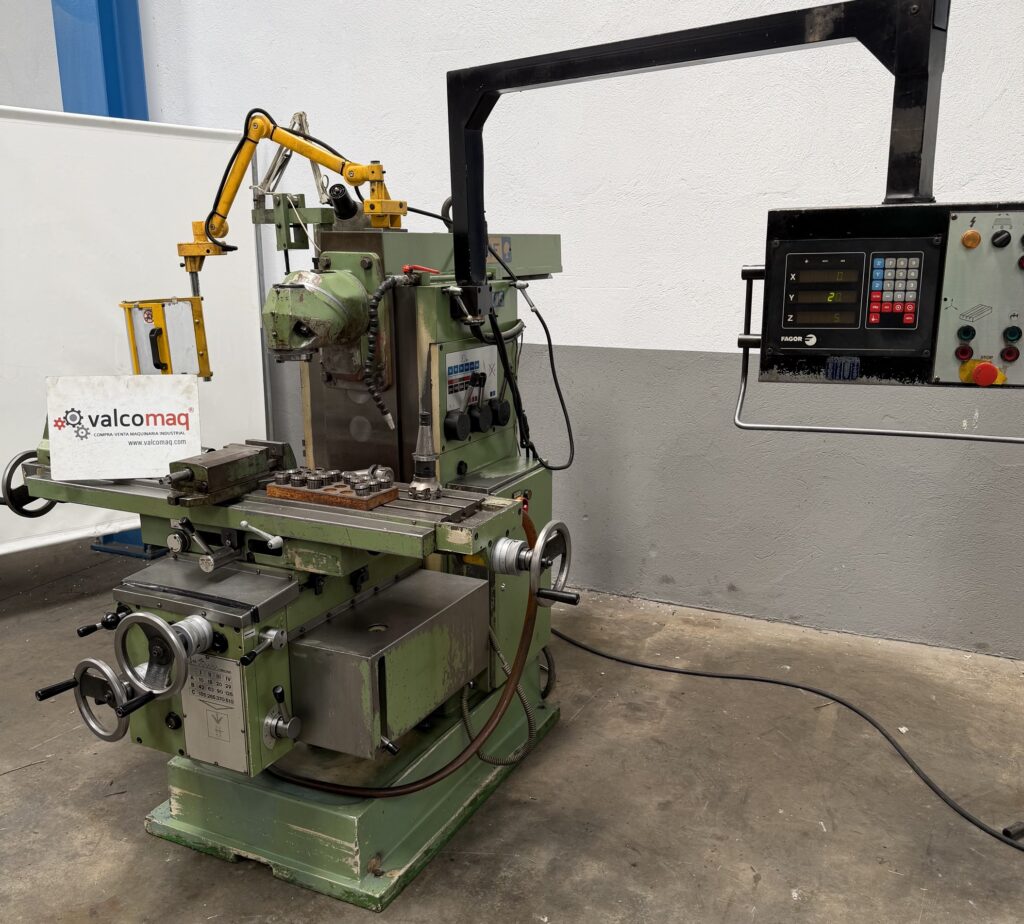
In the second-hand industrial machinery market, used MRF milling machines hold a prominent place thanks to the rugged build quality and versatility that define this Spanish manufacturer. General machine shops, mould and die makers, industrial maintenance departments and vocational training centres all turn to these machines when they want to combine precision and reliability with a purchase price far below that of new equipment. In this guide we look at what makes MRF milling machines recognisable on the used market, which ranges and models you are most likely to find for sale in Spain, the key technical points to inspect before closing a deal, and which type of workshop gets the most value out of them. We also cover preventive maintenance, the most common mistakes buyers make when purchasing used machinery, and an indicative price range for 2026, so you can make an informed decision before investing in your next knee-type milling machine.
What sets a used MRF milling machine apart from other brands?
The MRF brand has earned a solid reputation in the Spanish machining sector thanks to a design philosophy built around a rigid bed, cast from high-quality iron and stress-relieved to minimise deformation over the years. The ways are hardened and ground, allowing tight tolerances to be maintained even after decades of intensive use. The main spindle runs on precision bearings designed to absorb both radial and axial loads, a feature that becomes decisive when working with large-diameter cutters or performing aggressive roughing passes on steel or cast iron.
Another distinctive feature is head versatility: many used MRF milling machines come with universal heads that allow the spindle to be oriented both vertically and horizontally, considerably widening the range of possible operations without needing a second machine. In addition, a large share of the units reaching the used market come from tool-and-die shops or industrial maintenance departments, sectors where preventive maintenance tends to be rigorous, which helps these mills retain good mechanical condition after years of service.
Which MRF ranges and models are most common on the used market?
Within MRF’s historic catalogue, the range most widely found on the second-hand market is the fixed-bed universal milling machine, with worktables typically ranging from 1250 x 300 mm to 1600 x 400 mm, designed for medium-sized workpieces in general machine shops. These units combine a main vertical head with the option of fitting an auxiliary horizontal head, making them highly versatile machines for milling, drilling and light boring on steel, cast iron and non-ferrous alloys.
It is also common to find larger, heavy-duty models, with main motor power ranging from 5 to 15 kW, ISO40 or ISO50 spindle tapers, and extended travel on the X, Y and Z axes. These bigger used MRF milling machines typically come from sectors such as mould making, heavy sheet-metal fabrication or capital equipment maintenance, and on the used market it is common to find them fitted with Fagor digital readouts added after manufacture, or even partial Heidenhain CNC retrofits to improve repeatability on precision work.
Comparison of used MRF ranges and models
| Range / Model | Table dimensions | Main motor power | Spindle taper | Typical application |
|---|---|---|---|---|
| Light universal | 1250 x 300 mm | 3-5.5 kW | ISO40 | Repair and maintenance shops |
| Medium universal | 1400 x 350 mm | 5.5-7.5 kW | ISO40 | General machining and short runs |
| Reinforced universal | 1600 x 400 mm | 7.5-11 kW | ISO40/ISO50 | Tool and die making, moulds |
| Large capacity with retrofit | 1800 x 450 mm or more | 11-15 kW | ISO50 | Large parts, heavy machining |
What should you check before buying a used MRF milling machine?
Before closing the purchase of a second-hand MRF milling machine, it is essential to check the condition of the main spindle: it should turn without noticeable play or abnormal bearing noise, both at idle and under simulated load. You should also visually inspect the bed and ways for wear, deep scoring, or re-ground areas that might reveal poorly executed previous repairs. The condition of the drive belts, the level and cleanliness of the automatic lubrication oil, and the absence of leaks in the hydraulic or pneumatic systems are other clear indicators of how well the machine has been maintained throughout its working life.
It is also worth requesting the maintenance history if available, verifying that the electrical wiring complies with current regulations, and checking whether the machine has a digital readout or any added numerical control, since this directly affects daily precision and productivity. Whenever possible, it is advisable to run a real machining test on a steel workpiece, checking cutting stability, absence of vibration and the surface finish obtained before finalising the deal.
What type of workshop benefits most from an MRF milling machine?
Used MRF milling machines fit particularly well in general machining and industrial maintenance workshops, where a versatile machine is needed to handle both roughing work and precision operations on short runs. They are also highly valued by tool-and-die shops and mould makers, sectors where bed rigidity and head stability are decisive for achieving reliable finishes on complex parts.
They are likewise a common choice in vocational training centres and technical schools, where the mechanical simplicity of the universal models makes them easy to learn on without sacrificing real workshop performance. Thanks to their robustness, it is also not unusual to find them in agricultural, marine or heavy equipment repair shops, where the ability to withstand years of continuous use without losing accuracy is highly valued.
Preventive maintenance and service life of a reconditioned MRF milling machine
The service life of an MRF milling machine depends heavily on the preventive maintenance it has received: periodic lubrication of ways and spindles, timely inspection and replacement of drive belts, and occasional regrinding of the ways when wear appears are the tasks that most extend the machine’s productive life. A well cared-for unit can keep working with precision for decades, which explains why the fleet of MRF milling machines still in circulation across Spain remains large and active.
When a milling machine goes through a professional reconditioning process, such as the one carried out at Valcomaq, the critical components are thoroughly checked: spindle, bearings, electrical system, lubrication and paintwork, so that the machine is ready to go straight into production. This type of comprehensive overhaul drastically reduces the risk of early breakdowns and allows real guarantees to be offered on the equipment’s performance, something that does not always happen when buying used machinery directly from a private seller without any prior inspection.
What are the most common mistakes when buying a used milling machine?
One of the most frequent mistakes when buying a used MRF milling machine is purchasing it without running a real load test, relying solely on its visual appearance. It is also common to overlook important electrical details, such as checking whether the power supply is three-phase 230V or 400V and whether it is compatible with the destination workshop’s installation, which can lead to unexpected costs for electrical adaptation. Failing to request an invoice or any kind of guarantee on the machine’s basic operation is another mistake that can prove costly down the line.
Another common error is underestimating transport and installation costs, especially for larger models that require specialised lifting equipment and careful levelling of the bed after relocation. It is equally important to verify the compatibility of the spindle taper (ISO40 versus ISO50) with the tooling already available in the workshop, since a mismatch here can force a costly renewal of a large part of the existing tooling.
How much does a used MRF milling machine cost in 2026?
The price of a used MRF milling machine varies considerably depending on table size, motor power, and whether it includes a digital readout or any CNC retrofit. In 2026, mid-size mechanical universal models typically sell in a range of 3,000 to 9,000 euros, while larger-capacity versions with a reinforced head and a built-in digital readout can reach between 10,000 and 20,000 euros depending on condition and included accessories. These figures remain highly competitive compared with an equivalent new milling machine, which can easily exceed 40,000 euros.
Among the factors that most influence the final price are the estimated hours of use, the condition of the ball screws on motorised axes, the presence of accessories such as a dividing head, precision vices or collet sets, and of course the maintenance history and provenance of the machine. Buying through a specialised supplier that offers a prior inspection usually means paying somewhat more than buying from a private seller, but with a very significant reduction in the short-term risk of breakdown.
Frequently asked questions about used MRF milling machines
Can an older MRF milling machine be motorised or fitted with CNC?
Yes, this is common practice on the used market. Many MRF milling machines receive a partial retrofit with Fagor digital readouts or Heidenhain controls, which improves positioning accuracy without needing to replace the machine’s entire mechanical structure.
Are accessories from other brands compatible with an MRF milling machine?
Generally yes, as long as the spindle taper (ISO40 or ISO50) and the dimensions of the table’s T-slots are respected, since most dividing heads, vices and standard tooling are interchangeable between different brands of universal milling machines.
Which used MRF milling machine should you choose for your workshop?
Choose a light universal MRF milling machine if: your workshop mainly handles occasional repairs, maintenance of small to medium parts, and you do not need large table travel. This range offers an excellent balance of price, compactness and versatility for occasional milling and drilling work.
Choose a medium or reinforced universal MRF milling machine if: your main activity is general machining of short to medium production runs, and you need a machine capable of combining roughing and finishing without losing rigidity. It is the most balanced option for multi-disciplinary workshops handling different types of parts.
Choose a large-capacity MRF milling machine with retrofit if: you work in tool-and-die making, mould manufacturing or heavy machining and need greater positioning accuracy thanks to a built-in readout or numerical control. The extra cost is offset by reduced set-up times and improved machining repeatability.
Choose to buy through a specialised supplier if: you prefer to minimise risk and need a machine that is ready to work from day one, with a prior mechanical and electrical inspection and some form of guarantee on its basic operation.
The PDF manuals for MRF milling machines are available at Instrumachine.
Valcomaq, your trusted partner for buying used MRF milling machines with a guarantee
At Valcomaq we have more than 20 years of experience buying, reconditioning and selling used industrial machinery, including used MRF milling machines that have been inspected and are ready to join any workshop. We work both domestically and internationally, offering specialised advice to help you choose the right machine for your production needs, and we guarantee that every unit goes through a full inspection process before leaving our facilities. You can check the current stock of MRF milling machines available in our used MRF milling machines catalogue, where you will find several units ready to work, as well as other brands and models within our general used milling machines category. If you would like personalised advice, want more information on a specific model, or need to value your own machinery for sale, please contact us and we will help you find the best solution for your workshop.