

When a machining shop, an industrial locksmith business or a steel stockholder needs a reliable cutting machine without a huge upfront investment, used FAT saws are usually among the most searched options on the Spanish second-hand machinery market. FAT is a well-established name in the industrial saw sector, known for building robust equipment designed for shops that need constant output and precise cutting of profiles, tubes and solid bars. In this guide we cover what defines these machines, which ranges and models show up most often on the used market, which technical points you should check before closing the deal, and which type of workshop gets the most out of this kind of saw. We will also look at indicative 2026 prices, common mistakes when buying used machinery, and how Valcomaq can help you locate and appraise the right unit.
What sets FAT industrial saws apart from other brands?
FAT saws have earned a solid reputation within the Spanish machinery fleet thanks to a build quality focused on resistance and continuous production. Unlike equipment aimed more at home or semi-professional use, FAT units typically feature heavy cast-iron beds, which reduces vibration during cutting and extends blade life. This structural stability is especially valued in workshops that cut carbon steel profiles, stainless steel or sizeable aluminium alloy sections every day, where a less rigid bed translates into crooked cuts and premature wear.
Another distinctive feature is the range of cutting capacities offered across the different FAT series, from benchtop models suited to small sections up to automatic bed saws capable of handling diameters over 300 mm. On the used market it is common to find units with plenty of accumulated working hours that, after a proper reconditioning, still hold cutting tolerances perfectly valid for industrial production. This makes buying a used FAT saw a sensible alternative to a brand-new machine, as long as the pre-purchase inspection is carried out with the right technical criteria.
Which FAT saw ranges and models are most common on the used market?
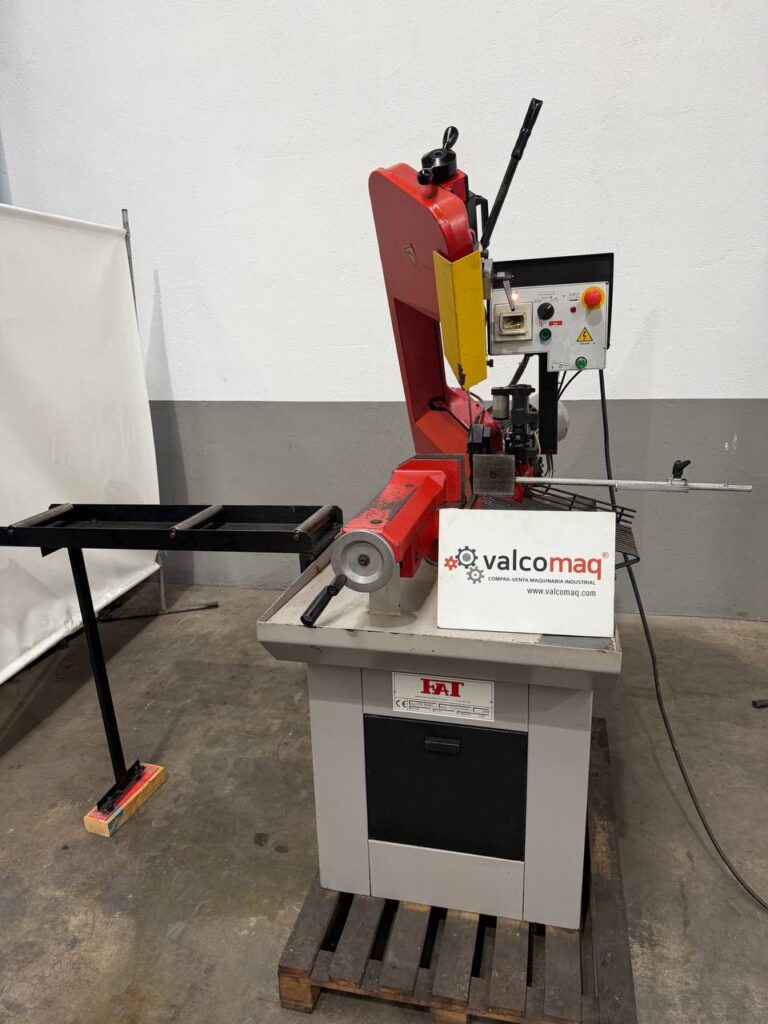
Three main families of FAT band saws tend to circulate on the second-hand market: manual lever-operated saws, designed for small workshops with intermittent production; semi-automatic saws, which feature controlled hydraulic descent and free up the operator during the cutting cycle; and automatic saws with programmable feed, aimed at long runs where part positioning and the cutting cycle are managed almost unattended. Within the latter category, some FAT models include double-vice feeding systems and variable speed control, allowing the blade speed to be adjusted to the material being cut.
Swing-column FAT saws also show up regularly on the used market, aimed at maintenance workshops and locksmiths that need a compact but reliable machine for occasional cuts of structural profiles. The choice between ranges mainly depends on production volume: a shop cutting only a few parts a day can easily get full value from a manual or semi-automatic saw, while a company with serial production will need to consider an automatic model with programmable feeding, even though its price on the used market is noticeably higher.
What should you check before buying a second-hand FAT saw?
The first inspection point should always be the blade and its guiding system. Worn carbide guides or guide rollers cause cutting deviations that, at first glance, can be mistaken for a bed alignment problem. It is also worth checking the condition of the drive and driven pulleys, since uneven wear in the pulley groove makes the blade slip or jump off during the cycle. On machines with plenty of hours in service it is normal for these parts to need replacing, and this should be reflected in the final sale price.
The second critical point is the speed variator system, present in most mid-to-high-range semi-automatic and automatic FAT saws. A mechanical or electronic variator in poor condition can limit the machine to a single cutting speed, drastically reducing its versatility for different materials. You should also check the hydraulic arm-descent system, confirming there are no leaks in the cylinders or abnormal pump noise, and inspect the tension and condition of the drive belt or chain. Finally, run the machine both idle and under load to confirm the motor shows no overheating or unusual vibration throughout the full cutting cycle.
How do blade type and machine structure affect the final result?
The choice of saw blade directly affects both finish quality and production speed. Bi-metal blades, with high-speed steel teeth welded onto a flexible body, are the most widely used on industrial FAT saws because they combine wear resistance with a degree of tolerance to impact. For particularly hard materials, such as austenitic stainless steels or hardened tool alloys, some workshops opt for tungsten carbide blades, which allow higher cutting speeds but require an especially rigid machine structure to avoid premature tooth breakage. This is why the quality of the FAT bed and the workpiece clamping system are decisive factors in getting the most out of this type of blade.
The cast-iron structure of FAT saws, particularly in mid and high-end models, absorbs vibration generated when cutting large sections more effectively, resulting in longer blade life and a cleaner surface finish. On the used market, a quick way to assess the structural condition of the machine is to visually inspect the bed for cracks or repair welds, and to check that the arm’s sliding guides show no excessive play when moved by hand with the machine switched off.
Comparison of FAT saw ranges by usage profile
| Range | Drive type | Indicative cutting capacity | Recommended workshop profile |
|---|---|---|---|
| Manual / swing column | Manual lever | Up to 150-180 mm | Locksmiths and maintenance workshops with occasional cuts |
| Semi-automatic | Controlled hydraulic descent | Up to 250-280 mm | Machining shops with medium output and varied sections |
| Automatic with programmable feed | Automatic cycle, double vice | From 300 mm upwards | Companies with serial production needing repeatability |
| Special / reinforced bed | Automatic with variable speed control | Depends on configuration, large sections | Plants with intensive cutting of structural profiles |
Which industries benefit most from a used FAT saw?
The locksmith and metal fabrication sector is one of the biggest beneficiaries of manual or semi-automatic FAT saws, since it requires precise cuts of tubular and angular profiles without needing high serial production. In general machining shops, where turning, milling and raw material cutting operations coexist, a semi-automatic FAT saw with speed variator allows the cycle to be adapted to different bar diameters without wasting time on constant manual adjustments. This kind of versatility is key for shops combining small orders with larger batches.
In steel distribution and profile warehouses, where daily cutting volume is considerably higher, automatic ranges with programmable feeding tend to be more cost-effective in the medium term, even when bought second-hand, because they cut down on labour dedicated solely to cutting. FAT saws are also common in boilermaking and structural steel workshops, where large-section profiles are cut to moderate tolerances, prioritising machine robustness over cycle speed.
What are the most common mistakes when buying a used industrial saw?
One of the most frequent mistakes is focusing solely on the purchase price without factoring in the cost of consumables that will need replacing soon after: saw blades, carbide guides, drive belts or hydraulic oil. A machine that looks cheap can stop being a bargain once these initial replacements are added up. Another common mistake is not requesting an actual cutting test with the material the workshop normally works with, settling instead for an idle start-up that reveals nothing about vibration, blade deviation or loss of power under load.
It is also common to underestimate the importance of the machine’s technical documentation and maintenance history. Buying a FAT saw without knowing its manufacturing year, approximate hours of use, or whether it has undergone any major structural repair increases the risk of unpleasant surprises shortly after start-up. For this reason, working with a specialised supplier that reconditions and inspects every machine before putting it up for sale significantly reduces the risk associated with buying used machinery.
How much does a used FAT saw cost in 2026?
Prices on the used market vary considerably depending on the range, the condition of the machine and the level of reconditioning applied. A manual or swing-column FAT saw in good condition usually falls within an accessible range for small workshops, while semi-automatic models with speed variator and hydraulic descent sit at an intermediate level, justified by their greater versatility. Automatic saws with programmable feeding, especially those designed for large sections, represent the highest investment within the used catalogue, but also offer the biggest long-term labour savings for companies with steady production.
In 2026, the trend in the used industrial machinery market points to a slight price stabilisation following the increases of recent years in raw materials and electronic components, which means buying a well-inspected used industrial saw remains one of the most reasonable options for workshops looking to expand cutting capacity without taking on the cost of a brand-new machine. The final value of each unit should always be set after a detailed technical inspection, never based solely on the manufacturing year or the hours declared by the seller.
How can you extend the service life of a FAT saw after purchase?
Once installed in the workshop, preventive maintenance is key to keeping a used FAT saw performing well for many more years. This includes periodic checks of blade tension, cleaning the cooling circuit to prevent chip build-up, and regular lubrication of the arm’s sliding guides. It is also worth setting a blade replacement schedule based on actual cutting hours rather than elapsed time alone, since wear depends heavily on the type of material being cut and the cutting speed used.
Another area to watch is the electrical system and speed variator, periodically checking connections and electrical cabinet ventilation to prevent overheating failures, especially in workshops running continuous multi-shift production. Keeping a basic log of issues and inspections also helps spot wear patterns before they turn into major breakdowns, which is particularly useful on machines that already have several years of prior service before being bought as used equipment.
Which buyer profile best fits each FAT saw range?
Choose a manual or swing-column FAT saw if: your workshop makes occasional cuts of profiles or tubes, you do not need serial production, and you are looking for a lower initial investment that still gives you a reliable, easy-to-operate machine. This is the typical choice for locksmiths, industrial maintenance workshops and small metal structure manufacturers that prioritise simple operation over automation.
Choose a semi-automatic FAT saw if: you need to combine section flexibility with a degree of autonomy during the cutting cycle, freeing up the operator for other tasks while the machine works. This profile suits general machining shops handling varied orders without reaching the volume of a serial production plant.
Choose an automatic FAT saw with programmable feed if: your activity involves repeatedly cutting large volumes of bar or profile, and you need to minimise manual intervention time per part. This is the most suitable range for steel distribution warehouses and boilermaking companies handling long production runs, where repeatability and dimensional accuracy are critical to meeting delivery deadlines.
Choose to get expert advice before deciding if: you have no previous experience assessing used machinery or are unsure between several ranges and models, since a professional technical inspection can prevent a purchase that does not match your workshop’s real needs and can catch components requiring immediate replacement in time.
Frequently asked questions about used FAT saws
Is it worth buying a used FAT saw instead of a new one? In most cases, yes, as long as the machine has been thoroughly inspected and the price reflects its real condition, since the cost difference compared with a new machine is usually very significant without losing cutting reliability. Is it hard to find spare parts for older FAT models? As a brand with wide presence on the Spanish market, it is usually possible to source compatible guides, pulleys and transmission components even for units with many years of service, although it is always worth checking availability before closing the purchase of a very specific model.
What documentation should you request when buying a used industrial saw? At the very least, you should ask about the manufacturing year, the maintenance history if available, and the possibility of running a cutting test with the material typically used in your workshop before finalising the deal — something we at Valcomaq make easy as part of our process for selling inspected machinery.
The PDF manuals for FAT sawing machines are available at Instrumachine.
Valcomaq, your partner for finding the right used FAT saw
At Valcomaq we have spent more than twenty years buying, reconditioning and selling used industrial machinery, and we know first-hand the technical particularities of brands like FAT within the industrial saw segment. Although we do not currently hold FAT units in immediate stock, our team actively sources this type of equipment on the domestic and international market, checking its structural condition, transmission system and variator before offering it to our customers, always backed by the inspection guarantee that defines our entire catalogue.
If you are looking to add a reliable used industrial saw to your workshop, you can check our catalogue of used FAT saws for current availability, or browse the rest of the equipment within our industrial saws category. Our team will help you identify the range and model that best fit your production volume and material type, also handling the technical inspection and commissioning before shipping. Feel free to contact us with any questions, to request a valuation, or to be notified when a unit matching your needs comes into stock.