


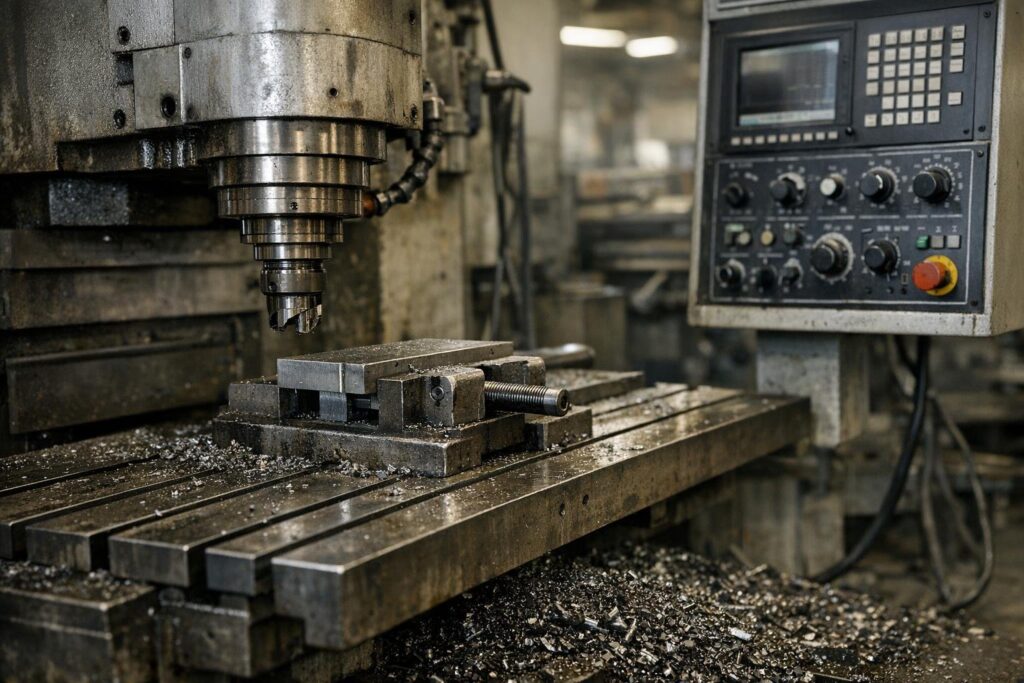
Buying or selling a second-hand industrial milling machine always raises the same question: what is the equipment really worth? Unlike other machine tools, a milling machine combines precision, versatility and an enormous range of configurations, which means its valuation is never a simple calculation based on weight or age. In this article we take a detailed look at the technical and commercial factors that determine the resale price of a used industrial milling machine: the brand, the spindle type, the bed design, whether or not it has CNC control, its overall condition, and many other aspects that a professional appraiser checks before quoting a figure. Whether you are thinking about selling your machine or buying a second-hand one, this guide will help you understand what really drives price in today’s market.
What factors determine the value of a used industrial milling machine?
The value of a used milling machine never depends on a single element, but on the combination of several factors that interact with each other. Among the most decisive are the brand and manufacturer origin, the spindle type and its machining capacity, the bed design (fixed, moving or universal), the presence of CNC control versus a conventional control, the overall condition of the ways, spindle and motors, and finally the working hours and documented maintenance the machine has received throughout its service life.
On top of these technical factors come commercial ones: spare parts availability, current demand for the model on the domestic and international market, and the possibility of reconditioning before sale. A machine that is many years old but perfectly maintained and fitted with original accessories can fetch a higher price than a newer but neglected model. This is why any serious appraisal requires a physical inspection, not just a review of a spec sheet or a set of photographs.
How does the brand influence resale price?
Brand remains one of the most important criteria in the used machinery market. Manufacturers such as Zayer, well known for their extremely robust fixed-bed milling machines, keep a strong resale value thanks to the reliability of their structures and the availability of spare parts. Brands like Lagun or CME are highly valued in medium-sized workshops for their value for money and ease of maintenance, while Fexac and MRF stand out in more specific applications, appreciated for their accuracy in medium-precision machining.
An experienced buyer knows that a well-known brand, even with more years of use, usually holds its value better than a generic or unknown-make machine. This is due to the reputation built over decades, the availability of technical manuals and original spare parts, and the confidence it gives to both domestic and international buyers. At Valcomaq we regularly work with these brands within our used machinery catalogue, which allows us to provide valuations that reflect real market demand.
The spindle and its machining capacity drive the price
The spindle is the heart of any milling machine, and its type, diameter and speed range directly influence the final valuation. An ISO 40 taper spindle is common in medium-sized workshop milling machines, while an ISO 50 taper allows heavier tooling and higher-stock-removal machining, which considerably increases resale value. Maximum spindle speed, which can range from 3,000 to 8,000 rpm depending on the model, also determines the machine’s versatility for working steel, aluminium or other soft materials.
Besides diameter and speed, the appraiser checks axial and radial spindle play using a dial indicator, since excessive wear means a costly repair that directly lowers the final price. A milling machine with a spindle in good condition, no noticeable play and original bearings, can be worth 20% to 30% more than an equivalent unit with a worn spindle, even if it is the same model and year.
Fixed bed or moving bed? Direct impact on value
Bed design is another decisive element. Fixed-bed milling machines, very common in Zayer models, offer greater rigidity and stability for heavy machining of bulky parts, which makes them highly valued in sectors such as mould making or capital goods manufacturing. Moving-bed or knee-type milling machines, on the other hand, are more versatile for general workshops, since they allow the table to move more freely on the three axes, at the cost of somewhat lower rigidity in demanding machining jobs.
The choice between one design or the other depends on end use, but in terms of valuation, large-tonnage fixed beds tend to hold a more stable resale value over time, especially when fitted with a rotary table, universal head or specialised clamping accessories. These extras, when in good condition, can add a significant amount on top of the base price of the bare machine.
CNC versus conventional control: the big price difference
The presence of CNC control is probably the single factor that most boosts the value of a used industrial milling machine. A machine fitted with a Heidenhain, Fagor or Fanuc control in good working order can double or even triple the price of an equivalent conventional-control model, since it allows repetitive machining to be programmed with high accuracy and reduces production times. The age of the control cabinet itself also matters: a recent-generation CNC with a touchscreen and updated software commands a better price than older versions with hard-to-maintain monochrome displays.
Conventional milling machines, with manual control and a digital readout, still enjoy solid demand in repair shops, industrial maintenance departments and technical training centres, where complex programming is not required but robustness and ease of use are. These machines usually have a more accessible entry price, making them an attractive option for small workshops or companies starting out in machining.
Overall condition, age and working hours: which matters most?
Although age is the first thing every buyer asks about, it is not always the most decisive factor. A twenty-year-old milling machine with rigorous maintenance, reground ways and original motors can be worth more than a ten-year-old unit that has been used intensively without servicing. The appraiser looks at visible wear on the ways, geometric accuracy checked with a dial indicator, the condition of belts and bearings, and any oil or coolant leaks that point to a lack of maintenance.
Working hours, when documented through a counter or maintenance history, give buyers confidence and usually improve the sale price. Conversely, a machine with no clear history raises doubts and forces a safety discount on the initial valuation, since the buyer takes on a greater risk of finding hidden faults after start-up.
Comparison table: factors affecting the price of a used milling machine
| Factor | Impact on price | Example |
|---|---|---|
| Brand and reputation | High | Zayer or Lagun hold a more stable resale value |
| Spindle type and condition | High | ISO 50 with no play is worth more than a worn ISO 40 |
| Presence of CNC | Very high | Recent Heidenhain control can double the price versus conventional |
| Bed design | Medium-high | Fixed bed with accessories raises the base value |
| Age | Medium | Less relevant when maintenance is documented |
| Working hours and maintenance | High | A clear service history reduces perceived risk |
| Accessories included | Medium | Rotary table, universal head, dividing head |
How much does a used industrial milling machine cost by range?
Prices on the second-hand market vary enormously depending on how the factors above combine. A medium-sized conventional universal milling machine, without CNC but in good condition, can sit at an accessible entry-level price, ideal for small workshops or training schools. Mid-range models, with a digital readout and a robust bed, command noticeably higher prices, especially when they carry recognised brands such as CME or MRF. At the top end sit fixed-bed milling machines with the latest-generation CNC, which can fetch prices several times higher than conventional models, justified by their productivity and accuracy in long production runs.
It is worth remembering that these ranges are only indicative, and every valuation should be carried out on a case-by-case basis. Factors such as geographic availability, urgency of sale or the need for special transport can also shift the final price up or down relative to the market average.
What mistakes do sellers make when pricing their milling machine?
One of the most common mistakes is setting the price based solely on the original purchase value, without accounting for real depreciation or the machine’s current condition. Another frequent error is failing to clean or prepare the machine before the appraisal, which gives an impression of neglect even if it is mechanically sound. It is also common to hide or be unaware of previous faults, something a professional appraiser quickly detects and which ends up hurting both trust and the final price offered.
Many sellers also underestimate the added value of original accessories, such as a dividing head, rotary table or a complete set of collets, and sell them separately, losing overall value. Basic reconditioning before the sale — general cleaning, replacing belts or adjusting play — is usually a small investment that pays for itself many times over in the final resale price.
What should the buyer check before closing the deal?
Before buying a used industrial milling machine, it is worth carrying out a series of basic checks: run the spindle at different speeds to detect abnormal vibration or noise, check the oil level in the feed gearbox, verify the full travel of the three axes without binding, and confirm that the electrical system and, if fitted, the CNC cabinet work correctly. It is also advisable to request a test part to check the machine’s real accuracy, especially for work requiring tight tolerances.
A professional inspection, like the one we offer at Valcomaq, helps uncover hidden defects before finalising the purchase, avoiding surprises and ensuring the price paid matches the machine’s actual condition.
Which is the best option depending on your buyer or seller profile?
Choose to sell your milling machine now if: the equipment is idle, taking up space in your facility and is no longer part of your regular production; the used machinery market maintains healthy demand, and waiting longer will only increase depreciation and wear from inactivity.
Choose to invest in reconditioning first if: your milling machine shows minor, easily correctable wear, such as worn belts or lack of lubrication, since a small investment can significantly increase the final sale price.
Choose to buy a used CNC milling machine if: your workshop needs to produce repetitive batches with high accuracy and you want to cut machining times, accepting a higher upfront investment in exchange for a fast return in productivity.
Choose a conventional fixed-bed milling machine if: your work focuses on repair, maintenance or one-off jobs where manual flexibility and structural robustness matter more than automation.
Used milling machines at Valcomaq: fair valuation and quality guarantee
At Valcomaq we have spent more than twenty years appraising, buying and reconditioning industrial machinery, and we know that every milling machine has its own history and characteristics that make it unique. That is why every valuation we carry out takes into account the brand, the spindle, the bed type, the presence of CNC and the machine’s real condition after a full physical inspection, always offering a fair price adjusted to current domestic and international market demand.
If you want to find out how much a used industrial milling machine is worth, whether to sell the one sitting idle in your workshop or to buy a fully inspected, guaranteed unit, visit our catalogue of used milling machines and discover models from brands such as Zayer, Lagun, CME, Fexac or MRF ready to get to work. And if you are looking to sell your machine, check out our industrial machinery purchase section and contact us: we will give you a professional, no-obligation valuation tailored to the real condition of your equipment.