


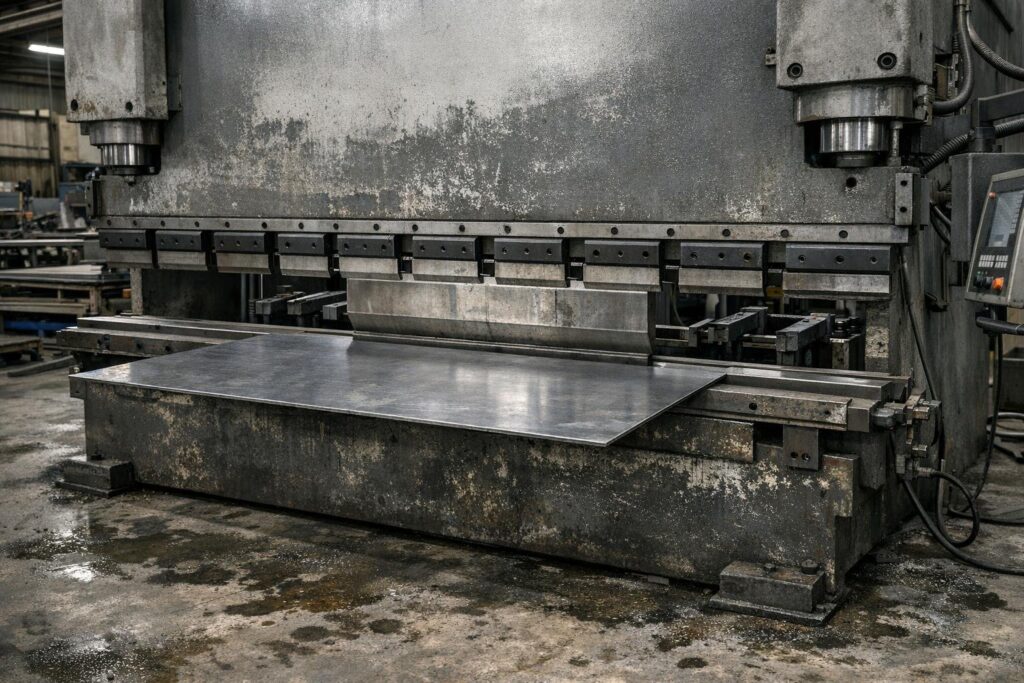
In the second-hand industrial machinery market, used Axial press brakes hold a prominent place among sheet metal and metalworking shops looking for robustness, precision and a reasonable acquisition cost. Axial is a brand with a long track record in sheet metal bending, well known for building hydraulic machines designed for intensive production and relatively straightforward maintenance. In this guide we cover what sets these machines apart, the most common ranges and models found on the used market, the key technical points to inspect before closing a deal, and which type of workshop gets the most out of a second-hand Axial press brake. We also look at indicative 2026 pricing, the most common buying mistakes, and how to access inspected units that are ready to run.
What characterizes Axial press brakes in the used machinery market?
Axial press brakes stand out for their heavy cast-iron frame, engineered to absorb bending loads without losing angular precision over the years. They feature synchronized hydraulic cylinders that guarantee uniform bending along the full length of the bed, a fast-return system that boosts productivity on medium-sized runs, and, in the more complete models, mechanical or hydraulic crowning compensation to prevent deflection on long sheets. This combination makes the brand a common choice when buyers look for used machinery that has already proven itself in boilermaking shops, structural steel fabrication or construction component manufacturing.
Another factor behind the strong resale performance of used Axial press brakes is the relatively wide availability of compatible spare parts, since many models share solenoid valves, pumps and industry-standard control systems such as Delem or Cybelec. This makes mid-term maintenance easier and reduces the risk of losing technical support, something any buyer of used machinery should weigh up before settling on a particular brand.
What ranges and models of Axial press brakes are most common second-hand?
Two major families of Axial press brakes appear regularly on the used equipment market: the manual or semi-automatic range, aimed at short-run workshops and simple parts, with bending forces from 60 to 135 tons and bed lengths between 2000 and 3100 mm; and the CNC range, fitted with multi-axis numerical control (X, Y1, Y2 and even R and Z), designed for medium to high-volume production where angular repeatability and fast program changeovers are essential. Within this second family it is common to find units with forces from 135 to 320 tons and lengths of up to 4100 mm, used in the manufacture of electrical cabinets, profiles and structural parts.
Intermediate configurations also exist, with basic two-axis numerical control and motorized back gauges, highly valued by workshops looking to step up from a manual press brake without taking on the cost of a full CNC machine. Regardless of the range, when evaluating used Axial press brakes it is worth checking the year of manufacture, estimated working hours and whether the control has received any upgrades, since these factors directly affect both price and remaining service life.
Bending capacities, bed length and CNC control systems
Bending force, expressed in tons, determines the maximum sheet thickness that can be worked depending on the length of the bend: a 135-ton, 3100 mm press brake can bend carbon steel sheet up to 8-10 mm thick across the full bed length, while a 220 to 320-ton unit with a 4000-4100 mm bed can handle thicknesses of 12 to 16 mm, typical in heavy structural work and boilermaking. Throat depth, maximum die opening and cylinder stroke are other parameters that define what type of part can be produced, especially for profiles with deep bends or closed boxes.
In terms of control, CNC-range Axial press brakes typically feature systems such as Delem DA-53/DA-66 or ESA, which allow bending sequences to be programmed, automatically manage crowning compensation and store programs by part reference, cutting changeover times between batches. Checking that the control starts up correctly, that the axes respond without lag and that angular calibration stays stable after repeated cycles is essential before finalizing the purchase of any used unit.
| Range / Indicative model | Bending force | Bed length | Control | Recommended workshop profile |
|---|---|---|---|---|
| Axial PH 60/20 | 60 tons | 2000 mm | Manual / manual back gauge | Small workshop, short simple parts |
| Axial PH 135/30 | 135 tons | 3100 mm | Semi-automatic, motorized back gauge | Medium workshop with short-to-medium runs |
| Axial CNC 220/4000 | 220 tons | 4000 mm | Multi-axis CNC (Delem/ESA) | Series production, structural and boilermaking work |
| Axial CNC 320/4100 | 320 tons | 4100 mm | Multi-axis CNC with automatic crowning compensation | Thick plate, long-length parts |
What to check before buying a used Axial press brake?
Before purchasing any of the used Axial press brakes available on the market, it is essential to check the condition of the bed: excessive deflection or irregular wear marks on the bending tool are signs of intensive use without proper maintenance. It is also worth checking the hydraulic cylinders and seals for leaks, the level and color of the hydraulic oil, and the operation of the solenoid valves that govern synchronization on both sides of the bed. A real bending test with a sheet of known thickness lets you verify whether the resulting angle is consistent along the full length, a key indicator for ruling out calibration issues or punch and die wear.
On CNC-controlled models it is essential to check that all axes respond with precision, that the encoders show no backlash and that the software retains stored programs without communication errors. The condition of the tooling should also be assessed: worn or chipped punches and dies directly affect bend quality and represent an additional short-term cost. Finally, it is advisable to request the maintenance history and, if possible, the CE marking certificate and safety documentation of the machine, especially for equipment destined for workshops subject to periodic health and safety inspections.
What maintenance does an Axial press brake require and what service life can be expected?
Maintenance on an Axial press brake mainly involves periodically checking the hydraulic oil and its filters, inspecting the cylinder seals to prevent leaks, and regularly greasing the guides and columns that support the movement of the upper beam. A well-executed preventive maintenance plan, with oil changes every 2000-2500 working hours and an annual check of angular calibration, allows these machines to retain their precision for decades, since the cast-iron frame barely suffers structural fatigue when operated within the manufacturer’s specified load limits.
For this reason it is not unusual to find units on the used market that are 15, 20 or even more years old which, after a full overhaul of cylinders, valves and electrical system, still perform at the level of a much newer machine. The key is telling the difference between normal, perfectly repairable wear and serious structural deterioration that would compromise bending accuracy in the long run, something that can only be assessed through a detailed technical inspection before purchase.
What mistakes do many buyers make when purchasing used bending machinery?
One of the most common mistakes when looking for used Axial press brakes is relying solely on photographs or the technical spec sheet without requesting a working test with real material. Another frequent error is failing to check parts availability for the specific CNC control fitted to the machine, which can lead to long downtime periods if a discontinued electronic component fails. It is also common to underestimate logistics costs: transport, unloading with the right equipment and levelling at the new site all represent expenses that should be factored in from the start, not after the fact.
A third frequent mistake is buying a bending capacity that exactly matches current needs with no room for growth, forcing a machine change shortly after if the workshop expands its range of parts or material thicknesses. Finally, many private buyers overlook the importance of verifying CE marking and safety documentation, an issue that can cause problems during audits or health and safety inspections once the machine is already installed and operating in the workshop.
How much does a used Axial press brake cost in 2026?
The price of a used Axial press brake in 2026 varies considerably depending on the range, condition and type of control. Entry-level manual or semi-automatic units, with forces between 60 and 135 tons, typically range from 8,000 to 18,000 euros if in good condition and inspected. Mid-range CNC press brakes, with forces of 150 to 220 tons and multi-axis controls, usually fall between 20,000 and 45,000 euros, while higher-tonnage equipment (300 tons or more), designed for thick plate and long parts, can reach between 50,000 and 90,000 euros depending on age and accumulated working hours.
Factors such as year of manufacture, working hours, the brand and version of the numerical control, the condition of the tooling and whether the machine has undergone professional refurbishment all directly influence the final price. Buying an already inspected unit, with a warranty and a verified start-up, usually pays off compared with a cheaper option that comes with no technical backing, since unexpected repair costs can quickly match or exceed the initial savings.
What type of workshop benefits most from an Axial press brake?
Boilermaking and structural steel workshops, manufacturers of electrical cabinets, panels and profiles, as well as workshops producing parts for shipbuilding or agricultural machinery, are the ones that get the most out of an Axial press brake thanks to its ability to work medium and heavy-gauge sheet with consistent angular precision. They are also a very interesting option for subcontract workshops that need versatility to handle varied orders, from single parts to small batches, without compromising bend quality in either case.
For companies expanding their production capacity or looking to replace an outdated press brake without taking on the cost of new equipment, used Axial press brakes offer a very competitive performance-to-price ratio, especially when sourced from a supplier that guarantees prior inspection and correct operation of all hydraulic and control systems before delivery.
Choose a manual or semi-automatic Axial press brake if: your workshop handles simple parts, short runs and you are working with a tight budget, since these machines offer mechanical reliability at a low entry cost and are easy to operate without prior specialized training.
Choose a mid-range CNC Axial press brake if: you need angular repeatability, frequent reference changes and medium-volume production, since the multi-axis numerical control reduces set-up times and improves bend consistency batch after batch.
Choose a high-tonnage CNC Axial press brake if: your work involves thick plate, long parts or heavy structural fabrication, since the 220 to 320-ton versions with beds of up to 4100 mm are designed precisely for that type of production demand.
Choose to buy from Valcomaq if: you are looking for real guarantees on the machine’s condition, a documented inspection process, technical advice during the buying decision, and logistics support for transport and installation at your workshop, avoiding surprises once the machine is already in production.
Used Axial press brakes at Valcomaq: inspection, warranty and real availability
At Valcomaq we have spent more than 20 years buying, refurbishing and selling second-hand industrial machinery, and used Axial press brakes are a regular part of our catalogue thanks to the reliability they show in workshops across Spain and beyond. Every unit that passes through our facilities undergoes a technical inspection covering the hydraulic system, the CNC control, the condition of the tooling and a real bending test before it is made available to our customers, so what arrives at your workshop is a machine ready to work from day one. Stock of this brand changes regularly as machines come in and go out, so we recommend checking current availability before making a decision.
You can browse the used Axial press brakes currently available in our catalogue, inspected and ready to join production, or check out the rest of the equipment within the general used press brakes category if you are looking for other brands, capacities or configurations. If you have technical questions about which model best suits your production, need a transport quote, or want to discuss selling your own press brake, contact us and we will help you find the right solution for your workshop.