


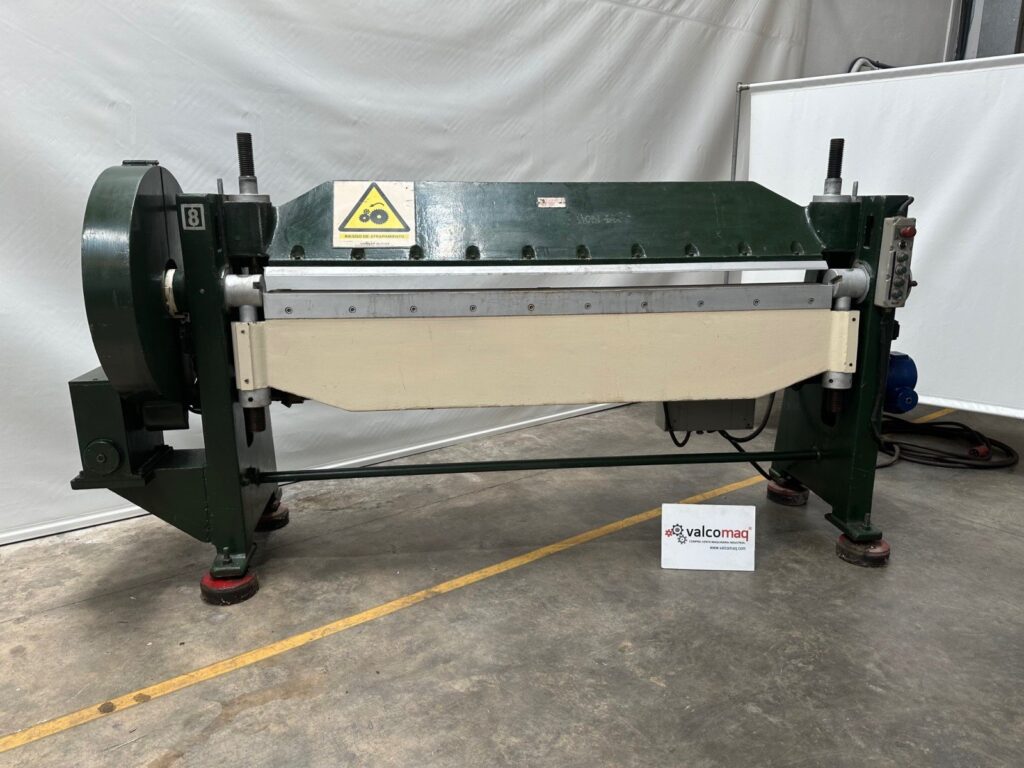
Buying a used press brake is one of the smartest investments a sheet metal, boilermaking or metal fabrication workshop can make, provided the brand and model are chosen carefully. Within the used machinery market, Collado press brakes hold a strong reputation thanks to their heavy-duty construction and the long service life of their hydraulic components. In this guide we cover what makes this Spanish brand stand out, which ranges and models you will most often find on the second-hand market, the technical points worth inspecting before signing off on a purchase, and which type of workshop gets the most value out of a Collado press brake. By the end of this article you should have enough criteria to evaluate any unit you come across, whether listed in a specialised catalogue or offered directly by a private seller.
Throughout the article you will also find a comparison table of models, indicative pricing for 2026, and recommendations based on your type of production. If you decide to take the next step, at Valcomaq we stock used Collado press brakes that have been inspected and are ready to work, backed by more than 20 years of experience buying and selling industrial machinery.
What makes Collado press brakes stand out in the used machinery market?
Collado is a long-established name in the Spanish sheet metal equipment industry, best known for its robust hydraulic bending machines and large-format guillotine shears. What usually stands out to anyone looking at a used Collado press brake for the first time is how overbuilt the structure is: thick cast or welded-steel frames, generously sized hydraulic cylinders, and mechanical or hydraulic synchronisation systems that keep bending parallelism accurate even after decades of heavy use. This engineering philosophy, designed to withstand demanding workloads in heavy boilermaking and structural steel workshops, explains why so many units from the 1990s and 2000s are still running smoothly today.
Another distinctive feature is the relatively easy availability of spare parts and technical support, since many of its hydraulic components (pumps, valves, cylinders) come from standard industry manufacturers, making long-term maintenance straightforward. CNC-controlled versions, typically fitted with Delem, ESA or Cybelec controllers depending on the manufacturing decade, allow complex bending sequences to be programmed and repeated with tight tolerances, while simpler models with a manual back gauge remain highly valued in workshops that prioritise simplicity of operation and low maintenance costs.
Which Collado ranges and models are most common on the used market?
On the used market you will mainly find three families of Collado press brakes: mid-range models, with bending lengths between 2000 and 3000 mm and working forces of 60 to 135 tonnes, aimed at light and medium sheet metal work; heavy-duty models, with bending lengths of up to 4000-6000 mm and capacities exceeding 200-300 tonnes, built for structural steel, tanks and shipbuilding; and older purely mechanical-hydraulic units without CNC, many of which are still in good working order in traditional workshops. Collado press brakes built from the 2000s onward usually already feature hydraulic synchronisation through proportional valves and linear measuring scales, which noticeably improves bending angle repeatability compared with earlier versions. You can browse our full range of used press brakes to compare models from different brands and specifications.
When searching for a specific unit, pay close attention to the combination of bed length, distance between uprights and cylinder stroke, since these three parameters determine which parts you can actually bend. A 3100 mm press brake with 135 tonnes of force, for example, can handle mild steel up to 8-10 mm thick across its full length, while a heavy-duty 4100 mm, 220-tonne unit extends that capacity to 12-15 mm, depending on the material’s yield strength. At Valcomaq we inspect every unit before adding it to our catalogue, checking hydraulic tightness, bending accuracy and the condition of the upper and lower blades.
Bending capacities and applications by sector
Collado press brakes are used across many different sectors precisely because of the breadth of their capacity range. In boilermaking and tank manufacturing, the longer and higher-tonnage versions allow shell sections and thick-plate panels to be formed with consistent angular accuracy across the whole piece. In metalworking and light structural steel shops, mid-range models are ideal for profiles, trays, electrical cabinets and facade elements, where cycle speed and ease of tooling changes matter more than raw force. They are also common in industrial automotive and agricultural machinery manufacturing, where medium-thickness sheets are bent to tight tolerances thanks to CNC control.
One point worth checking is the type of tooling fitted on the machine: standard European-style punches and dies (Amada-type or similar) make it easier to find replacements and expand the tooling set, while proprietary tooling can complicate future upgrades. Before buying, ask explicitly about the tool clamping system, as this affects your future investment in new punches or dies for special profiles such as boxes, large radii or Z-bends.
What to check before buying a used Collado press brake
The first inspection point should always be bending angle accuracy across the full length of the bed: run several tests with sheets of different thicknesses and confirm the angle stays consistent at both ends and in the centre, which indicates a healthy synchronisation system. Second, it is essential to check the hydraulic unit: oil level and cleanliness, no leaks at cylinders or fittings, and quiet pump operation. A noisy or overheating hydraulic unit usually signals a costly repair down the line.
You should also check the condition of the guides and blades (punch and die), looking for uneven wear, nicks or loss of straightness, as well as the operation of the back gauge: its movement should be smooth and repeatable, with no play or jumps. On CNC-equipped versions, make sure the controller boots correctly, shows no axis errors, and that programs can be saved and recalled without issues. Finally, review the available documentation (manual, electrical and hydraulic diagrams, CE certificate if applicable) and, whenever possible, ask for a live bending demonstration before closing the deal.
| Range | Bending length | Approx. force | Typical control | Recommended use |
|---|---|---|---|---|
| Light/manual | 1500-2000 mm | 40-80 t | Manual back gauge or basic NC | Metalworking, thin sheet |
| Medium | 2000-3100 mm | 80-135 t | Delem/ESA CNC | Structures, cabinets, profiles |
| Heavy duty | 4000-6000 mm | 200-300 t | Multi-axis CNC | Heavy boilermaking, tanks |
| Special/naval | 6000 mm or more | +300 t | Advanced CNC | Shipbuilding, large structures |
How much does a used Collado press brake cost in 2026?
The price of a used Collado press brake varies widely depending on age, condition, whether or not it has CNC, and the machine’s length and tonnage. As an indicative reference for 2026, light or mid-range units without CNC in good overall condition typically sell for between 6,000 and 15,000 euros. Mid-range units with numerical control, a motorised back gauge and a recent overhaul tend to fall between 15,000 and 35,000 euros, while heavy-duty units with long bending length and advanced CNC can exceed 40,000-60,000 euros, especially when fitted with extras such as quick tool-change systems or updated safety guarding.
These figures are always indicative, since factors such as actual hours of use, maintenance history, the machine’s origin (private workshop vs. auction) and whether transport and installation are included can significantly change the final budget. That is why we always recommend requesting a professional appraisal or valuation before comparing prices across different sellers, a service we offer at Valcomaq as part of our specialised advisory support.
Common mistakes when buying a used press brake
One of the most frequent mistakes is focusing only on the purchase price without factoring in commissioning costs: transporting a machine that weighs several tonnes, levelling it, arranging the correct three-phase electrical connection and, if needed, upgrading safety guarding to meet current regulations. Another common mistake is failing to verify electrical and voltage compatibility, especially on machines that have changed location or country at some point in their life. It is also common to underestimate the space required: a long press brake needs not only bed footprint but also lateral clearance for handling long sheets with an overhead crane or forklift.
Finally, many first-time buyers skip a real functional test with their own material before closing the deal, which can lead to unpleasant surprises after installation. Buying through a specialised supplier like Valcomaq, which inspects and commissions every machine before sale, drastically reduces this risk and offers additional guarantees compared with buying directly from a private individual.
Maintenance and lifespan of a Collado press brake
A well-maintained Collado press brake can easily last three or four decades, thanks to the strength of its frame and the ability to replace hydraulic components without touching the main structure. Basic preventive maintenance includes periodic hydraulic oil changes (typically every 2,000-4,000 working hours), checking cylinder seals and gaskets, lubricating guides and columns, and periodically verifying the calibration of the synchronisation system. On CNC versions, it is also worth regularly backing up bending programs and checking the condition of encoders or linear scales.
Proper maintenance not only extends the machine’s life but also keeps bending accuracy within acceptable tolerances for quality work, avoiding rejected parts and wasted material. For this reason, when buying a used unit, it is advisable to request the maintenance history if available, or at least confirm the machine has been professionally serviced before sale, as is the case with every unit that passes through our workshop.
Which type of workshop is best suited to a Collado press brake?
Choose a light or mid-range Collado press brake if: your production focuses on thin or medium-gauge sheet, you run short to medium batches with frequent part changes, and you want a reliable machine with low maintenance costs and simple operation, whether with a manual back gauge or a basic CNC that speeds up repeatability without a large investment.
Choose a heavy-duty Collado press brake if: your activity involves industrial boilermaking, tank manufacturing, large-format structural steel work or shipbuilding, and you need to bend thick, long sheets with guaranteed angular accuracy across the whole piece, something only an overbuilt frame like this brand’s can deliver.
Choose a CNC-equipped unit if: you work with repetitive batches, multiple part references, or need to minimise setup time between program changes, since numerical control lets you store bending sequences and recall back gauge settings automatically.
Choose a unit without CNC if: your priority is operational simplicity, lower purchase and maintenance costs, and you work with simple-geometry parts where advanced programming is not essential.
Frequently asked questions about used Collado press brakes
Is it safe to buy a Collado press brake over 20 years old? Yes, as long as the frame is in good condition and the hydraulic system has been serviced or rebuilt, since the frame and mechanical components of this brand are designed for a very long service life. Is it worth fitting a CNC to an older press brake without numerical control? In many cases yes, especially when working with medium to high volumes, since the investment pays for itself quickly through time saved on manual adjustments. What guarantees do you get buying from a specialised supplier instead of a private seller? Mainly a prior technical inspection, a tested start-up, advice on the right machine for your production, and in many cases a warranty period after delivery.
Valcomaq, your partner for finding used Collado press brakes
At Valcomaq we have specialised for more than 20 years in buying, reconditioning and selling used industrial machinery, including hydraulic press brakes from leading brands such as Collado. Every unit we add to our catalogue goes through a technical review that includes checking bending accuracy, the condition of the hydraulic unit, CNC performance where fitted, and a general tune-up, so it arrives at your workshop ready to work from day one. We currently have units available in our catalogue, although stock changes frequently given the pace of our buying and selling operations. If you are also looking to part with an old machine, we also buy used equipment through our we buy your machine service.
If you are considering adding a used Collado press brake to your production line, we invite you to visit the Valcomaq catalogue of used Collado press brakes to check available units and their up-to-date technical specifications, or contact us for personalised advice on which model best fits your production volume, material type and budget.