

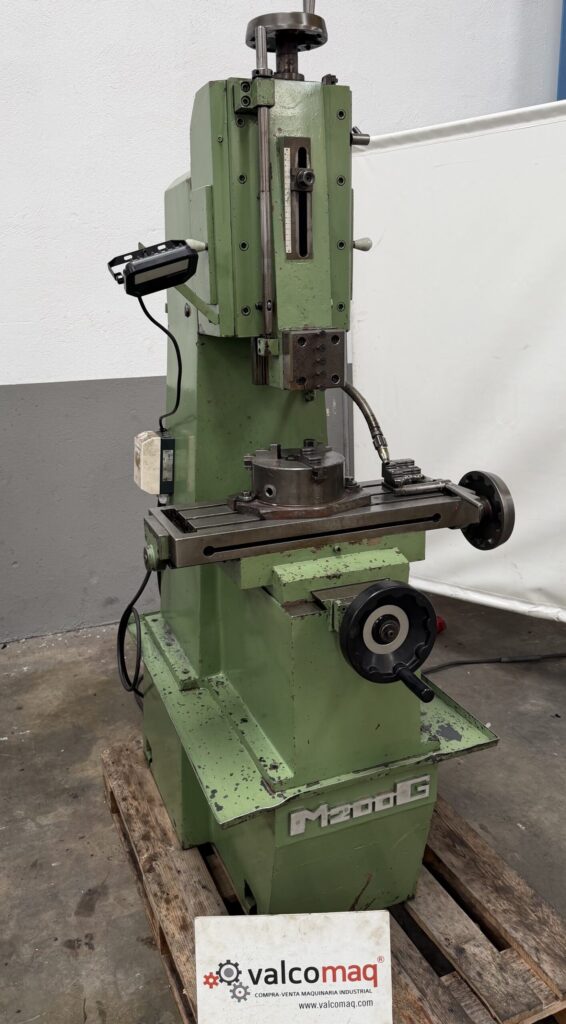
Shapers (slotting machines) remain essential tools in many machine shops, especially for internal keyways, straight slots and profiles that other machines simply cannot reproduce with the same precision. Among the brands that inspire the most confidence on the used machinery market is Urpe, a manufacturer with a long track record of building rugged, low-maintenance equipment. In this guide we look at what sets Urpe shapers apart, which ranges and models tend to appear on the second-hand market, which technical points you should check before buying, and which type of workshop they suit best. If you are considering adding a used Urpe shaper to your production line, this guide will help you make an informed decision and avoid unpleasant surprises.
Throughout the article you will find concrete technical data, a comparison table of models and buying criteria, recommendations based on your workshop profile, and answers to the most common questions. By the end, you should know exactly what to ask and what to inspect before signing off on the purchase of any used Urpe shaper.
What sets Urpe shapers apart on the used machinery market?
Urpe’s reputation on the Spanish market rests on extremely rigid cast-iron beds, highly robust mechanical drive systems, and a design philosophy geared towards continuous production with minimal maintenance demands. Unlike brands aimed more at short runs, Urpe shapers were engineered for workshops with demanding workloads, where the tool ram has to maintain a perfectly straight stroke over thousands of cycles without losing accuracy. This constructional solidity is why, even after 30 or 40 years of service, many units are still fully operational once properly reconditioned.
Another defining feature is the mechanical simplicity of their feed systems, typically based on crank-and-connecting-rod mechanisms with a ratchet for automatic table feed, which makes maintenance far easier and simplifies sourcing or machining custom replacement parts. This makes used Urpe shapers a particularly appealing option for workshops looking for long-term reliability without relying on complex electronics or hard-to-replace components.
Which Urpe shaper ranges and models can you find on the used market?
On the Spanish used machinery market it is common to find mid-stroke Urpe shapers, generally with a 300 to 600 mm ram stroke, designed for medium-sized workpieces such as pulleys, gears, bushings and transmission parts. These models usually feature a rotary table with independent longitudinal and transverse movements, allowing internal slots, keyways and straight profiles to be machined with very tight dimensional control thanks to digital readouts added in later factory revisions or fitted by the workshop itself.
Larger-capacity versions also exist, with strokes close to 800 mm, aimed at the large workpieces typical of foundries, mould shops or heavy machinery components. These units feature larger tables, higher-power motors (typically between 3 and 7.5 kW depending on the model and year of manufacture) and stroke-speed regulation via stepped pulleys or mechanical variators. The choice between ranges depends directly on the typical workpiece size in your shop and the type of operation involved: fine precision slotting versus roughing larger-section profiles.
What technical points should you check before buying a used Urpe shaper?
Before purchasing any used shaper it is essential to check the condition of the ram guideways, since wear in this area translates directly into loss of parallelism and cutting accuracy. Ask for a test run, ideally under load, checking for no perceptible play by hand and no abnormal vibration throughout the full up-and-down cycle. You should also inspect the rotary table, wear on the transverse and longitudinal feed slides, and backlash in the drive leadscrews, since these elements determine the repeatability of machined dimensions.
Another critical point is the lubrication system: on machines with several decades of service it is common for the oil lines to have become clogged or blocked, accelerating wear of internal components. It is advisable to request a recent inspection report, check the condition of the electric motor (insulation, bearings, rated current draw) and confirm that the ram braking system works correctly, avoiding sharp impacts at the end of stroke. Finally, inspect the bed for cracks or previous weld repairs, a defect that seriously compromises the machine’s structural rigidity.
| Criterion | What to check | Consequence if faulty |
|---|---|---|
| Ram guideways | Play, parallelism, wear marks | Loss of precision in slots and keyways |
| Rotary table | Angular play, firm locking, legible graduation | Positioning errors on round parts |
| Feed leadscrews | Backlash, nut wear | Lack of dimensional repeatability |
| Electric motor | Insulation, noise, overheating | Unexpected downtime, risk of major failure |
| Bed | Cracks, welds, flatness | Vibration and loss of structural rigidity |
| Lubrication system | Clean lines, correct oil grade | Accelerated wear of internal components |
How do Urpe shapers compare against other brands on the market?
When comparing shapers from different brands, three factors matter most: constructional robustness, spare parts availability and ease of maintenance. Urpe shapers stand out particularly on the second and third points, thanks to conventional mechanics that any workshop experienced with classic machinery can maintain without relying on hard-to-source proprietary components. Compared to brands with more sophisticated systems, Urpe offers a shorter learning curve for operators and lower medium-term repair costs, although on very large-stroke models some alternative brands may offer slightly higher power outputs.
The table below gives an indicative comparison of how Urpe shapers stack up against other common options on the Spanish used machinery market, based on practical purchasing criteria.
| Criterion | Urpe shapers | Other classic brands |
|---|---|---|
| Bed robustness | High, heavy cast iron | Varies by manufacturer |
| Spare parts availability | Good, adaptable mechanics | Depends on whether the manufacturer is still active |
| Ease of maintenance | High, conventional mechanics | Medium-high |
| Used market price | Competitive | Similar or higher |
| Typical strokes | 300-800 mm | Varies, 250-900 mm |
Which type of machine shop are Urpe shapers best suited for?
Urpe shapers are particularly well suited to industrial repair shops, machinery maintenance operations and spare parts manufacturing, where production runs are short and versatility matters more than full automation. They are also a great fit for machine shops that regularly work with gears, pulleys, bushings and transmission components requiring internal keyways or straight slots that are impossible to obtain on a conventional milling machine without specific tooling. Their robust mechanics also allow machining of medium-to-high hardness steels without compromising tool life or machining accuracy.
On the other hand, they are not the best choice for shops focused on long, highly automated production runs, where cycle time and CNC integration are decisive factors. In that scenario, other specialised machining solutions tend to be more efficient. However, for one-off precision jobs, corrective maintenance or manufacturing in-house tooling, a well-reconditioned used Urpe shaper remains a highly cost-effective investment, with an acquisition cost far below that of an equivalent new machine.
What maintenance does an Urpe shaper need to extend its service life?
Preventive maintenance on an Urpe shaper is relatively straightforward compared to electronically complex machines, but it should never be neglected. It is advisable to establish a daily lubrication routine for guideways and slides, check the drive case oil level weekly, and inspect the tightness of the ram and rotary table fixings monthly. Clearing away swarf after every shift prevents metal particles from getting into the guideways and accelerating premature wear of the sliding surfaces.
In addition, a more thorough annual inspection should be carried out, including checking the parallelism of the ram relative to the table, the condition of the drive belts (on models fitted with them) and verifying correct operation of the automatic feed system. Following these basic guidelines allows a used Urpe shaper, purchased with proper guarantees, to continue providing service for many more years without major repairs, protecting the investment made in its purchase.
What are the most common mistakes when buying a used shaper?
One of the most frequent mistakes is being guided solely by the sale price without requesting a real functional test under load. A cheap machine with significant play in the guideways or a cracked bed can end up costing far more in repairs than a slightly pricier unit that has been properly reconditioned. Another common mistake is failing to verify the machine’s origin or maintenance history, which is especially relevant if the shaper has been idle for long periods, since prolonged inactivity can cause internal rust and dried-out seals and gaskets.
It is also common to underestimate transport and installation costs, particularly on larger models that require specific lifting equipment and proper foundations to absorb working-cycle vibrations. Finally, many buyers fail to request technical documentation or drawings for the machine, which later makes it harder to source spare parts or carry out precise adjustments. Working with a specialist supplier who inspects, documents and guarantees the machine’s condition before delivery drastically reduces these risks.
What is the indicative price of a used Urpe shaper in 2026?
The price of a used Urpe shaper varies considerably depending on the ram stroke, condition, age, and whether it includes upgrades such as digital readouts or reinforced automatic feed systems. As a general guide, mid-stroke models in good working order typically sell for a price significantly lower than an equivalent new machine, making them a very attractive option for workshops with tight budgets that need to add slotting capacity without a major investment.
It is important to bear in mind that the final price should always include the technical inspection, adjustment of any play detected, and, in many cases, transport to the buyer’s premises. Comparing only the sale price between different suppliers without factoring in these elements can lead to poor decisions. At Valcomaq, every unit is inspected and put into working condition before delivery, allowing us to offer a fair but realistic price with no surprises for the buyer afterwards.
What questions should you ask before closing the purchase?
Before finalising the purchase of a used Urpe shaper, you should ask about the estimated hours of use, whether the machine has undergone any major repair to the bed or ram, what type of maintenance it has received, and whether accessories such as cutting tools, clamps or specific tooling are included. It is also worth asking whether the machine comes with a functional warranty and whether the supplier offers after-sales technical support, an especially important aspect with classic machinery, where specific model knowledge makes the difference between a quick repair and a prolonged production stoppage.
Finally, it is advisable to request photographs or video of the machine actually running, as well as information on its exact weight and dimensions to properly plan transport and placement in your workshop. A reputable supplier should have no problem providing all of this information before closing the deal.
Which Urpe shaper should you choose based on your workshop profile?
Choose a short-stroke Urpe shaper if: your workshop mainly handles small and medium-sized parts, such as pulleys, bushings or transmission gears, and you need a compact machine that does not take up much floor space while still maintaining the precision needed for tight internal keyways.
Choose a mid-stroke Urpe shaper if: your business combines industrial repair with manufacturing spare parts of varying sizes, and you are looking for a balance between working capacity, moderate energy consumption and ease of use for different operators.
Choose a large-stroke Urpe shaper if: your workshop regularly works with large foundry parts, moulds or heavy machinery components that require deep slotting and higher motor power to maintain performance during demanding roughing operations.
Choose to buy through a specialist like Valcomaq if: you would rather avoid unnecessary risk, want a machine that has already been inspected, with tight tolerances and ready to run from day one, and you value technical guidance when choosing the exact model your production needs.
Used Urpe shapers at Valcomaq: inspected catalogue and working guarantee
At Valcomaq we have specialised for more than twenty years in buying, reconditioning and selling used industrial machinery, and used Urpe shapers are a regular feature of our catalogue thanks to steady demand from workshops that value their robustness and reliability. Every unit that enters our facilities goes through an inspection process that covers the guideways, rotary table, feed system, electric motor and overall condition of the bed, so that when it reaches your workshop it is genuinely ready to produce from day one. We currently have several units in stock, although inventory changes frequently, so we recommend checking current availability before making a decision.
If you are looking to add used industrial machinery with real guarantees, take a look at our catalogue of used Urpe shapers available at Valcomaq and check the specific specifications of each unit. Our team will advise you on which model best fits your workload and the type of parts you regularly machine, and we will arrange transport to your workshop under the best possible conditions. Contact us with any questions about technical specifications, pricing or availability, and take the next step towards a reliable used Urpe shaper that is ready to work.