

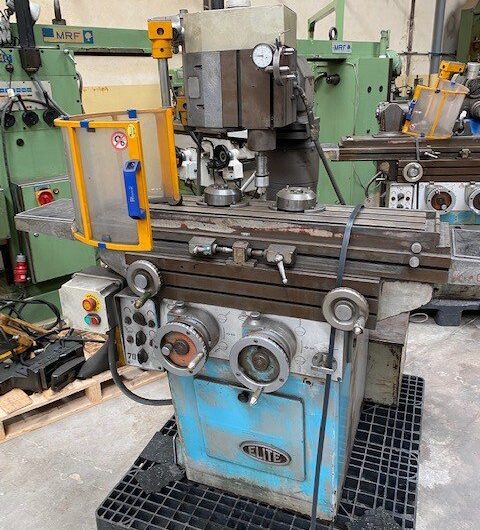
If you run a sharpening, tool maintenance or grinding workshop, you know that a good grinder is the difference between a correct edge and a scrapped part. Elite grinding machines have been a fixture in Spanish workshops for decades thanks to their mechanical robustness and ease of maintenance, which makes them one of the most sought-after options on the used machinery market. In this guide we cover what characterises used Elite tool grinders, which ranges and models show up most often on the Spanish second-hand market, what to check before signing off on a purchase, and which type of workshop they suit best. If you are considering adding one of these machines to your production line, here you will find the technical criteria that actually matter before you decide.
Throughout the article we will also look at a comparison of ranges, the most common mistakes when buying used grinding equipment, a realistic price outlook for 2026, and recommendations based on buyer profile.
What sets an Elite grinder apart in the used machinery market?
The Elite brand earned its reputation in the grinding sector by building robust, ribbed cast-iron beds capable of absorbing the vibrations generated when the abrasive wheel contacts the tool being sharpened. This structural rigidity is precisely what allows tight tolerances to be maintained over years of intensive use, something especially noticeable in units that are 15 or 20 years old and, after a proper overhaul, still deliver hundredth-of-a-millimetre precision on the edge. Unlike other brands more focused on series production, Elite committed to a semi-universal design that combines versatility with simple handling, which explains why so many workshops sharpening cutting tools, drills, mills and industrial blades still run these machines today.
Another defining trait is the availability of mechanical spare parts: spindles, bearings, belts and wheel-mounting components are still available or can be custom-made by Spanish grinding workshops, which significantly extends the service life of these grinders compared with imported brands whose spare parts are harder to source. This makes a used Elite grinder a long-term investment, provided the specific unit has received reasonable maintenance throughout its working life.
Which Elite grinder ranges and models appear most often on the used market?
Three main families of Elite grinding machines coexist in the Spanish used machinery pool: the universal range, designed for sharpening mills, drills and cutting tools of varying geometry via a swivelling head and a table with longitudinal and transverse travel; the industrial cutting-tool range, aimed at inserts, blades and large-format tooling with wheel diameters of up to 400 mm; and a more compact range, common in in-house maintenance departments at metalworking plants, with shorter beds and motor outputs between 0.75 and 1.5 kW. Each one answers a different production need, so it is worth identifying what type of tool you will be sharpening most often before settling on a specific model.
Universal models usually include graduated dividing heads that allow grinding angles to be repeated precisely, a feature particularly valued by workshops running short series of special tools. On the larger cutting-tool range, the wheel spindle is typically mounted on high-speed precision bearings, which reduces heat build-up in the workpiece during grinding and prevents the steel’s temper from being affected. If you want to see which units are currently available, take a look at the Valcomaq catalogue of used Elite grinding machines, where stock is updated constantly.
What should you check before buying a used Elite grinder?
The first thing to inspect is the condition of the wheel spindle: any noticeable play when moving the wheel with the machine switched off is a sign of worn bearings, which translates directly into a loss of precision on the finished edge. It is also worth checking the condition of the mounted abrasive wheels: if they are unevenly worn, unbalanced or cracked, they will need replacing immediately, and that is a cost to factor into price negotiations. The table feed system, whether manual via handwheel or motorised, should move smoothly without jumps or stiff spots; an uneven feed leaves visible grinding marks and forces the operator to pass the tool over several times.
Equally important is checking the bed and ways for wear or deep scoring, a sign the machine has run for years without proper lubrication. You should also start the motor and confirm there are no abnormal noises, excessive vibration or premature overheating after a few minutes of running. Finally, always ask for the maintenance history and, if possible, request a real grinding test on a sample tool before closing the deal; it is the most reliable way to verify the machine’s actual precision under real working conditions.
How do the different Elite grinder ranges compare?
To make the decision easier, it helps to put the indicative specifications of each range side by side, since differences in wheel diameter, precision and application directly determine what type of work each machine can handle.
| Elite range | Wheel diameter | Indicative precision | Typical application | Motor power |
|---|---|---|---|---|
| Universal | 150 – 250 mm | ± 0.01 – 0.02 mm | Mills, drills, taps | 0.5 – 1 kW |
| Cutting tools | 250 – 400 mm | ± 0.01 mm | Industrial blades, inserts | 1 – 2.2 kW |
| Compact maintenance | 125 – 200 mm | ± 0.02 – 0.03 mm | In-house workshop tools | 0.75 – 1.5 kW |
Which workshops are best suited to a used Elite grinder?
Tool-sharpening workshops serving external machine shops find the universal range a versatile machine capable of handling varied jobs without needing to reconfigure the machine for every type of tool. In-house maintenance departments at automotive, foundry or metal carpentry plants, meanwhile, tend to favour the compact models, since their daily workload does not justify investing in higher-capacity equipment, but they still need day-to-day reliability to keep their own production tools operational. Finally, companies working with large-format inserts and blades for presses, shears or industrial cutting lines require the cutting-tool range, with larger wheel diameters and more powerful motors to handle bigger workpieces without losing precision.
In every case, buying a used grinder instead of a new one frees up budget for accessories, replacement wheels or operator training, without sacrificing the precision demanded by daily work. This is precisely why so many Spanish workshops, from small family businesses to medium-sized production plants, keep choosing reconditioned machinery from established brands like Elite.
What maintenance does an Elite grinder need to keep its accuracy?
Preventive maintenance on an Elite grinder does not require major infrastructure, but it does require consistency. Regular lubrication of the ways and spindle is essential to prevent premature wear, as is regular balancing of the abrasive wheel, which should be checked every time it is replaced to avoid vibrations that affect the finish of the edge. It is also advisable to clean the coolant system if the machine has one, since grinding debris tends to build up and can clog the lines, reducing cooling efficiency and accelerating wheel wear.
A good habit is to keep a simple log of operating hours and wheel replacements, so you can anticipate when bearings or drive belts need inspecting. Reconditioned Elite grinders that come to the used market with this kind of documented history tend to present fewer surprises once installed in the new workshop, and it is well worth asking the seller for this information before closing any deal.
What are the most common mistakes when buying a used grinder?
One of the most frequent mistakes is focusing only on the sale price without factoring in the cost of bringing the machine up to standard: a cheap machine with a worn spindle or a damaged wheel can end up costing more than a unit that was properly inspected from the start. Another common error is failing to check the electrical voltage and motor type, especially on older units that may need adapting if the workshop runs a different three-phase setup to the machine’s original configuration. It is also common to underestimate the space and foundation required: although grinders do not usually need beds as heavy as a lathe or milling machine, they do need a level surface free of external vibration to guarantee grinding precision.
Finally, many buyers skip a practical demonstration before purchasing, relying only on photographs or descriptions. Whenever possible, it is advisable to see the machine running, check the spindle noise, assess the stability of the feed and, if the seller allows it, carry out a grinding test on a real tool to evaluate the finish obtained.
How much does a used Elite grinder cost in 2026?
Prices for used Elite tool grinders vary considerably depending on the range, condition, and whether the machine has been professionally reconditioned or sold as-is without inspection. Compact in-house maintenance models in good working order but without a full overhaul tend to sit at the more affordable end, while units from the cutting-tool range, with larger wheel diameters and more powerful motors, command higher prices, especially when they include original precision dividing heads and accessories in good condition. A fully inspected grinder, with a checked spindle, a new wheel and a working guarantee, will always cost somewhat more than an unchecked unit, but it drastically reduces the risk of unexpected breakdowns in the first few months of use.
At Valcomaq we work with reconditioned, tested machinery before it goes on sale, which allows us to offer a fair price in line with each machine’s real condition. If you want to know the indicative price of the unit currently available, the best approach is to check the stock directly or request personalised information about the model that best fits your production needs.
Which buyer profile fits each type of Elite grinder?
Choose the universal range if: your workshop takes on varied sharpening jobs for third parties, you need to work with mills, drills and taps of different diameters, and you value versatility over specialising in a single type of tool. This range lets you adapt to one-off orders without investing in several different machines.
Choose the cutting-tool range if: your core business revolves around sharpening industrial blades, large-format inserts or cutting tools for heavy production lines, and you need a larger wheel diameter together with motor power that can handle bigger workpieces without losing stability or edge precision.
Choose the compact range if: you are looking to equip the in-house maintenance department of your factory or workshop, with a moderate grinding workload focused on keeping your own production tools operational, prioritising simple handling and a lower purchase cost.
Choose a reconditioned unit over an unchecked one if: you do not have in-house technical staff capable of diagnosing and repairing spindle or feed-system wear, and you would rather start production from day one with guarantees on the machine’s real condition.
Valcomaq, your trusted partner for used grinders with a warranty
We have spent over twenty years buying, reconditioning and selling used industrial machinery, and we know that a properly serviced grinder is a working tool that needs to perform from day one. That is why every machine that leaves our facility goes through a full mechanical and electrical inspection, so it arrives at your workshop ready to run without surprises. If you are considering adding an Elite grinder to your production line, check out the catalogue of used Elite grinding machines available at Valcomaq and request all the technical information you need before deciding.
Our grinder catalogue is updated constantly, so we recommend checking current stock of used Elite tool grinders before making a decision. If you have questions about which model best fits your production, need financing, transport, or a valuation of your own machinery as part payment, contact us and we will advise you with no obligation so you can find the grinder your workshop really needs.