

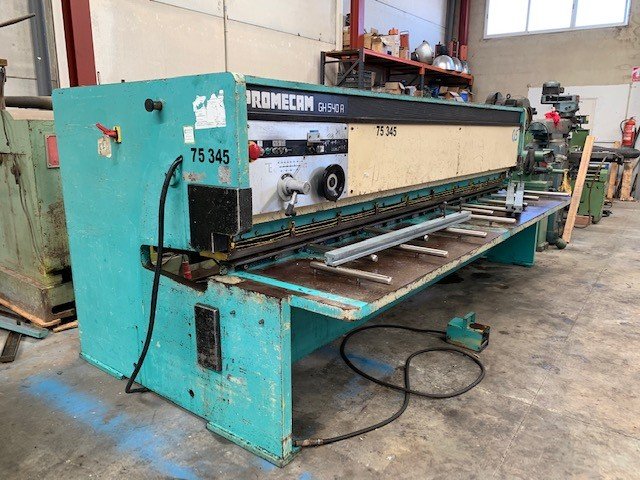
When a sheet metal workshop needs long-term reliability, the French brand Promecam almost always comes up among the options recommended by experienced technicians and buyers. Used Promecam shears have earned a reputation for robustness and precision thanks to decades of manufacturing aimed at heavy European industry. In this article we go through their technical features, compare their performance against brands like Durma, Ajial and Loire, and explain what type of workshop gets the most benefit from adding one of these reconditioned machines to its floor. We also look at what to check before buying, how to keep it in top condition, and what price range to expect depending on the machine’s condition and capabilities.
If you work with steel, stainless steel or aluminium sheet and are looking for a straight-cut solution with many years of service life ahead, understanding what sets Promecam apart from other second-hand market brands will help you make an informed decision and avoid surprises after the purchase.
What is a Promecam shear and what sets it apart in the industrial market?
Promecam is a French manufacturer with a long track record in sheet metal forming machinery, particularly well known for its hydraulic guillotine shears and press brakes. Its design philosophy is built on thick cast-iron beds, oversized hydraulic systems and special attention to structural rigidity, which reduces blade deflection during cutting and guarantees straight cuts even on long sheets. This solidity is why so many used Promecam shears, built twenty or thirty years ago, are still running in European workshops with barely any mechanical play.
Unlike manufacturers that prioritise production volume, Promecam historically favoured smaller production runs and higher-quality components, which translated into a higher original purchase cost but also a longer service life. On the second-hand market this means machines that, once properly reconditioned, deliver cutting tolerances very close to those of a new shear — something especially valued in sectors where the dimensional accuracy of the cut part is critical before moving on to bending or welding processes.
What technical features stand out in Promecam shears?
Promecam shears are typically available in cutting lengths between 2000 and 6000 mm, with thickness capacities ranging from 4 mm in high-strength steel up to 25 mm in standard carbon steel, depending on the model and installed hydraulic power. The cutting system includes an adjustable rake angle, allowing the cutting force to be tailored to the thickness and hardness of the material, reducing sheet deformation at the ends. Many units also feature a table crowning system that compensates for the natural deflection of the bed during long cuts, ensuring an even cut across the full width of the sheet.
As for controls, it’s not uncommon to find used Promecam shears fitted with numerical controllers such as Cybelec or ESA, managing programmable back-stroke, back-gauge position and cutting angle selection from a touchscreen. The hydraulic system, generally rated between 15 and 45 kW depending on tonnage, provides approach and cutting speeds regulated via a variable-speed drive, which reduces blade wear and improves the finish of the cut edge — a detail highly valued on parts destined for structural welding.
Cutting precision and durability: the Promecam hallmark
Promecam’s reputation rests on two pillars: repeatable precision and structural durability. The rigidity of its ribbed cast-iron beds minimises torsion when cutting thick sheets, resulting in very tight perpendicularity and parallelism tolerances even after years of intensive use. This precision is especially relevant in workshops fabricating boilermaking parts that are later assembled by robotic welding, where an uneven cut can cause cumulative misalignment in the final assembly.
Durability, in turn, comes down to the quality of the original hydraulic components and the relatively simple maintenance of the blade system, which in most models allows up to four re-grindings per blade set before replacement. When a Promecam shear goes through a thorough reconditioning process — including checking the hydraulic seals, calibrating the cutting system and replacing worn blades — the result is a machine that performs almost on par with a new unit, but at a fraction of its original price.
How do Promecam shears compare with Durma, Ajial and Loire?
In the used hydraulic shear segment, Durma stands out for its strong balance between modern CNC technology and price, making it a very competitive choice for workshops that prioritise automation. Ajial, of Spanish origin, offers robust, straightforward machines that are highly appreciated for their ease of maintenance in workshops with less technical infrastructure. Loire, also French, shares some of Promecam’s construction philosophy, although its ranges are generally geared towards somewhat lower thicknesses. Promecam positions itself as the benchmark choice when the priority is sustained cutting precision over time and the ability to handle thicker sheets without sacrificing accuracy.
| Brand | Origin | Strength | Typical capacity | Ideal workshop profile |
|---|---|---|---|---|
| Promecam | France | Precision and structural rigidity | Up to 25 mm in carbon steel | Precision boilermaking and long production runs |
| Durma | Turkey | Accessible CNC automation | Up to 20 mm | Workshops seeking digitalisation |
| Ajial | Spain | Simplicity and easy maintenance | Up to 16 mm | General workshops with tight budgets |
| Loire | France | Solid build quality | Up to 20 mm | Medium-volume production with standard sheet |
Which sheet metal workshops benefit most from a Promecam shear?
Structural boilermaking workshops working with medium to heavy thicknesses, and needing to repeat identical cuts across long production runs, are the ones that get the most out of a Promecam shear’s rigidity. The absence of bed deflection keeps tolerances stable throughout the working day, which translates into fewer rejected parts and less adjustment time between batches. Manufacturers of metal structures for construction, cutting long-length sheet destined for welded profiles, also find in Promecam the reliability needed to avoid compromising the final geometry of the part.
Another profile that benefits particularly well is subcontract workshops serving several clients with different specifications, since the versatility in rake and speed adjustment allows the machine to adapt to very different materials, from stainless steel to soft aluminium, without losing cutting quality. On the other hand, workshops with very occasional needs or low production volumes might not make the most of a machine in this range, and would be better served by lower-tonnage equipment or brands geared towards sporadic production.
What should you check before buying a used Promecam shear?
Before closing the purchase of a used Promecam shear, it’s worth checking the condition of the blades, verifying how many usable edges remain and whether there are nicks or uneven wear. It’s also important to check the hydraulic system: cylinder leaks, hose condition, and actual working pressure against the manufacturer’s specification. The calibration of the cutting angle and the parallelism between the upper and lower blade should be checked with a test cut, since any deviation here translates directly into defective cuts.
It’s also advisable to request the maintenance history and, if possible, the year of manufacture and estimated hours of use. A serious reconditioned machinery supplier should be able to show the inspection process carried out, including seal replacement, checks of the electrical and control system, and an actual test cut on sheets of different thicknesses. Buying without this prior verification is one of the most common mistakes when purchasing second-hand machinery, and can end up generating repair costs that wipe out the initial savings.
Maintenance and service life of a reconditioned Promecam shear
Once on the shop floor, maintaining a Promecam shear is relatively straightforward if basic guidelines are followed: periodic checks of hydraulic oil level and quality, greasing of the cutting table guides, and checking blade tightness after the first cycles of intensive work. The electrical system, especially in models with Cybelec or ESA control, requires regular cleaning of the control cabinets to prevent metal dust build-up — a common issue in cutting workshops that can affect the reliability of position sensors.
With proper maintenance, it’s not unusual for a well-reconditioned Promecam shear to deliver two or even three additional decades of active service, especially if the original hydraulic system has been replaced with modern components that improve energy efficiency without altering the mechanical structure. This exceptionally long service life is one of the strongest arguments in favour of investing in a well-inspected used unit rather than a new, entry-level machine, whose service life tends to be considerably shorter.
How much does a used Promecam shear cost?
The price of a used Promecam shear varies notably depending on cutting length, tonnage, the type of control installed and the overall reconditioning standard. Compact models up to 3000 mm with medium thicknesses can be found at prices accessible to small workshops, while larger units with full CNC and capacities above 15 mm in steel reach higher prices, comparable to those of a new entry-level machine but with far superior performance.
In any case, price should always be weighed against the condition of the blades, the age of the hydraulic system, and whether the machine has gone through a full overhaul. A cheaper shear without proper inspection can end up costing more in the medium term through repairs and production downtime, while a unit reconditioned by a specialist supplier offers performance guarantees from the very first day on the shop floor.
Which shear should you choose for your workshop’s needs?
Choose a Promecam shear if: your workshop runs long production series, needs to maintain very tight tolerances throughout the whole working day, and regularly cuts medium to heavy sheet thicknesses. The rigidity of its bed and the quality of its hydraulic components make it the most reliable long-term option for structural boilermaking and the manufacture of parts destined for welding.
Choose a Durma shear if: your priority is having a modern, accessible CNC system with simple programming of repetitive cuts, and you’re looking for a machine that combines automation with an affordable price on the second-hand market.
Choose an Ajial shear if: your workshop has a moderate workload, you prefer a machine that’s simple to operate without excessive electronic complexity, and you value ease of maintenance above other more advanced features.
Choose a Loire shear if: you’re looking for a solidly built French alternative, with balanced performance for standard thicknesses, and you value a construction heritage similar to Promecam but in a somewhat more moderate tonnage range.
Choose a higher-tonnage Promecam shear if: your production regularly includes thick sheet and you can’t afford downtime caused by premature blade wear or loss of precision on long cuts.
Used Promecam shears at Valcomaq: a safe bet for your workshop
At Valcomaq, we inspect every machine that enters our catalogue, checking the hydraulic system, blade condition and cutting calibration before making it available to our customers. Our more than twenty years of experience in the industry allow us to identify which machines offer the best balance of price, precision and durability, and to advise each workshop according to its production volume and the type of material it typically works with.
If you’re considering adding a robust, precise shear to your cutting line, we invite you to explore our catalogue of used industrial machinery, where you’ll find used Promecam shears alongside other brands such as Durma, Ajial and Loire, all inspected and ready to work. Our technical team can help you choose the right model based on your tonnage, cutting length and control-type requirements, so don’t hesitate to contact us for personalised advice and a no-obligation assessment of your project.