

When a machine shop needs to expand its drilling capacity without blowing the budget, used Foradia drills come up again and again as one of the most sought-after options on the second-hand industrial machinery market. These are rugged machines, built for heavy-duty use, with a reputation for reliability that has held up decade after decade in boilermaking, metalworking and structural fabrication shops. In this guide we look at what sets the brand apart, which ranges and models show up most often on the resale market, which technical points to check before closing a deal, and which type of workshop gets the most value out of one. We will also cover ballpark 2026 pricing, common mistakes buyers make, and how to extend the service life of these machines once they are running on the shop floor.
What makes used Foradia drills stand out in the industrial market?
The Foradia brand has earned a solid reputation among manufacturers of column drills and radial arm drills built for heavy work, particularly in boilermaking and structural steel fabrication. Its machines are known for a heavy cast-iron bed, which reduces vibration during machining and keeps tolerances tight even when working with large-diameter bits. Unlike models aimed at smaller shops, Foradia drills typically feature multi-step mechanical gearboxes designed to handle everything from hardened steel to cast iron and aluminium.
Another defining trait is the durability of the internal components: hardened spindles, oversized bearings and centralised lubrication systems that make preventive maintenance straightforward. That is why it is common to find units on the second-hand market with over twenty years of service that, after a proper overhaul, still deliver accurate work. Buying a used Foradia drill does not mean giving up reliability — it means taking advantage of a machine originally built to last, at a fraction of the cost of an equivalent new unit.
Which Foradia ranges and models turn up most often on the second-hand market?
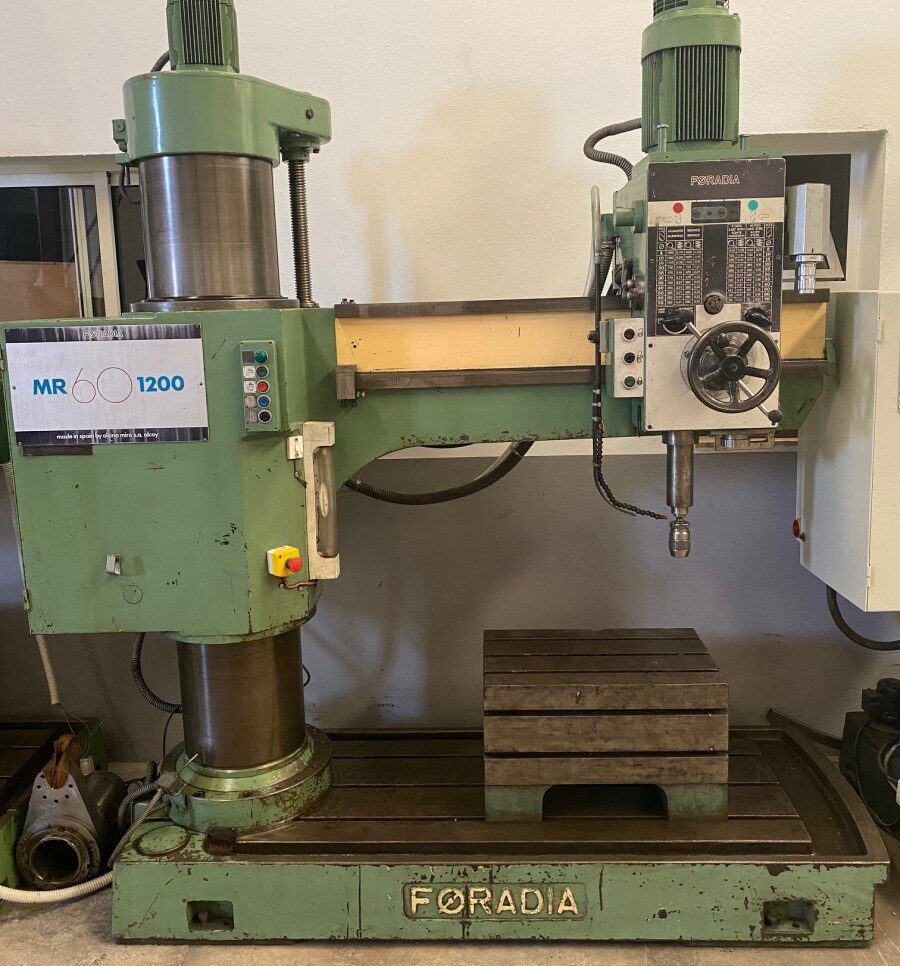
Two main families of the brand circulate on the used equipment market: bench or floor-standing column drills, aimed at medium-diameter drilling in general-purpose shops, and large-capacity radial arm drills, designed to work on oversized parts that cannot easily be moved under the spindle. Radial models typically offer arm travel of 1,000 to 2,000 mm, with columns capable of rotating a full 360 degrees, allowing the drilling head to be positioned over any point on a bulky workpiece without having to reposition it on the table.
Within these ranges, typical drilling capacity in steel runs from 40 to 80 mm in diameter, and can exceed 100 mm in grey cast iron depending on the main motor power. Many units currently on the used market feature adjustable power feed and automatic tapping via reverse rotation — functions that were once cutting-edge and are still highly valued today because they cut cycle time and reduce operator fatigue. It is also common to find variants with rotating and tilting tables, built for angular drilling on heavy boilermaking parts.
What should you check before buying a used Foradia drill?
The first checkpoint on any used industrial drill press is the condition of the main spindle. Make sure it shows no excessive axial or radial play, that the tool-holding taper is not damaged, and that it moves down smoothly through its full travel without binding or unusual noise. A worn spindle translates directly into lost concentricity and bits that wander during drilling — a defect that is very expensive to fix once the machine is in production.
The second critical point is the power feed system: check that the feed gearbox gears are not excessively worn, that the selector levers engage correctly, and that the clutch does not slip under load. It is also worth starting the main motor and confirming that the rated power matches stable operation at each speed, with no drop in RPM or unusual heat build-up after several minutes of continuous use. Inspecting the column, checking the base is level, and confirming there are no cracks in the casting are all essential before finalising any purchase.
Foradia drills vs. other common brands on the used machinery market
Before settling on a specific brand, many shops compare several options available on the second-hand market. The table below summarises the most common differences between Foradia and other brands frequently found in this segment, based on drilling capacity, bed robustness and spare parts availability.
| Brand | Typical capacity in steel | Bed robustness | Spare parts availability | Recommended workshop profile |
|---|---|---|---|---|
| Foradia | 40 to 80 mm | Very high | Good, standardised components | Boilermaking and heavy parts |
| Erlo | 30 to 60 mm | High | Good | General-purpose workshop |
| Soraluce | 60 to 100 mm | Very high | Average, more specific units | Heavy industrial machining |
| Generic Asian brands | 20 to 40 mm | Average | Limited | Small or occasional-use shops |
Which workshops benefit most from a Foradia drill?
Heavy boilermaking and structural steel shops find a natural ally in Foradia drills, since their ability to drill bulky parts without moving them under the spindle noticeably speeds up production times. On steel structures, crane arms, hoppers or tanks, the ability to swing the radial arm a full 360 degrees around the column avoids constant repositioning and reduces the risk of misalignment between consecutive holes on the same part.
These machines are also highly valued by industrial maintenance workshops that need versatility to work on parts of very different shapes and sizes, from flanges and base plates to heavy machinery components. The combination of high drilling capacity, bed robustness and an affordable purchase price on the used market makes these machines a great fit for industrial SMEs that need a versatile machine without the cost of a brand-new high-end unit.
What are the most common mistakes when buying a used industrial drill press?
One of the most frequent mistakes is not checking the real condition of the spindle under load, relying only on a visual inspection while the machine idles. A spindle can look fine spinning without a tool and still show clear play as soon as it is put under real drilling pressure. Another common error is failing to verify the machine’s history and maintenance records: a unit that has worked in a harsh environment, with poorly managed coolant or irregular greasing, can hide far more internal wear than a simple repaint suggests.
It is also common to underestimate the importance of electrical supply and space requirements: a large-capacity radial drill needs a level, properly anchored base as well as an electrical supply matched to the main motor’s power. Buying without checking these details beforehand can lead to installation overruns that eat into the savings gained from buying second-hand. That is why it always pays to buy through a supplier that offers the machine inspected, tested, and backed by clear guarantees on its working condition.
How to extend the service life of a reconditioned Foradia drill?
Once installed on the shop floor, preventive maintenance is key to keeping a used Foradia drill accurate for many years to come. This includes periodic checks of the centralised lubrication system, regular cleaning of the guides and column to prevent chip and coolant build-up, and periodic checks of the bed anchor bolts. It is also worth checking the condition and tension of the drive belts, since undetected wear can lead to gradual power loss.
It is advisable to keep a simple log of running hours and oil or grease changes at critical points, and to train operators in the correct use of the power feed to avoid overloading the clutch system. With proper maintenance, it is not unusual for a reconditioned Foradia drill to deliver another decade of productive service, which only reinforces the brand’s appeal in the used industrial machinery market.
How much does a used Foradia drill cost in 2026?
The price of a used Foradia drill mainly depends on three factors: drilling capacity, the overall condition of the spindle and bed, and whether the unit includes features such as power feed or automatic tapping. In the domestic used industrial machinery market, medium-capacity column drills can be found at accessible prices, while large-capacity radial models with rotary tables and high power command higher figures — though always well below the cost of an equivalent new machine.
At Valcomaq, after a full technical inspection of each unit, the final price reflects both the real condition of the machine and the features it includes, so the buyer gets a machine ready to produce from day one, backed by a professional reconditioning process. Check our current stock to see up-to-date indicative prices, since unit availability changes frequently.
Frequently asked questions about used Foradia drills
Is it safe to buy a Foradia drill that is over fifteen years old? Yes, as long as the machine has received proper maintenance and has been inspected by a professional before sale. The rugged construction of these machines means that, after replacing wear parts such as bearings or belts, performance can be practically on par with a much newer unit.
Do I need special installation for a Foradia radial drill? In general, a level base, anchors suited to the machine’s weight, and a three-phase electrical supply matched to the motor’s power are enough. At Valcomaq we advise on these requirements before shipping, so start-up at your facility is as smooth as possible.
Which option should you choose depending on your workshop?
Choose a Foradia column drill if: your shop mainly works with medium-sized parts and you need a versatile, compact machine that is easy to fit into a facility with limited space, without giving up the brand’s characteristic robustness.
Choose a Foradia radial drill if: your work is focused on heavy boilermaking, steel structures or bulky parts that are difficult to move, since the rotating radial arm lets you position the spindle over any point on the workpiece without shifting it.
Choose a model with power feed and automatic tapping if: your production includes repetitive drilling and tapping runs, where cutting cycle time and operator fatigue delivers a direct improvement in daily shop productivity.
Choose to buy through a specialist like Valcomaq if: you value the peace of mind of acquiring a machine that has been inspected, comes with clear guarantees on its condition, and includes technical advice before, during and after the purchase — avoiding the common risks of buying used machinery without a specialised intermediary.
Valcomaq, your specialist in used Foradia industrial drills
At Valcomaq we have over twenty years of experience buying, reconditioning and selling second-hand industrial machinery, including several Foradia drills that have been inspected and are ready to work. Every machine goes through a full technical inspection process before leaving our facility, ensuring the spindle, feed system and main motor all perform to the brand’s original specifications. You can browse our updated catalogue of used Foradia drills to see which units are available right now, along with detailed technical specifications and condition reports. You can also check our full range of used industrial drill presses if you are open to other brands. If you are considering adding an industrial drill to your shop, whether column or radial, contact us and we will advise you at no obligation on the best option for your production needs, part dimensions and available budget.