

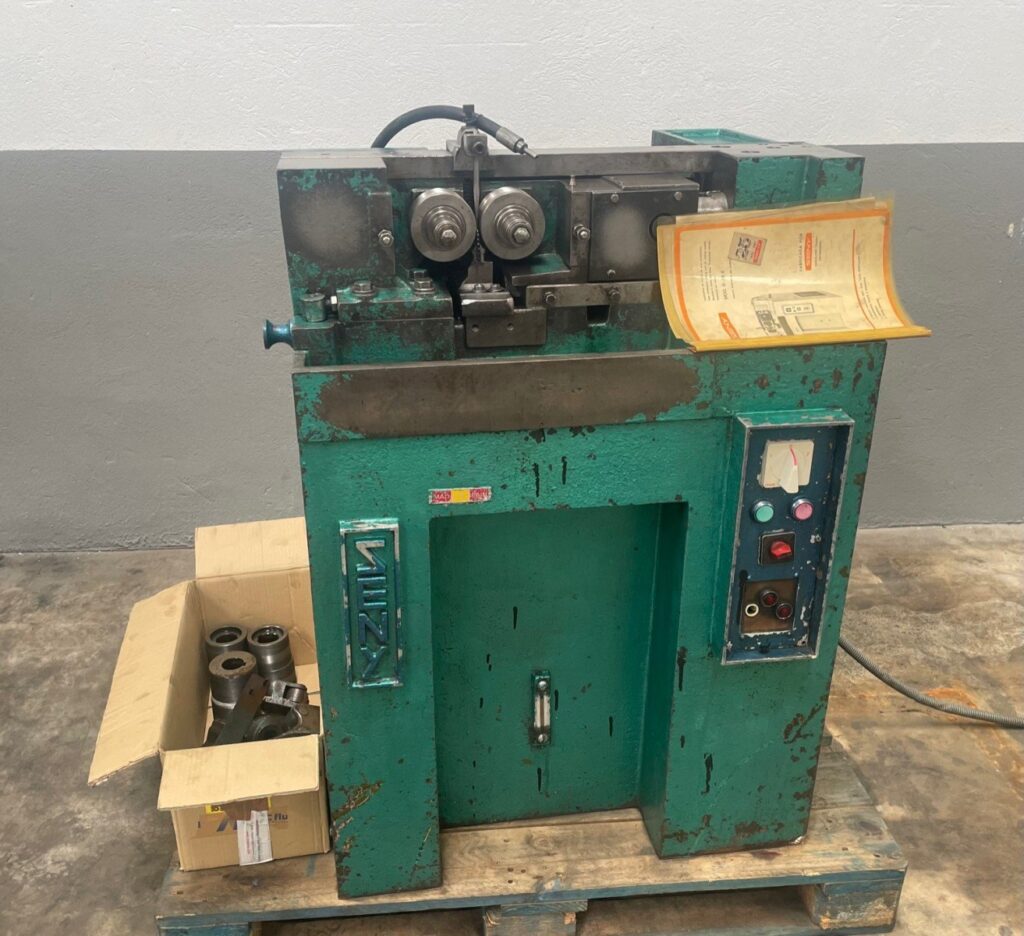
Used Seny thread rolling machines are among the most sought-after equipment for machine shops, fastener manufacturers and subcontracting companies that need to produce high-strength threads without chip removal. Seny has been building rugged production equipment for decades, and the second-hand market offers an attractive way to access this technology at a fraction of the cost of a new machine. In this guide we cover what sets Seny machines apart from other brands, which ranges and models show up most often on the used market, which components need to be inspected before closing a deal, and which type of workshop gets the most value out of this kind of equipment. We also look at indicative pricing, common buying mistakes and maintenance, so your purchase decision is as informed as possible.
If you are considering adding a thread rolling machine to your production line, understanding the differences between ranges and the importance of each mechanical component will save you headaches and downtime once the machine is installed in your workshop. Let’s break it down step by step.
What sets Seny thread rolling machines apart from other brands?
Seny has built a strong reputation in the Spanish and international markets for producing thread rollers with heavy cast-iron beds designed to absorb cold-forming forces without losing geometric precision over the years. Unlike manufacturers that prioritise cycle speed, Seny has historically focused on structural robustness and highly reliable hydraulic or mechanical drive systems, which explains why units more than twenty years old are still fully operational on the second-hand market. This durability is one of the reasons workshops inspecting a used Seny thread rolling machine usually find the bed and guideways in excellent condition, even when other auxiliary components need a tune-up.
Another distinguishing feature of Seny compared with brands such as Escofet, Mecanotecno or high-end German manufacturers is the versatility of its roller systems, which allow the machine to work with either cylindrical rollers or flat dies depending on the model and configuration, adapting to both short runs and continuous production. Many Seny machines also incorporate adjustable feed systems that make it possible to roll parts of varying lengths and diameters without changing the entire tooling set-up, a practical advantage for shops manufacturing several fastener, stud or threaded-rod references throughout the month.
Which Seny ranges and models appear most often on the used market?
Three main families of Seny thread rolling machines tend to show up on the Spanish used-equipment market. The first is the compact range, aimed at small and medium diameters, typically 3 to 30 mm, very common in standard fastener shops and fixing-element manufacturers. The second is the intermediate range, with capacities of up to 60-80 mm in diameter, usually featuring hydraulic roller closing and tighter control over rolling pressure, ideal for studs, threaded rods and heavy-duty automotive parts. The third range, less frequent on the second-hand market due to lower turnover, covers large-capacity equipment capable of rolling up to 100-150 mm in diameter, built for sectors such as civil engineering, rail and structural anchoring.
Within these ranges, the models most commonly found on the used market are usually identified with RH and RL-type designations followed by a number indicating the maximum capacity in millimetres, sometimes paired with digital controls added later by refurbishment specialists. It is common to find units with motor outputs between 7.5 and 30 kW depending on capacity, multi-tonne cast-iron beds, and centralised lubrication systems that extend roller life. At Valcomaq we inspect every unit before putting it up for sale, checking the condition of the rollers, spindles and hydraulic system, and you can check current availability in Valcomaq’s catalogue of used Seny thread rolling machines, which is updated as inspected units come in and go out.
Which components should you check before buying a used Seny thread roller?
The first inspection point should be the condition of the rollers or flat dies, since their wear directly determines the quality of the resulting thread profile. A worn roller produces threads with a poorly formed crest or burrs, and replacement can be costly if the specific model is no longer in production. You should also check the closing and pressure system, whether hydraulic or mechanical, making sure there are no oil leaks, that the solenoid valves respond correctly and that pressure remains stable throughout the full rolling cycle, since irregular pressure directly affects thread dimensional accuracy.
Another critical aspect is the condition of the guideways and sliding carriages, which must move without play or sticking; excessive clearance in these guideways results in off-centre threads or irregular pitch. You should also check the lubrication and cooling system, essential for preventing roller overheating during long runs, along with the electrical cabinet and emergency-stop automatisms, which must comply with current machine safety regulations. Finally, it is advisable to request an actual rolling test on a part of known diameter before closing the deal, something Valcomaq always makes possible whenever a buyer requests it, since we consider a hands-on test the best guarantee that the machine performs as expected.
| Seny Range | Working Diameter | Drive Type | Recommended Use |
|---|---|---|---|
| Compact | 3 – 30 mm | Mechanical | Standard fasteners, short runs |
| Intermediate | 30 – 80 mm | Hydraulic | Studs, heavy-duty automotive |
| Large capacity | 80 – 150 mm | Reinforced hydraulic | Civil engineering, rail, anchoring |
Which type of workshop benefits most from a used Seny thread roller?
Fastener and fixing-element manufacturers are undoubtedly the ones who see the fastest return on investment with a Seny thread roller, since cold-formed threading significantly improves the fatigue resistance of the part compared with cut threading, while also reducing material consumption and cycle time. Manufacturers of studs, threaded rods and construction anchoring elements also benefit enormously, since thread mechanical strength is a regulatory requirement in that field and cold rolling provides a surface hardening that conventional machining cannot offer.
Subcontracting workshops serving the automotive, agricultural machinery or capital goods sectors find in these machines a way to diversify their service offering without expanding their workforce, since the rolling process is fast and, once the tooling is set, requires little supervision. On the other hand, a workshop with very low volume and highly variable part geometry may not recoup the investment as quickly, and in those cases it may be more reasonable to stick with conventional threading on a lathe or milling machine, unless demand for threaded parts is expected to grow in the coming years.
How much does a used Seny thread rolling machine cost in 2026?
The price of a used Seny thread rolling machine varies considerably depending on the range, year of manufacture, roller condition and whether the unit has been refurbished by a specialist. In 2026, a compact-range unit with diameters up to 30 mm, in good general condition with usable rollers, usually falls within a bracket considerably more affordable than an equivalent new machine, while an intermediate-range machine with hydraulic drive and greater capacity involves a higher investment, though still well below the cost of a new machine with similar performance. Large-capacity units, being less common on the second-hand market, tend to hold a higher price due to specific demand from sectors such as rail and civil engineering.
Beyond the purchase price, it is worth budgeting for transport costs, possible roller replacement if heavily worn, and a supervised start-up, especially if the machine has been idle for a long time. At Valcomaq we always carry out a pre-sale inspection that allows us to offer a price fairly aligned with the real condition of the equipment, avoiding surprises once the thread roller is installed in your workshop.
What are the most common mistakes when buying a used thread rolling machine?
One of the most frequent mistakes is focusing solely on price without assessing the real condition of the rollers, which represent a very significant part of the total cost of ownership in the medium term. Buying a cheap machine with rollers at the end of their service life can lead to a tooling expense that matches or exceeds the initial savings. Another common mistake is failing to check whether the thread pitch and profile your workshop needs is compatible with the roller configuration available on the machine, since changing profile may require specific tooling not always included in the sale.
It is also common to underestimate the space and electrical installation required, especially for intermediate and large-capacity units with high-power motors and hydraulic systems that need an appropriate three-phase supply and, in some cases, an oil cooling system. Finally, many buyers skip requesting a working demonstration before closing the deal, which prevents them from checking aspects such as vibration levels, noise during the cycle or rolling pressure stability, variables that can only be detected by watching the machine operate.
What maintenance does a Seny thread roller need to keep performing well?
Maintenance of a Seny thread rolling machine mainly focuses on constant lubrication of rollers, guideways and the hydraulic system, following the intervals recommended by the manufacturer based on hours of use. It is advisable to regularly check the hydraulic oil condition and replace it when it loses viscosity or shows metallic particles, a sign of internal wear in pumps or valves. Rollers should also be visually inspected after each batch change, detecting micro-cracks or asymmetric wear that could affect thread quality before the problem becomes visible on the finished part.
Well-planned preventive maintenance, combined with use within the diameter and material hardness parameters recommended by Seny, allows these machines to remain operational for decades, as shown by the number of units from the 1990s and 2000s still running in workshops across Spain. This longevity is precisely one of the strongest arguments in favour of buying a used Seny thread roller instead of opting directly for a new machine from a brand with less proven track record.
Which thread rolling machine should you choose based on your production type?
Choose a compact range if: your production focuses on standard fasteners, short studs or small-to-medium diameter parts, and you need an affordable machine that is easy to install in a workshop with limited space and low operating costs.
Choose an intermediate range with hydraulic drive if: you work with larger-diameter parts, need longer production runs and value more precise pressure control to ensure thread consistency in output destined for automotive or capital goods applications.
Choose a large-capacity range if: your activity is oriented towards civil engineering, rail or structural anchoring manufacturing, and you need to roll large diameters with maximum mechanical strength in the resulting thread.
Choose to buy from Valcomaq if: you are looking for real guarantees on the condition of the machine, a pre-sale inspection, advice on which model fits your production, and the chance to see the machine running before you decide.
Used Seny thread rolling machines in Valcomaq’s catalogue
At Valcomaq we work with inspected, ready-to-run used metalworking machinery, and Seny thread rolling machines are a regular part of our inventory thanks to the reliability they offer over the years. We keep several units available across different ranges, inspected by our technical team before going up for sale, which allows us to offer competitive prices without compromising on a guaranteed correct performance from day one in your workshop.
You can check current stock of used Seny thread rolling machines directly in our catalogue, where available models are updated as equipment comes in and goes out. If your project requires a different brand or range, you can also browse the full category of used thread rolling machines to compare alternatives before making a decision. We also buy used industrial machinery, so if you are looking to sell your equipment instead, take a look at our we buy your machine page. And if you have any questions about which model best suits your production, contact us: our team will advise you with no obligation and help you find the used Seny thread rolling machine that truly fits your workshop’s needs.