

In the Spanish used machinery market, few comparisons raise as many questions as used Gurutzpe vs Pinacho lathes. Both manufacturers have been building parallel lathes in Spain for decades and enjoy a similar reputation among machine shops, which makes it difficult for many buyers to decide which brand to choose when looking for reliable equipment with a good value-for-money ratio. In this article we honestly compare both brands, analyzing their construction, precision, spare parts availability, typical applications by industry, and resale value on the second-hand market. We also review ranges, indicative 2026 prices, and the most common mistakes when buying a used lathe from either brand, so you can make the right decision for your workshop’s real needs.
What makes Gurutzpe and Pinacho lathes different?
Gurutzpe was founded in Elgoibar, Gipuzkoa, a region with a long tradition in capital goods and machine tools, and from its origins specialized in large-dimension parallel lathes. Its historic catalog includes models with up to 8000 mm between centers and large-diameter spindles, designed to machine heavy parts for sectors such as wind energy, shipbuilding, or heavy forging. This focus on large capacity defines its entire design philosophy, with oversized beds and reinforced components built to absorb high cutting forces without losing stability.
Pinacho, headquartered in Zaragoza with a history dating back to the early 20th century, has historically focused its production on medium-sized universal parallel lathes, widely used in both general machine shops and vocational training centers. Its production volume has been much higher than Gurutzpe’s, which explains why there are far more Pinacho units circulating on the second-hand market today, generally at more accessible prices than a large-capacity lathe.
How do construction and precision compare between the two brands?
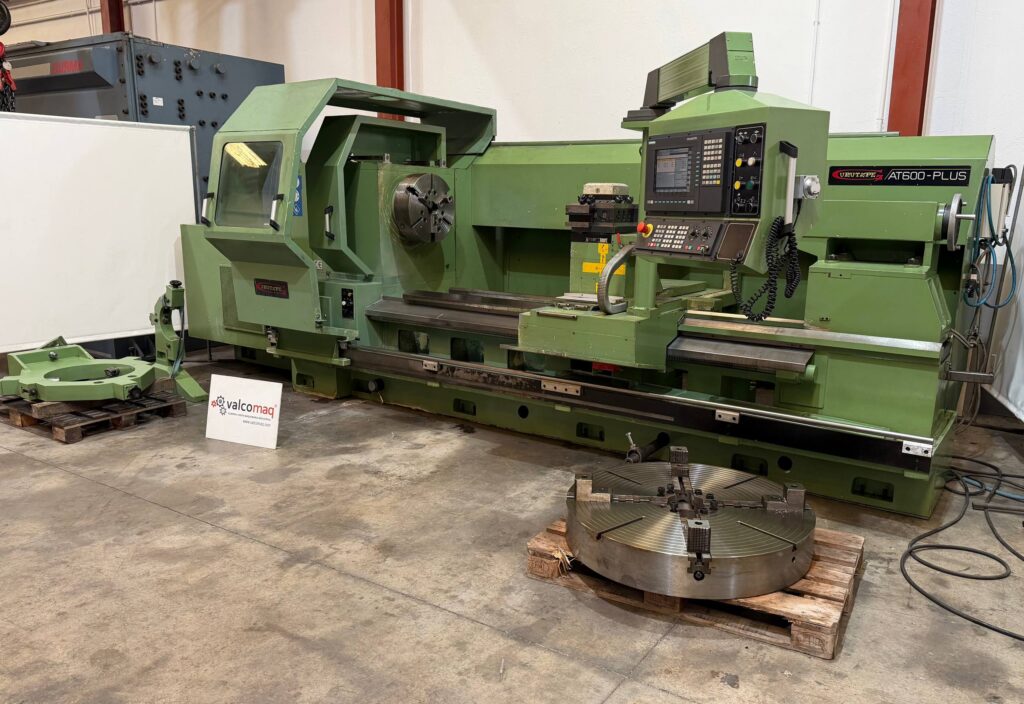
Gurutzpe lathes feature hardened and ground beds, spindles of up to 360 mm in diameter on the largest-capacity models, and chucks available in 800 and 1000 mm diameters. Models such as the Super RT-API or the BT range include automatic threading, fixed and traveling steady rests, and digital readouts that make it easier to control precision even on long, heavy workpieces. This structural robustness keeps tolerances tight despite heavy loads, which is critical when machining long shafts for wind turbine generators or large naval components.
Pinacho, on the other hand, opted for a more compact and ergonomic design in its S90, S160, and TCN series, aimed at machining medium-sized parts with fine finishes. Its headstocks are fitted with precision bearings that provide very good rigidity for their typical working range, and the layout of controls is especially comfortable in training environments and small-batch production of small and medium parts. It does not match Gurutzpe’s heavy-tonnage capacity, but within its size range it offers precision and repeatability that are highly valued in the automotive sector and auxiliary industry.
Ranges and most sought-after models on the used market
Within Gurutzpe’s catalog, the most in-demand used models are from the Super RT-API and BT series, with distances between centers ranging from 2000 mm up to 8000 mm on the largest-capacity versions, such as the Gurutzpe RT-API with 8000 mm between centers, a 360 mm spindle, and automatic threading. The BT models with 800 mm center height are also highly sought after, valued by workshops that need versatility between medium and large parts without sacrificing the brand’s characteristic robustness.
For Pinacho, the S90 and S160 series are the most common on the used market, along with models from the Smart and TCN ranges aimed at conventional workshop machining. Their wide distribution in training centers and SMEs over the decades means there are numerous units with varying degrees of wear, which is why provenance and maintenance history are decisive when evaluating a purchase. In both cases, always request technical documentation and, if possible, the machine’s usage history.
What about spare parts availability and technical support?
Gurutzpe remains an active manufacturer in Spain, which makes it easier to access original spare parts and specialized technical support, especially for models built in the last two or three decades. On very old machines, some specific components may need to be custom-made in precision machining workshops, but the mechanical structure of these lathes is robust enough that major repairs are rare if maintenance has been carried out properly over the years.
Pinacho has gone through several corporate changes throughout its history, which can sometimes make it harder to find original spare parts for the oldest models. However, its huge distribution across Spain has created a wide network of workshops specialized in repairing Pinacho lathes, capable of manufacturing compatible parts or adapting generic components without major difficulty. In practice, this means maintaining a used Pinacho is rarely a problem, though it is worth checking the condition of the headstock and feed gearbox before buying.
Direct comparison: used Gurutzpe vs Pinacho lathes
The table below summarizes the key aspects you should weigh up before deciding on one brand or the other, depending on the type of work typically carried out in your shop.
| Criterion | Gurutzpe Lathes | Pinacho Lathes |
|---|---|---|
| Typical capacity | Up to 8000 mm between centers, large-diameter spindles | Medium size, aimed at small and medium parts |
| Rigidity and robustness | Very high, oversized beds | Good for its working range |
| Precision on small parts | Correct, though not its specialty | Very good, design aimed at tight tolerances |
| Availability of units | More limited, more specialized market | Wide supply thanks to high historic production volume |
| Spare parts and technical service | Active manufacturer in Spain, direct support | Wide network of specialized workshops |
| Resale value | High due to its rarity in large capacity | Stable, with fast turnover on the market |
| Typical sectors | Shipbuilding, wind energy, forging, large shafts | General machining, training, automotive |
What resale value do these used lathes hold?
Large-capacity Gurutzpe lathes tend to hold their value well on the second-hand market because fewer units are available and because companies that need to machine heavy-tonnage parts have few equally robust alternatives. A Gurutzpe with 6000 or 8000 mm between centers in good condition can maintain an attractive value for years, especially if it comes with automatic threading, steady rests, and a well-functioning digital readout system.
Pinacho, having produced a much larger volume of machines, has a more liquid used market, with more supply and, consequently, somewhat tighter prices for equivalent models in terms of age and condition. This does not mean they are worth less in absolute terms, but rather that turnover is faster and there is more room for negotiation, which is especially attractive for workshops looking to add quality machinery without a large upfront investment.
What mistakes should you avoid when buying a used Gurutzpe or Pinacho lathe?
One of the most common mistakes is not checking the condition of the bed ways or the wear on the main spindle, two elements that directly affect the machine’s future precision. It is also common to buy without requesting technical documentation, without checking the electrical cabinet, or without verifying that the lathe starts up and works under real load, not just at idle. On large machines such as the bigger Gurutzpe models, it is also worth checking the alignment between centers and the condition of the tailstock.
Another common mistake is focusing solely on the lowest price without accounting for transport costs, commissioning, and possible subsequent adjustments, which can be significant on heavy-tonnage lathes. Buying through a specialized supplier that inspects, repairs, and commissions the machine before delivery greatly reduces this risk, compared to buying directly from private sellers without warranties or after-sales technical support.
Which industries best suit each brand?
Gurutzpe lathes are particularly well suited to metalworking shops that manufacture large shafts, flanges, wind turbine components, heavy forging parts, or shipbuilding elements, where part weight and length require long distances between centers and large-diameter spindles. They are also suitable for industrial repair shops that work with heavy machinery components from power plants, cement factories, or mining operations.
Pinacho lathes, on the other hand, are the natural choice for general machine shops, automotive subcontractors, vocational training centers, and small and medium-sized businesses that work with medium-sized parts requiring high precision and finish. Their intuitive operation and more compact size also make them well suited to shops with limited space that need day-to-day versatility without investing in a large-capacity machine.
How much does a used Gurutzpe or Pinacho lathe cost in 2026?
In 2026, the price range of a used Gurutzpe lathe depends heavily on its capacity: models with 2000-3000 mm between centers in good condition tend to fall within a mid-range price band, while large-capacity models, from 6000 to 8000 mm between centers, with automatic threading, steady rests, and a digital readout, command higher figures, justified by their rarity and the limited supply of comparable alternatives on the domestic and international markets.
Used Pinacho lathes, given the larger number of units in circulation, offer a wider and generally more accessible price range for equivalent medium-sized capacities. A refurbished S90 or S160 series model in good condition can represent a considerably smaller investment than a heavy-tonnage lathe, making it a very reasonable option for workshops starting out or looking to expand capacity without a large outlay.
Which one suits your workshop profile best?
Choose Gurutzpe if: your workshop regularly works with long, heavy, or large-diameter parts, such as shafts for wind energy, naval components, or industrial forging elements, and you need a machine with a reinforced bed capable of absorbing intense cutting forces without losing precision over thousands of hours of use.
Choose Pinacho if: your activity is focused on general machining of small and medium parts, you work for the automotive or auxiliary sector, or you need a versatile, intuitive lathe for staff training or production in workshops with limited space and a tighter budget.
Choose Gurutzpe if: you value low long-term depreciation and plan to resell the machine in the future, since the limited supply of large-capacity lathes on the used market tends to support its value better than more common models.
Choose Pinacho if: you prioritize finding spare parts and technical service quickly anywhere in Spain, thanks to the wide network of specialized workshops that have worked with this brand across the country for decades.
Frequently asked questions about used Gurutzpe and Pinacho lathes
Is it better to buy a new lathe or a used one? For most workshops, a used Gurutzpe or Pinacho lathe inspected and commissioned by a specialized supplier offers a much better value-for-money ratio than a new machine, as long as its mechanical and electrical condition is verified before purchase.
What age is reasonable for a lathe from these brands? Both Gurutzpe and Pinacho build machines with very durable beds, so equipment fifteen or twenty years old in good maintenance condition can still deliver excellent performance for many years to come.
Can they be compared directly on price? Not always, since this depends heavily on size and capacity: a heavy-tonnage Gurutzpe is not comparable in price to a medium-sized Pinacho, even though both can be considered equivalent-tier machines within their own segment.
The PDF manuals for Gurutzpe lathes are available at Instrumachine.
Valcomaq, your trusted partner for buying used Gurutzpe and Pinacho lathes with guarantees
At Valcomaq we have more than twenty years of specialized experience in buying, reconditioning, and selling used industrial machinery, including Gurutzpe and Pinacho lathes that are inspected and ready to work from day one. We currently have several Gurutzpe lathes available in our catalog, along with Pinacho models of various capacities, so we recommend checking current stock before deciding, as availability changes frequently as equipment enters and leaves our facilities.
If you are considering a large-capacity lathe or a more versatile model for general machining, you can browse our catalog of used Gurutzpe lathes and compare the available units and their technical specifications directly. Our team inspects every machine, verifies its mechanical and electrical condition, and advises you based on the type of parts you machine, so your investment truly matches your workshop’s needs, not just the purchase price.
Whether you ultimately choose a Gurutzpe or a Pinacho lathe, what matters most is that the machine arrives at your workshop inspected, tested, and fully guaranteed. Contact us and tell us what kind of parts you typically machine: we will help you choose from our available used machinery, with specialized advice and competitive prices tailored to your budget.