


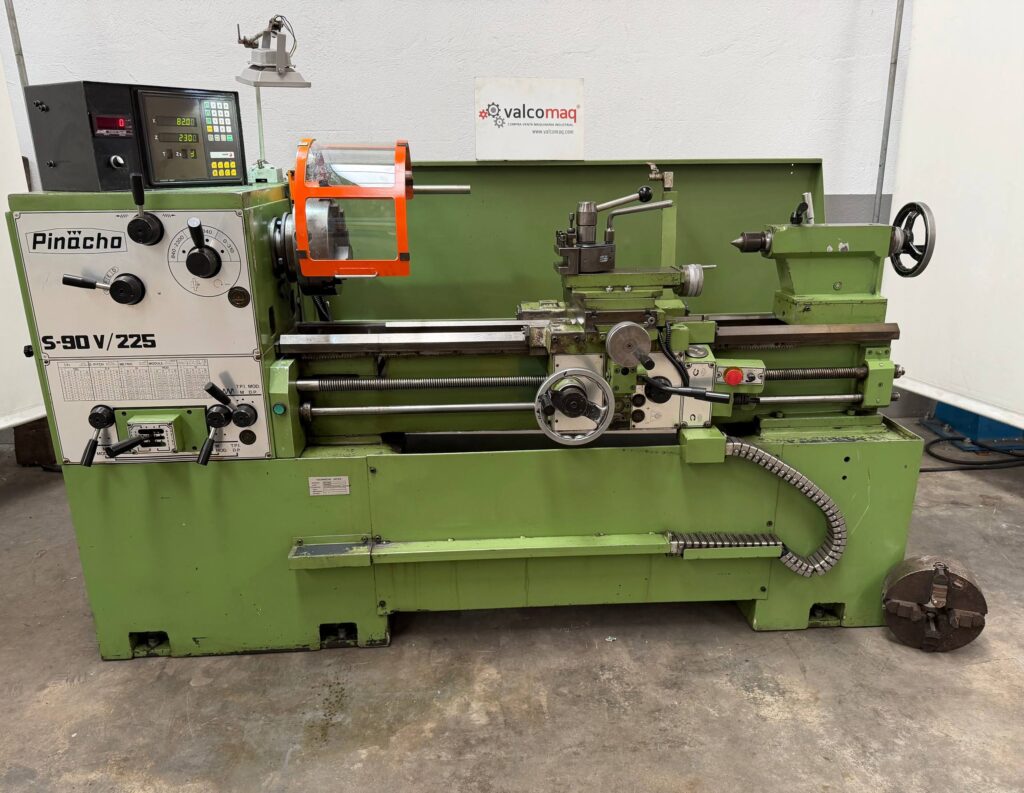
Choosing between a used Pinacho lathe and a used Amutio Cazeneuve lathe is one of the most common decisions machine shops face when they need to expand capacity without a huge upfront investment. Both brands are part of Spain’s industrial heritage and are still running at full capacity in thousands of workshops today, but they don’t perform the same way on every job. In this guide we break down the construction, precision, spare parts availability and resale value of each brand, backed by real technical data and a side-by-side comparison table. We also explain which shop profile fits best with each option and which mistakes to avoid when buying second-hand machinery in 2026.
At Valcomaq we’ve spent more than two decades inspecting, reconditioning and selling used lathes, so this comparison isn’t theoretical — it’s based on what we see coming in and out of our workshop every week. If you’re looking for a reliable used Pinacho lathe or weighing up alternatives like Amutio Cazeneuve, here are the real criteria that matter.
What makes a second-hand Pinacho lathe stand out?
Pinacho is one of Spain’s most recognised manufacturers of engine lathes, with a range that spans small workshop models through to heavy-duty lathes built for aggressive metal removal. The most sought-after series on the used market are the S-90, the S-200 and the L series, with distances between centres ranging from 1000 mm up to over 3000 mm on reinforced-bed models. Pinacho lathes are known for their hardened, ground beds with substantial thickness, giving them notable rigidity against vibration during heavy roughing passes.
Another hallmark of a used Pinacho lathe is the strength of its headstock, with mechanical gearboxes that remain durable and keep acceptable tolerances even after decades of intensive use, provided they’ve been properly maintained. Many shops also value the broad threading range, with a lead screw that cuts metric, Whitworth and module threads without complex changeovers. This versatility is why Pinacho remains a go-to choice for repair shops, subcontractors and manufacturers of one-off parts or short production runs.
How are Amutio Cazeneuve lathes built?
Amutio Cazeneuve was born from the merger of two engineering traditions — the Basque heritage of Amutio and the French precision engineering of Cazeneuve — resulting in lathes built for accuracy and demanding part geometries. The most common models on the second-hand market are the HB and CNM series, with distances between centres of 1000 to 2000 mm and swing-over-bed diameters typically in the 400 to 600 mm range. Amutio Cazeneuve beds usually feature hardened ways with a very fine finish, designed for high-quality surface finishes rather than aggressive stock removal.
On the headstock side, many Amutio Cazeneuve models incorporate quieter, more progressive speed-change systems, with a feed range built for fine threading and precision machining in sectors like aerospace or mould and die making. This focus means that, at a similar age, a well-maintained Amutio Cazeneuve can hold slightly tighter concentricity tolerances than an equivalent Pinacho — though at the cost of lower stock-removal capacity on deep passes in hard materials.
Precision vs rigidity: which one matters more for your decision?
Precision and rigidity are not interchangeable concepts, and understanding the difference is essential before buying a used lathe. Rigidity determines the machine’s ability to absorb vibration during heavy chip removal, which is critical if your shop works with castings, forgings or raw carbon steel. Precision, on the other hand, refers to repeatability and the surface finish achievable in fine machining — a priority if you manufacture components for tight-fit assemblies or dimensionally critical parts.
Pinacho lathes tend to excel in the first area thanks to the weight and thickness of their beds, while Amutio Cazeneuve units typically perform better in the second, especially models with high-speed spindles and precision bearings in the headstock. This doesn’t mean a Pinacho can’t deliver a fine finish, or that an Amutio Cazeneuve can’t handle roughing — both are serious industrial machines, but each was designed with a different emphasis that should match the type of parts you typically produce in your shop.
Comparison table: second-hand Pinacho vs Amutio Cazeneuve
| Criteria | Pinacho | Amutio Cazeneuve |
|---|---|---|
| Bed rigidity | Very high, ideal for heavy roughing | High, built for stability in fine finishing |
| Finishing precision | Good, sufficient for most industrial parts | Very good, built for tight tolerances |
| Typical distance between centres | 1000 to over 3000 mm | 1000 to 2000 mm |
| Spare parts availability | Very wide across the Spanish market | Good, though more limited for specific parts |
| Resale value | Stable, high turnover on the used market | Good on well-kept precision models |
| Recommended shop profile | Repair, subcontracting, short runs | Moulds, precision, tight-tolerance parts |
Where can you find spare parts for each brand?
One of the biggest factors in the real service life of a used lathe is spare parts availability. For Pinacho lathes there’s a very well-established secondary market in Spain, with specialist workshops and suppliers producing compatible parts such as bushings, Norton-box gears, collets and threading components. This drastically cuts downtime after a breakdown and keeps medium-term maintenance costs low — an especially important point for shops that can’t afford long stoppages.
For Amutio Cazeneuve, the parts network is also solid thanks to the shared technical heritage with Cazeneuve, although very specific precision-headstock components may require custom manufacturing or specialist regrinding of original parts. Before buying any used lathe, regardless of brand, it’s worth asking about the condition of the gearbox, the main spindle and the lubrication system, since these are the most expensive components to replace on either manufacturer.
Resale value and depreciation on the used machinery market
Resale value is a criterion many buyers overlook, yet it’s decisive if your shop replaces machinery every few years. Pinacho lathes, being one of the most recognised brands with the highest turnover in the Spanish market, hold relatively stable resale value as long as they’re kept with documented maintenance and no structural damage to the bed. Steady demand from small and medium-sized shops makes it easier to find a buyer when it’s time to renew your machine fleet.
Amutio Cazeneuve lathes, for their part, hold good value especially in precision-oriented models, which are in high demand among mould makers, tool-and-die shops and sectors requiring tight tolerances. However, since this is a more specific niche, the sales process can take a bit longer without a specialised channel. In both cases, having service records, geometric verification certificates and photos of the bed and spindle condition significantly improves resale speed and price.
Which applications by sector suit each brand best?
In industrial maintenance shops, agricultural machinery repair or spare parts manufacturing, a used Pinacho lathe is usually the most versatile option: its rigidity lets you machine shafts, flanges and large castings without losing precision during roughing passes. Heavy metalworking, auxiliary shipbuilding and subcontracting shops that receive highly varied parts find Pinacho to be a reliable tool for a wide range of jobs without needing to specialise in a single part type.
Conversely, in sectors like mould making, die making, precision automotive components or parts for tight-tolerance assemblies, a used Amutio Cazeneuve lathe can offer a real advantage in surface finish and repeatability. Prototyping shops, precision machining for the medical sector, or manufacturers of specific tooling tend to favour this brand when they find a well-preserved unit, since the cost of a dimensional error in these sectors is usually much higher than in general machining.
Common mistakes when buying a used lathe
The most common mistake when buying used machinery is focusing only on price without checking the real condition of the bed. A lathe with worn ways or play in the cross slide may look like a bargain, but it will end up producing out-of-tolerance parts and regrinding costs that far exceed the initial savings. It’s essential to request a load test, check vibration levels at different speeds, and visually inspect the wear on the prismatic ways, especially near the headstock, where most of the work is concentrated.
Another common mistake is failing to verify the machine’s origin and maintenance history. Buying without warranty from private sellers or non-specialist intermediaries increases the risk of acquiring a lathe with improvised component replacements or poorly executed bed repairs. Working with a supplier that inspects, reconditions and tests every machine before delivery dramatically reduces this risk and allows you to negotiate with real information about the condition of the headstock, spindle and electrical system.
How much does a used Pinacho or Amutio Cazeneuve lathe cost in 2026?
Prices for used Pinacho lathes in 2026 vary considerably depending on size, condition and extra features such as a digital readout or automatic threading. Small workshop models with 1000 to 1500 mm between centres tend to sell at more accessible price points, while larger capacity models — over 2500 mm between centres, with reinforced beds and added control systems — command significantly higher prices due to their versatility and sustained demand from heavy-duty machine shops.
For Amutio Cazeneuve lathes, the price range tends to be more uniform, concentrated around precision models with medium capacities. Units with well-maintained spindles and beds, especially those with recent bearing and threading-system overhauls, hold stable prices even at a considerable age. In both cases, the factor that most impacts the final price isn’t so much the brand as the machine’s real condition, the reconditioning it has received, and whether it’s delivered ready to produce from day one or needs further adjustment by the buyer.
Maintenance and service life: keys to extending performance
Both Pinacho and Amutio Cazeneuve lathes are built to last for decades with proper maintenance. Regular lubrication of the bed ways, belt tension checks, monitoring play in the carriage screws, and routine cleaning of the coolant system are basic tasks that make the difference between a machine that keeps producing accurately and one that wears out prematurely. On used machines, it’s also worth checking the electrical cabinet and limit switches, components that tend to fail before the mechanical structure does.
A preventive maintenance plan, with quarterly oil-level checks and an annual geometric inspection using a dial indicator, allows a lathe over thirty years old to keep working within acceptable tolerances for most industrial applications. This design robustness is, in fact, one of the reasons the market for used Pinacho and Amutio Cazeneuve lathes remains so active in Spain: these are machines built to last, not to become obsolete in a few years.
Which one should you choose for your shop?
Choose Pinacho if: your shop works with large parts, you need a very rigid bed for aggressive roughing, you want easy access to competitively priced spare parts, and you value a versatile lathe capable of handling a wide variety of jobs without excessive specialisation. It’s also the recommended option if you prioritise solid medium-term resale value thanks to the brand’s high turnover on the Spanish market.
Choose Amutio Cazeneuve if: your business focuses on precision machining, mould making or tight-tolerance parts, and you prefer a quiet headstock with fine feeds for delicate threading work. It’s the best choice if surface finish and dimensional repeatability matter more to your production process than raw stock-removal capacity.
Choose either brand if: what really matters to you is buying a machine that’s been inspected, comes with guarantees and is ready to produce from day one, regardless of the name on the nameplate. In that case, the most important thing is working with a specialist supplier that reconditions the machine, verifies its geometry and offers after-sales support — whether the lathe says Pinacho or Amutio Cazeneuve.
FAQs about used Pinacho and Amutio Cazeneuve lathes
Is it better to buy an older lathe with a heavily reinforced bed, or a newer one with fewer hours of use? The answer depends on the job: for heavy roughing, an older but well-maintained Pinacho bed usually outperforms a more modern but lighter-built model. For precision work, hours of use and spindle condition matter more than the age of the machine itself.
Is it worth installing a digital readout on an older Pinacho or Amutio Cazeneuve lathe? In most cases, yes — it significantly improves productivity and reduces machining errors without having to replace the entire machine, making it a relatively affordable investment compared with buying a new CNC machine.
Need the documentation for a Pinacho lathe? You can find it at Instrumachine.
Valcomaq, your partner for finding the right used lathe
At Valcomaq we inspect and recondition every lathe before putting it up for sale, checking geometry, headstock condition, spindle and electrical system so it arrives at your shop ready to work from day one. We currently have several Pinacho lathe units in our catalogue, along with Amutio Cazeneuve models for those who prioritise precision, so we recommend checking current stock before deciding, as availability changes frequently depending on domestic and international demand.
If you’re considering adding a used Pinacho lathe to your shop, browse the available catalogue at used Pinacho lathes at Valcomaq and compare models, capacities and features. Our team can also advise you on Amutio Cazeneuve units depending on the type of parts you manufacture — so contact us and we’ll give you all the information you need to make the best decision for your shop.