

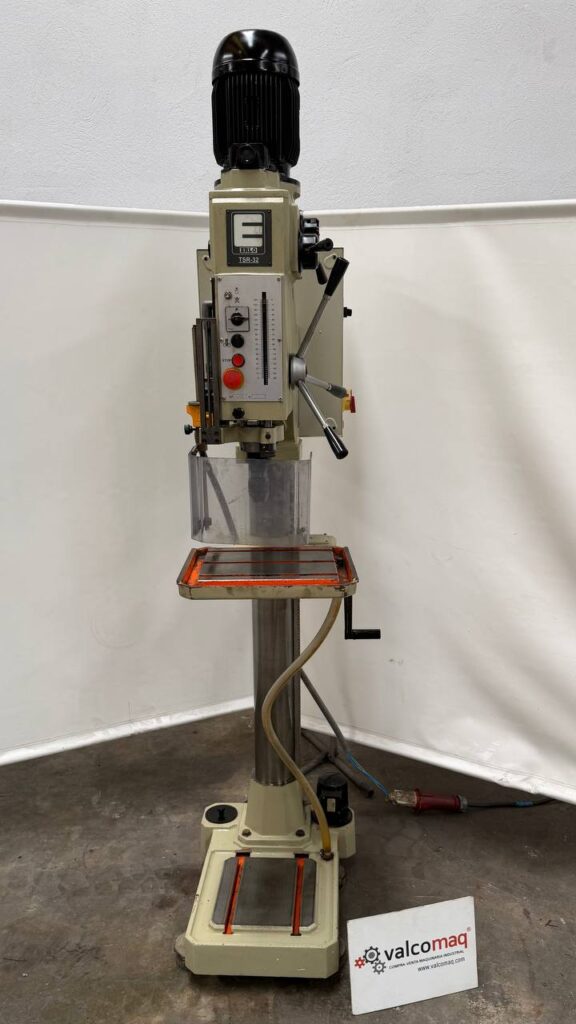
When a workshop needs to expand its machining capacity without a heavy capital outlay, used industrial drills remain one of the most sensible choices on the second-hand machinery market. Within that category, the brand Erlo holds a strong position thanks to its heritage as a Spanish manufacturer of rugged drilling machines built to run for decades with minimal play. In this guide we look at what sets used Erlo drills apart from other brands, which ranges and models tend to appear on the used market, which technical points you should check before signing off on a purchase, and which type of workshop gets the most out of this kind of equipment. The goal is to help you make a technically sound decision, not just a price-driven one.
Throughout the article you will also find a comparison table of drill types, a section on common mistakes when buying used machinery, and an indicative pricing guide for 2026, along with concrete recommendations based on your workshop profile. If you already know the brand and just want to check current availability, you can go straight to the Valcomaq catalog of used Erlo drills to see current stock.
What sets an Erlo drill apart in the used machinery market?
Erlo is a Spanish manufacturer with a long track record in machine tools, historically specialising in radial arm drills and column drills built with exceptional structural strength. What sets these machines apart from generic brands is the oversized bed and radial arm, originally designed for heavy boiler-making and shipbuilding workshops, where the parts being drilled are large and the spindle must run vibration-free even with large-diameter bits. This constructive philosophy is precisely why, decades later, many units are still fully operational once properly reconditioned.
Another defining feature is the precision of the spindle feed, achieved through multi-step mechanical gearboxes and automatic feed systems independent of the rotation. On radial models, the arm allows the head to be rotated 360° and moved along the column, multiplying versatility compared with a fixed column drill. Buying a used Erlo drill generally means inheriting a cast-iron structure far more rigid than that of current entry-level manufacturers, provided the unit received proper maintenance throughout its working life.
What Erlo ranges and models are commonly found second-hand?
On the used market, two main families of the brand are typically available: radial arm drills, with drilling capacities in steel ranging from 40 mm up to more than 80 mm depending on the model, and column drills, bench or floor mounted, aimed at lighter, more repetitive work. Within the radial range, arm lengths between 1,000 and 2,000 mm are the most sought after, as they cover a very wide range of part sizes without taking up as much floor space as the longer-reach models, which are usually reserved for heavy structural steel or shipyard workshops. You can browse the full range of second-hand drilling equipment in the used industrial drills catalog to compare formats side by side.
It is also common to find units with partial upgrades, such as digital position readouts added later to the table or spindle, rewound motors or replacements with higher-power versions, and automatic tapping units fitted during a second life of the machine. These modifications do not reduce the value of a used Erlo drill; on the contrary, they are usually a sign that the previous owner invested in keeping it productive, which is a good indicator before deciding to buy.
What should you check technically before buying a used Erlo drill?
The first inspection point should be the main spindle: check that there is no excessive axial or radial play, that the internal taper (usually Morse) is free of dents or wear that would prevent a firm grip on the drill bit, and that the automatic feed engages smoothly without jumps. A spindle with too much play translates directly into oval or misaligned holes, a defect that cannot be fixed with surface maintenance and may require costly regrinding. Always ask for a real drilling test with several diameters before closing the deal.
The second area to inspect is the mechanical structure: column guides, the carriage lifting rack on radial models, and the condition of the bed or worktable, which should show no cracks or deformation from part impacts. You should also check the electric motor (current draw, bearing noise, temperature after a continuous work cycle), the cooling system if fitted, and the condition of the electrical cabinet, especially on machines over 20 years old where original components may have been replaced with non-certified parts. A professional reconditioning process, like the one Valcomaq applies to its machinery, covers exactly these points before a machine goes on sale.
Column drill or radial Erlo drill? Practical differences
The choice between a column drill and a radial drill depends directly on the type of part usually machined. The Erlo column drill is more compact, cheaper to maintain, and more than adequate for workshops working small to medium-sized parts in repetitive batches, where there is no need to move the head relative to the part. The radial drill, on the other hand, allows the spindle to be positioned over points far from the central axis without moving the part, which is essential in boiler-making, structural steel fabrication and machining large flanges or plates.
The table below summarises the most relevant differences between the two configurations within the Erlo range, to help you decide based on the type of work planned for your workshop.
| Criteria | Erlo Column Drill | Erlo Radial Drill |
|---|---|---|
| Drilling capacity | Up to 40-50 mm in steel | 50-100 mm in steel depending on model |
| Head mobility | Fixed, the part is moved instead | 360° rotation and travel along the arm |
| Floor space | Small | Medium to large depending on arm length |
| Ideal parts | Small and medium repetitive batches | Large parts, flanges, structures, boiler-making |
| Approximate used investment | More affordable | Higher, depending on capacity and condition |
How does previous maintenance affect the machine’s remaining lifespan?
The real service life of a used Erlo industrial drill depends far more on the maintenance it has received than on its nominal age. A fifteen-year-old machine with regular greasing, gearbox oil changes and guide adjustments can outperform an eight-year-old unit that worked without proper lubrication or under constant overload. That is why, when evaluating a used Erlo drill, it is far more relevant to ask about the usage and maintenance history than to focus solely on the manufacturing year shown on the nameplate.
The usual lubrication points include the gearbox, the carriage sliding guides on radial models, the lifting rack, and the drill chuck spindle. A simple preventive maintenance plan – weekly greasing, monthly play checks and an oil change every 500-1,000 working hours – is enough to extend the service life of these machines well beyond what a lighter-built machine would offer. At Valcomaq, before any unit is listed for sale, these points are checked and the actual condition of the machine is documented.
What are the most common mistakes when buying a used industrial drill?
One of the most frequent mistakes is being guided solely by the asking price without requesting a functional test under load. A drill can start and spin fine with no load, yet show vibration, excessive heating or loss of torque as soon as it is put to work with a substantial drill bit diameter. Another common mistake is failing to check electrical compatibility and available floor space at the destination workshop before closing the purchase: radial drills, in particular, require a certain ceiling height and arm swing radius that are not always considered until the machine is already on its way.
It is also common to underestimate transport and installation costs, especially for heavy-tonnage equipment, and to skip requesting documentation on the machine’s origin or maintenance history. Buying through a specialist dealer in used industrial machinery, who inspects, repairs and commissions the equipment before delivery, drastically reduces these risks compared with buying directly from a private seller with no guarantees or prior testing.
How much does a used Erlo drill cost in 2026?
The price of a used Erlo drill varies considerably depending on the type, drilling capacity, manufacturing year and level of reconditioning applied. A column drill in good condition, with moderate capacity, usually falls within a more affordable range on the used machinery market, while a radial drill with a long arm, automatic tapping unit and digital readout can reach noticeably higher figures, always well below the cost of an equivalent new machine. In 2026, with the general rise in new machine tool prices, the price gap between buying new and buying reconditioned used equipment has widened, making this option even more attractive for workshops with tight budgets.
Factors such as the presence of original accessories, the condition of the paintwork and casting, the availability of technical manuals, and whether the machine comes from a single industrial owner also influence the final price. It is always worth comparing several suppliers and requesting the maintenance history before negotiating, rather than focusing exclusively on the advertised sale price.
What type of workshop benefits most from a used Erlo drill?
Choose an Erlo column drill if: your production focuses on small or medium-sized parts, you run repetitive drilling batches, and you need to optimise space in a workshop with limited floor area. This configuration offers sufficient precision for most light machining work, and its purchase and maintenance costs are lower than those of a radial drill.
Choose an Erlo radial drill if: your activity includes heavy boiler-making, structural steel fabrication, flange manufacturing, or machining bulky parts that cannot be easily moved. The ability to position the head over a fixed part, rather than moving the part to the bit, is essential in these environments and justifies the higher initial investment.
Choose an upgraded Erlo drill (digital readout, automatic tapping unit) if: you are looking to improve productivity and reduce operator error without taking on the cost of a brand-new machine. When well integrated, these upgrades deliver much of the benefit of a modern machine while keeping the brand’s original structural robustness.
Choose buying through a specialist like Valcomaq if: you value the assurance of a machine that has been inspected, tested and commissioned before delivery, with technical guidance on which model truly fits your production, rather than risking a direct purchase from a private seller with no prior checks whatsoever.
Used Erlo drills in Valcomaq’s catalog
At Valcomaq we have been working with used industrial machinery since 2001, inspecting every unit before making it available to our customers, both nationally and internationally. We currently have used Erlo drills in stock, fully inspected and ready to go into production, and we constantly refresh our inventory as new machines arrive at our warehouse. If your workshop needs to expand its drilling capacity with a brand known for its durability, we recommend checking current availability directly.
You can browse the Valcomaq catalog of used Erlo drills to see the units available right now, with technical specifications and condition reports for each machine. If you have any questions about which model best suits your production, indicative pricing, or the purchasing and shipping process, please contact us and we will be happy to advise you at no obligation, as we have been doing for workshops across Spain and beyond for more than twenty years.