


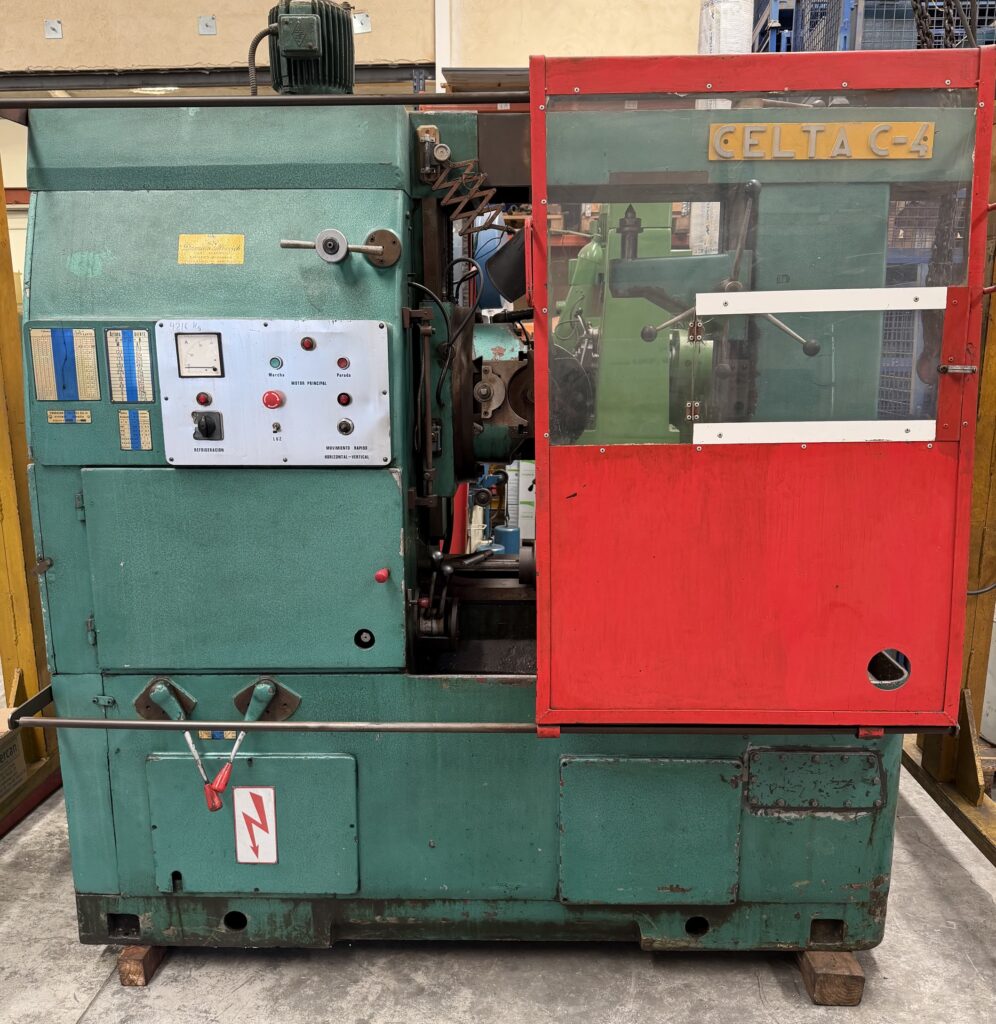
Finding a used Celta gear hobbing machine in good working condition is not straightforward: these are specialised machines with much lower turnover on the second-hand market than conventional machining equipment, and assessing their real condition requires specific technical knowledge. In this article we explain what defines Celta hobbing machines, which models turn up most often on the Spanish used-machinery market, what to check before signing the purchase order — from indexer accuracy to spindle wear and the hobbing system itself — and which type of workshop each configuration suits best. We also cover indicative 2026 pricing, common mistakes buyers make, and how to extend the service life of these machines once they are up and running in your shop.
What characterises used Celta gear hobbing machines?
The Celta brand belongs to the generation of Spanish capital-goods manufacturers that supplied gear hobbing machines for decades to general machining workshops, gearbox manufacturers and industrial maintenance companies. These machines are built on a robust cast-iron bed designed to absorb the vibrations inherent to the hobbing process, and typically feature a swivelling hob head that allows both spur and helical gear cutting within a module range that, depending on the model, runs from module 1 up to module 8-10. This structural robustness is precisely why, half a century after they were built, many units are still running in workshops across Spain.
Another distinctive feature is the mechanical indexing system, made up of a gear train and an index plate that synchronises the rotation of the workpiece with the feed of the hob cutter. Unlike modern CNC hobbing machines, on used Celta units this process depends on extremely precise mechanical adjustment, which is why the condition of the indexer is one of the most decisive factors when valuing a second-hand unit. Many of these machines also include an adjustable tailstock, drip or pump-fed coolant, and a longitudinal feed system for cutting wider gear faces.
Which Celta models are most common on the second-hand market?
The Spanish industrial machinery park includes several generations of Celta gear hobbing machines, ranging from compact models aimed at repair workshops to larger units built for series production of transmission parts. Mid-range models, with a distance-between-centres of 500 to 800 mm and module capacity up to 6, are the ones that appear most often on the used market, since they were the best-selling machines to general workshops throughout the seventies, eighties and nineties. It is also common to find versions with a larger-diameter table, suited to large-diameter workpieces and variable-angle helical gearing.
Higher-module units, normally intended for producing crown wheels and pinions for agricultural or public-works machinery, are scarcer on the second-hand circuit precisely because their reliability keeps them in production for longer. When they do reach the market it is usually due to workshop closures, owner retirement, or a technology upgrade to CNC equipment, and it is worth paying particular attention to the condition of their precision components before buying, since their replacement value is considerably higher.
What should you inspect before buying a used Celta hobbing machine?
Before closing the purchase of any used Celta gear hobbing machine available on the market, it is worth carrying out a systematic inspection covering both precision mechanical components and auxiliary systems. The critical points are the condition of the indexer and its gear train, the axial and radial play of the hob spindle, wear on the bed guideways, the state of the electrical starting and protection system, and any play in the tailstock. It is also important to check that the machine still has its original documentation or, at the very least, that the seller can confirm the year of manufacture and maintenance history.
A recommended step, whenever possible, is to request a real cutting test on a workpiece of known diameter and module, and then check the resulting gear teeth with a module gauge or a profile projector. This test directly reveals whether the generating system still maintains the angular accuracy required, something a simple visual inspection does not always detect. At Valcomaq, every unit that enters our catalogue goes through this type of check before it is offered for sale, precisely to give buyers real guarantees.
Indexer accuracy: the component that determines gear quality
The indexer is, without question, the most sensitive component of a mechanically generated gear hobbing machine. Its job is to synchronise the rotation of the workpiece with the angular movement of the hob cutter with extreme precision, so that each tooth is generated in the correct position relative to the previous one. A worn indexer, with play in its gear train or a damaged index plate, produces circular pitch errors that translate into noisy gears, uneven tooth contact and reduced service life. This defect is not always visible at a glance, so it is worth checking the mechanism with the cover open and confirming there is no excessive play when the reduction train is turned by hand.
Beyond the mechanical condition, it is worth verifying that the machine’s original indexing range is complete — in other words, that no change-gear plates or interchangeable gear sets used to obtain different tooth counts are missing. Losing these accessories, common in machines that have passed through several owners, significantly limits the versatility of the equipment and should be reflected in the final sale price.
How to detect spindle and hobbing system wear
The hob spindle is the second critical inspection point. Its wear usually shows up as vibration during cutting, irregular marks on the generated teeth, or unusual noise when running idle at different speeds. It is worth checking axial play with a dial indicator against the shaft, as well as the condition of the bearings and drive keys. A spindle with excessive play not only affects the surface finish quality of the tooth, it also accelerates wear on the hob cutter itself, driving up production costs in the medium term.
The hobbing system as a whole — including the head carriage, the longitudinal feed mechanism and the coolant system — should be checked while running, not only at a standstill. Irregular feed, with noticeable stops or jerks, usually points to wear in the feed screw or its corresponding nut, while leaks or lack of pressure in the coolant circuit indicate pending maintenance that should be budgeted for before closing the deal. These details make the difference between a machine that is ready to produce from day one and one that will require additional investment in reconditioning.
| Brand | Origin | Typical module | Spare parts availability | Indicative used price |
|---|---|---|---|---|
| Celta | Spain | Module 1 to 8-10 | Good, wide national network | Low-medium |
| Pfauter | Germany | Module 2 to 12 | Good but more expensive | Medium-high |
| Lorenz | Germany | Module 1 to 10 | Medium, depends on model | High |
| Gleason | USA | Variable by series | Limited in Spain | High |
Which type of gear workshop suits a Celta hobbing machine best?
A used Celta gear hobbing machine is particularly well suited to repair and industrial maintenance workshops that need to manufacture pinions, crown wheels or splined shafts on an occasional basis, without requiring long production runs or top-tier precision tolerances. It is also a very sensible option for small and medium-sized companies manufacturing reducers or gearboxes for agricultural or public-works machinery, where production volume does not justify investing in a new CNC hobbing machine, but in-house gear-cutting capacity is still needed without relying on outside subcontracting.
In sectors such as spare-parts automotive work, agricultural machinery repair, or maintenance workshops for industrial plants, having an operational Celta hobbing machine drastically cuts lead times for replacement parts that are no longer produced in series. Its versatility for cutting both spur and helical gears, combined with an acquisition cost far below an equivalent new machine, makes it a cost-effective tool for workshops looking to expand their service offering without committing to a large investment.
How much does a used Celta gear hobbing machine cost in 2026?
The price of a used Celta hobbing machine depends on several factors: the maximum module it can cut, the condition of the indexer and spindle, its age, the presence of original accessories such as change-gear sets and additional tailstocks, and the level of reconditioning carried out before sale. On the Spanish market in 2026, a mid-range unit in good working order, inspected and sold with a start-up warranty, typically sits in a mid-range price bracket within used machining equipment, notably below the cost of an equivalent new CNC hobbing machine.
Machines that need indexer reconditioning, spindle bearing replacement or electrical system repair are usually offered at lower prices, but it is worth adding the real cost of that overhaul before comparing offers. Buying through a specialised supplier that has already carried out this inspection, as is the case with Valcomaq, is usually more economical in the medium term than buying a cheap unit with no guarantees and later absorbing repair costs and production losses caused by an undetected fault.
What are the most common mistakes when buying a used gear hobbing machine?
Many first-time buyers make mistakes that could easily be avoided with a more rigorous inspection. Among the most frequent:
- Not verifying the real condition of the indexer, simply checking that the machine starts and turns.
- Overlooking missing original accessories, such as change gears or steady rests, which are later difficult and expensive to source.
- Not requesting a cutting test on a real workpiece before closing the purchase.
- Underestimating the cost of transporting and installing a machine of considerable weight and size.
- Buying from private sellers with no warranty or return option in case of a hidden fault.
Avoiding these mistakes, in practice, requires the advice of professionals who know the particularities of each brand and model well. A supplier specialised in used machining equipment can anticipate typical issues for each generation of Celta hobbing machine and guide the buyer towards the unit that best fits their actual production needs, avoiding surprises once the machine is already installed in the workshop.
Maintenance and expected service life of a Celta hobbing machine
A well-maintained Celta gear hobbing machine can stay in production for decades, which explains why so many units from the seventies and eighties are still working in Spanish workshops today. Basic maintenance includes periodic lubrication of the indexer and bed guideways, checking the level and condition of the coolant oil, adjusting spindle play, and scheduled replacement of hob cutters once their cutting edges show wear. A simple preventive maintenance plan, applied consistently, significantly extends the equipment’s service life and keeps the accuracy of the generated teeth stable.
Periodic calibration with reference workpieces is also advisable, especially in workshops where the machine works to demanding tolerances. This check, combined with regular cleaning of the coolant system to prevent fine chip build-up in the circuit, significantly reduces the risk of costly breakdowns and ensures that the investment made when buying a used Celta hobbing machine pays off fully over its years of service.
Which Celta hobbing machine best fits your workshop?
Choose a mid-range Celta hobbing machine if: your workshop manufactures pinions and crown wheels on an occasional basis, with modules up to 6, and you want a reliable machine with a low acquisition cost and simple maintenance, suited to general repair or industrial maintenance workshops.
Choose a higher-module Celta hobbing machine if: your business focuses on manufacturing large gears for agricultural machinery, public-works equipment or industrial reducers, and you need the capacity to work modules above 6-8 with reliable precision.
Choose another premium brand if: your production requires very tight tolerances on long production runs or integrated numerical control, in which case brands such as Pfauter or Lorenz can offer additional performance, albeit at a considerably higher acquisition cost.
Choose to buy through a specialised supplier if: you want to avoid hidden risks, get a start-up warranty, and receive technical advice on which Celta model best matches your real production needs — something buying directly from a private seller rarely offers.
Used Celta gear hobbing machines in Valcomaq’s catalogue
At Valcomaq we inspect, recondition and start up every Celta gear hobbing machine before adding it to our catalogue, checking the condition of the indexer, spindle and hobbing system to guarantee it reaches your workshop ready to produce from day one. We currently have several units available, alongside other gear hobbing machinery models that we update on an ongoing basis. Browse the catalogue of used Celta gear hobbing machines to see current stock, technical specifications and the condition of each unit. If you are looking for a gear hobbing machine of another brand or capacity, contact us and we will advise you, with no obligation, to find the equipment that best suits your production needs.