


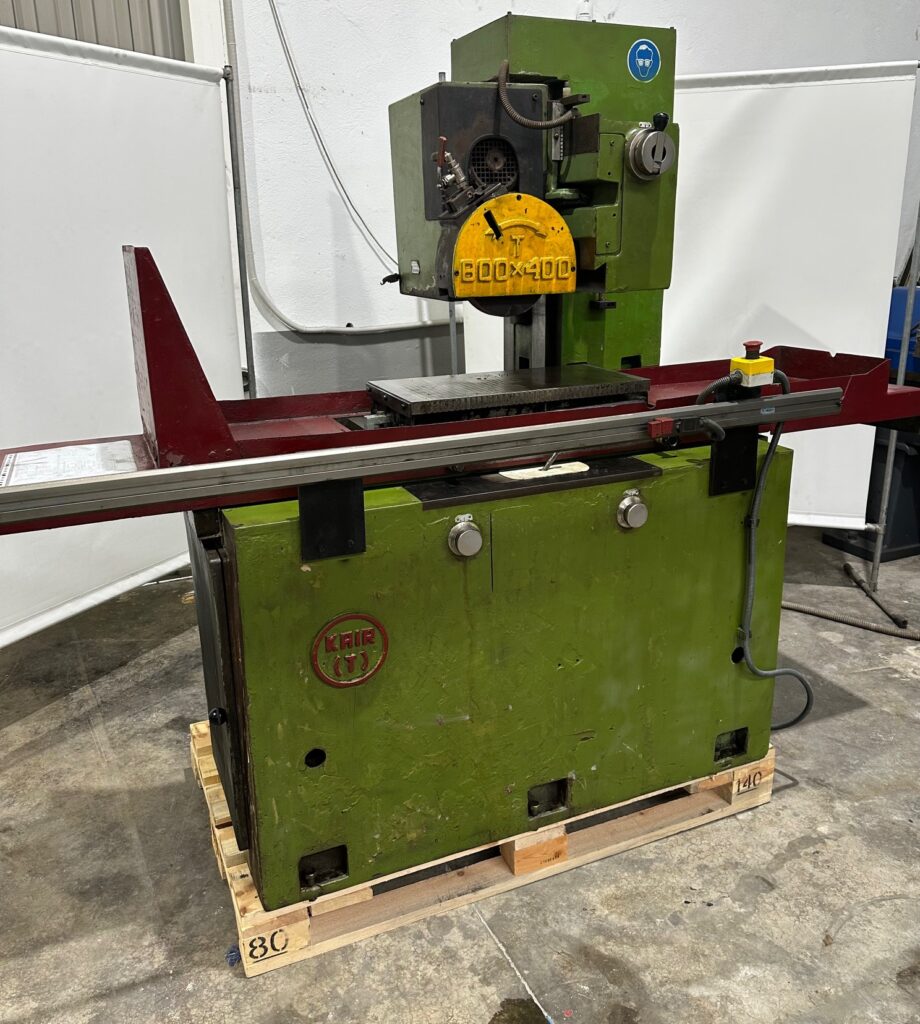
Buying a used industrial grinding machine is one of the most delicate decisions in workshop machinery investment, since these machines work to tolerances of just a few microns and any hidden wear can compromise the precision of finished parts. Unlike a lathe or a milling machine, where a certain amount of play can be tolerated, on a grinding machine the surface finish and dimensional accuracy are the entire reason the machine exists. In this guide we cover the types of grinding machines on the market, what precision really means for this kind of equipment, how to evaluate the spindle and overall condition before buying, and which mistakes to avoid so you don’t end up with a costly surprise. We’ll also look at indicative prices, applications by industry, and a comparison table to help you decide which type of grinding machine best suits your production.
The used machinery market offers real opportunities for shops that need precision machining without taking on the cost of new equipment, but it demands technical judgement. Let’s break down everything you need to know before signing the purchase.
What Is an Industrial Grinding Machine and What Is It Used For?
An industrial grinding machine is a machine tool that uses a rotating abrasive wheel to remove material in very small amounts, on the order of microns, in order to achieve extremely tight dimensional precision and a fine surface finish. It is typically used as the final machining operation, after a part has already gone through a lathe or milling machine, to correct geometric deviations, harden the surface, or reach tolerances that no other material-removal process can guarantee. It is an essential machine in sectors such as mould and die manufacturing, automotive, aerospace, and the repair of precision mechanical parts, where the fit between components must be almost perfect.
The working principle is based on the wheel’s rotational speed, the workpiece feed rate, and the depth of cut — three variables that must be precisely calibrated to avoid surface burning or loss of tolerance. That’s why, when evaluating a used grinding machine, it isn’t enough to look at its exterior condition: you need to verify that the spindle-wheel-bed assembly still holds the rigidity and accuracy it was originally designed with.
What Types of Grinding Machines Are Available on the Market?
There are essentially two main families of industrial grinding machines: surface grinders and cylindrical grinders, although each family has specific variants depending on the application. A surface grinder works with a horizontal magnetic chuck onto which the workpiece is fixed, and the wheel moves back and forth to grind flat surfaces, squareness, and parallelism. It’s the most common machine in die shops, mould shops, and industrial maintenance, with table sizes typically ranging from 300 x 600 mm up to more than 600 x 2000 mm on larger-capacity machines.
A cylindrical grinder, on the other hand, is used to machine parts of revolution: shafts, spindles, bushings, and hydraulic cylinders. There are external, internal, and universal versions, capable of working between centres with lengths ranging from 500 mm to more than 2000 mm on industrial machines. There are also centerless grinders, widely used for high-volume production of bars and shafts, where the workpiece isn’t held between centres but rests on a blade and rotates between two wheels, delivering much higher throughput on simple-geometry parts.
Precision and Spindle: The Factors That Determine Machine Quality
The spindle is the heart of any grinding machine and the element that most affects final precision. On a surface grinder, the wheel spindle must rotate without vibration or axial play, typically running on precision bearings or hydrostatic bearings on higher-end models. A worn spindle results in vibration marks on the workpiece, loss of surface finish, and, in the worst cases, the inability to hold tolerances tighter than 0.01 mm. When inspecting a used machine, it’s worth turning the spindle by hand, checking for noise or perceptible play, and, whenever possible, requesting a real grinding test on a sample part.
Beyond the spindle, the geometric accuracy of the bed and slideways is critical. The slideways must maintain longitudinal and transverse travel without play, since any deviation translates directly into a loss of flatness or roundness. Many used machines feature digital readouts to make positioning control easier, and some more advanced models include CNC control to automate repetitive grinding cycles — a feature that is especially valued in high-volume production of precision parts.
What Should You Check Before Buying a Used Industrial Grinding Machine?
Before closing the purchase of a used grinding machine, there are several technical points that must be inspected without exception. The first is the condition of the magnetic chuck on surface grinders: it should provide uniform holding across its entire surface, with no dead zones or loss of magnetism, which is easy to check with a test part. The second point is the coolant cooling and filtration system, essential for preventing part burning and extending wheel life; a poor filtration system is a sign of neglected maintenance.
It’s also essential to check the condition of the slideways and carriages, looking for play, uneven wear, or deep scoring, as well as the operation of the feed motors and limit switches. On cylindrical grinders, you also need to check the alignment between the workhead and the tailstock, since even minimal misalignment produces taper on the machined shaft. Finally, it’s worth requesting the maintenance history and, whenever possible, a working demonstration with the actual wheel and coolant running, not just a dry start-up.
| Grinding machine type | Main application | Typical precision | Common capacity |
|---|---|---|---|
| Surface grinder | Flat surfaces, moulds, dies | 0.005 – 0.01 mm | 300×600 mm to 600×2000 mm table |
| Universal cylindrical grinder | Shafts, spindles, hydraulic cylinders | 0.01 mm | 500 to 2000+ mm between centres |
| Centerless grinder | High-volume production of bars and shafts | 0.01 – 0.02 mm | High volume, small/medium diameters |
| Internal grinder | Bores, bushings, hollow cylinders | 0.005 – 0.015 mm | Internal diameters from just a few mm |
How Much Does a Used Industrial Grinding Machine Cost?
The price of a used grinding machine varies enormously depending on type, size, and condition. A mid-size surface grinder with a 300 x 600 mm magnetic chuck in good condition can be found from around €4,000-8,000, while larger-capacity machines with CNC or tables over 1000 mm can exceed €20,000. Cylindrical grinders tend to sit in similar or higher price ranges, especially if they include CNC control or integrated internal grinding heads — features that add noticeably to the price but bring extra production versatility.
Compared to the cost of a new machine, which can be three or four times higher, buying a well-inspected used grinding machine gives you access to established brands such as Hidroprecis or Txurtxil at a fraction of the cost, provided the seller can guarantee the mechanical condition and offer a verified start-up. It’s important not to be guided solely by the lowest price, since a cheap machine with a damaged spindle can end up costing more in repairs than the initial savings.
Which Industries Rely on Precision Grinding Machines?
The industrial grinding machine is a tool used across numerous production sectors. In the mould and die industry it’s essential for achieving the mating surfaces that guarantee a perfect seal between plates, while in the automotive and mechanical components sector it’s used for the final finishing of shafts, cams, and bearings that require very tight tolerances. It’s also common in repair and industrial maintenance workshops, where worn parts are ground back to their original size before being reassembled into machines or vehicles.
Another highly relevant field of application is the manufacture of cutting tools and tooling, where a surface grinder can achieve flatness and parallelism that no conventional milling machine can match. In job shops working to custom orders, having your own grinding machine — even a used one — means you can offer a full service to your customers without relying on outsourcing precision finishing to a third party, which shortens lead times and improves final part quality control.
What Are the Most Common Mistakes When Buying a Used Grinding Machine?
One of the most frequent mistakes is focusing only on the machine’s cosmetic appearance rather than its actual behaviour under load. A grinding machine can have fresh paint and look immaculate while still hiding a spindle with play or worn slideways that aren’t visible at first glance. Another common mistake is failing to check spare parts availability, especially on older models or those from manufacturers that no longer exist, which can complicate future repairs. It’s also common to underestimate the cost of transport and installation, since these machines often weigh several tonnes and require precise levelling on the workshop floor to avoid losing accuracy after relocation.
Finally, many buyers don’t request a real grinding test on an actual part before closing the deal, settling instead for seeing the machine run empty. This test is the only reliable way to confirm that the surface finish and dimensional tolerance actually match what the seller is promising. At Valcomaq, every machine goes through an inspection and reconditioning process before it’s offered for sale, precisely to avoid this kind of surprise for the end buyer.
Which Type of Grinding Machine Best Suits Your Shop?
Choose a surface grinder if: your production is centred on flat parts, moulds, dies, or tooling that requires extreme parallelism and flatness, and you need versatility to work parts of varying sizes held on a magnetic chuck. It’s the most common choice in general machining and die shops, and is usually the first grinding machine a workshop adds when it starts offering precision finishing services.
Choose a cylindrical grinder if: your main activity involves manufacturing or repairing shafts, spindles, hydraulic cylinders, or any part of revolution that needs an extremely precise external or internal finish. It’s essential in industrial maintenance workshops and heavy machinery repair shops, where restoring a worn shaft to its original size delivers substantial savings compared with manufacturing a new one.
Choose a centerless grinder if: your production is high-volume and you work with constant-diameter bars or shafts in large quantities, since this type of machine offers a production rate far higher than a conventional cylindrical grinder, though with less flexibility for parts with variable geometry.
Choose a CNC-equipped machine if: you need repeatability across long runs of complex parts and want to reduce dependence on operator skill, particularly in sectors such as automotive or standardised component manufacturing where traceability and dimensional consistency are critical.
Used Grinding Machines at Valcomaq: Guaranteed Precision
At Valcomaq we understand that a used industrial grinding machine only makes sense if it retains the precision it was designed for, which is why every machine in our catalogue goes through a mechanical inspection and reconditioning process before we offer it to our customers. With more than 20 years of experience buying, reconditioning, and selling industrial machinery, we’re able to offer genuine technical guidance on which type of grinding machine best fits each production process, whether surface, cylindrical, or internal grinding.
If you’re considering adding a grinding machine to your workshop, or if instead you have a machine you no longer use and want to know its market value, at Valcomaq we can help with both processes with the same level of dedication. We invite you to browse our used machinery catalogue, where you’ll find grinding machines and other industrial equipment, inspected and ready to work, and you can also check how our service works if you want to sell your machine in the we buy your machine section. For any technical question about precision, spindle condition, or the state of a specific machine, contact us through our contact page and we’ll give you personalised advice tailored to your production’s real needs.