


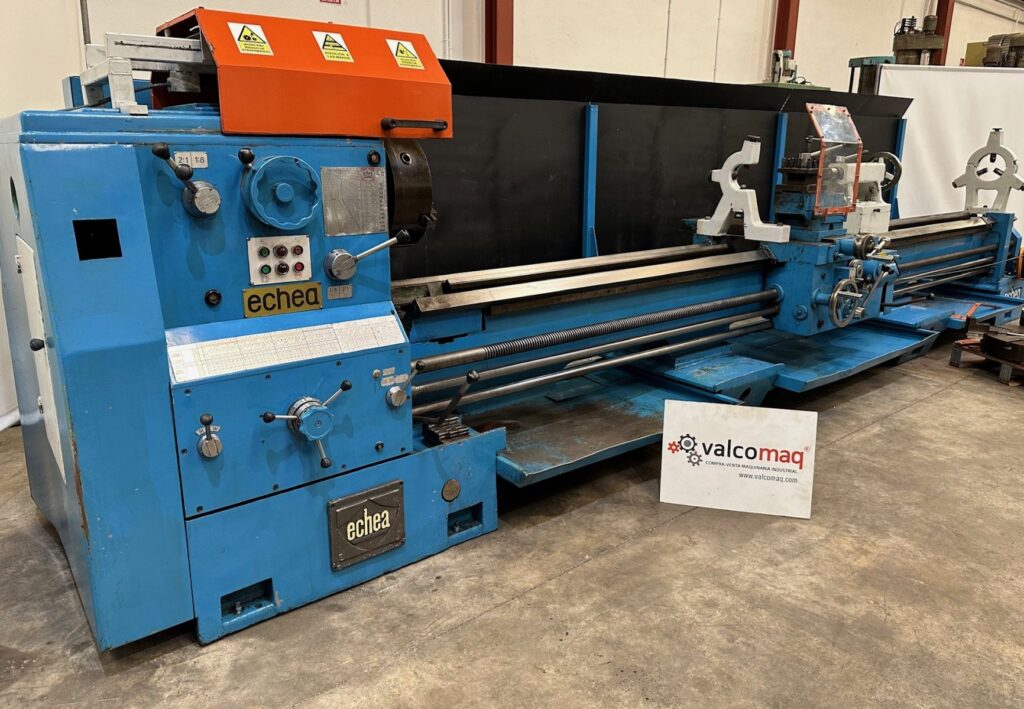
When it comes to equipping a machine shop on a tight budget without giving up reliability, the used Echea lathe is frequently among the top choices for small and medium-sized workshops. This Spanish brand, with a long track record in machine tool manufacturing, has left a solid number of units on the second-hand market that, after proper reconditioning, continue to deliver strong performance for many years to come.
In this article we look at what defines a used Echea lathe, how it compares to reference brands in our catalog such as Pinacho or Gurutzpe, which industrial applications it suits best, what mistakes to avoid when buying one, and what price range to expect. By the end, you should have clear criteria to decide whether this brand fits your workshop’s real needs.
What is an Echea lathe and what sets it apart in the used machinery market?
Echea is a Spanish manufacturer of conventional center lathes traditionally aimed at general machining shops, industrial repair work and small production runs. Its most common used models feature center distances ranging from 1000 to 3000 mm, with center heights of 210 to 300 mm over the bed, enough to handle medium-to-large parts without needing to move up to heavy-duty lathes. The main spindle, with combined metric and imperial thread pitches, allows both cylindrical turning and moderate-precision threading work.
What sets a used Echea lathe apart from cheaper alternatives on the second-hand market is the solidity of its bed, cast in high-density iron with hardened ways, which keeps wear low even after decades of intensive use. Many of the workshops now selling these machines originally bought them for industrial maintenance work, so they often reach the market with moderate wear compared to units that ran continuous three-shift production.
How robust and precise is a used Echea lathe really?
The robustness of a used Echea lathe is most noticeable when machining long or large-diameter parts, where bed rigidity prevents vibrations that would otherwise affect surface finish. Models fitted with fixed and travelling steadies, common in longer-bed configurations, allow slender shafts to be held without deflection, something particularly valued in workshops repairing pumps, gearboxes or transmission shafts.
In terms of precision, a properly serviced Echea lathe with reground ways can hold hundredth-of-a-millimetre tolerances on medium-length parts, more than enough for general machining, spare-part fitting or short production runs. That said, these are conventional lathes without numerical control, so final precision depends heavily on operator skill and on the condition of the digital readout, when fitted, and of the feed screws.
Echea vs Pinacho vs Gurutzpe lathes: what are the differences?
Within the used lathe catalog, workshops often hesitate between an Echea lathe, a Pinacho lathe or a Gurutzpe lathe, three brands with a similar history in the domestic market but distinct nuances. Pinacho is known for its wider range of sizes and a larger supply of original spare parts, which makes long-term maintenance easier. Gurutzpe, on the other hand, has specialised in large, high-power lathes designed for parts of considerable diameter and length, such as the Super RT-API or Super BT models available in the Valcomaq used machinery catalog.
The used Echea lathe, by contrast, tends to sit in the middle ground: it doesn’t reach the extreme dimensions of a large-capacity Gurutzpe, but it offers a very competitive value-for-money ratio compared with a similarly specced Pinacho, especially among mid-range models that have already been on the market for several decades. For workshops that don’t need to machine parts over 3000 mm between centers or extreme diameters, this difference translates into significant savings without sacrificing mechanical reliability.
| Feature | Echea Lathe | Pinacho Lathe | Gurutzpe Lathe |
|---|---|---|---|
| Typical center distance | 1000-3000 mm | 1000-4000 mm | up to 8000 mm |
| Center height | 210-300 mm | 250-400 mm | up to 500 mm |
| Main focus | General machining and maintenance | Versatile workshops, short runs | Large, heavy parts |
| Spare parts availability | Moderate | High | Moderate-High |
| Typical used price | Budget-friendly | Mid-range | Mid-to-high |
Which workshops are best suited to a used Echea lathe?
A used Echea lathe is particularly well suited to industrial maintenance workshops, mechanical locksmiths, agricultural repair shops and small machining businesses that need a reliable machine for one-off jobs or short runs. Its medium footprint makes it easy to fit into workshops with limited floor space, and its mechanical simplicity means technicians with basic turning skills can operate it without a long learning curve, unlike more sophisticated CNC lathes.
It’s also a very sensible choice for vocational schools and technical training centers, where mechanical robustness and ease of maintenance are prioritised over the latest numerical control technology. In these settings, an Echea lathe serviced by a specialist, with reground ways and an updated electrical system, can operate safely for many more years, at a fraction of the cost of an equivalent new machine.
Applications by industrial sector
In industrial maintenance, the used Echea lathe is commonly used to regrind shafts, manufacture bushings, fit flanges and repair pump and gearbox components. In the agricultural and heavy machinery sector, it’s often found in workshops dedicated to repairing drive shafts, gears and tractor components, where the rigidity of the bed absorbs significant machining loads without compromising the final accuracy of the part.
In general metalworking shops, this type of lathe pairs perfectly with more specialised equipment such as a milling machine or an industrial saw, covering the turning operations that come up occasionally within a broader workflow. This versatility is one of the reasons many workshops choose to add a used Echea lathe as a secondary support machine, reserving CNC equipment for jobs with tighter dimensional demands.
How can you extend the service life of a used Echea lathe?
Maintaining a used Echea lathe is, in essence, no different from maintaining any conventional lathe: regular lubrication of ways and lead screws, checking the condition of drive belts, verifying play in the cross and longitudinal slides, and regular cleaning of swarf to keep abrasive particles out of the hardened ways. Well-planned preventive maintenance, with lubrication intervals every 40-50 hours of use, can extend the machine’s service life by several more decades without a noticeable loss of precision.
It’s also worth checking the condition of the electrical cabinet and motors on units that have been idle for several years, since humidity and dust can affect the insulation. At Valcomaq, before putting any used lathe up for sale, we carry out a full inspection covering these points, ensuring the machine arrives at your workshop ready to work from day one, with no surprises or hidden commissioning costs.
What mistakes should you avoid when buying a used Echea lathe?
One of the most common mistakes when buying a used Echea lathe is failing to check the actual wear on the bed ways, which tends to concentrate in the area closest to the chuck, since it’s the most heavily used section. Excessive wear here causes taper in turned parts and calls for costly regrinding. It’s also common to overlook the condition of the chuck jaws, whose centering accuracy directly affects part finish, and the condition of the headstock bearings, which cause noise and vibration when worn.
Another common mistake is not checking the technical documentation and maintenance history of the machine, something you can and should demand when buying through a specialised dealer. Buying a used Echea lathe with no warranty, no prior inspection and no chance to test it running can end up generating unexpected costs that wipe out the initial savings compared with buying a new machine or a unit from another brand with better after-sales support.
How much does a used Echea lathe cost?
The price of a used Echea lathe varies considerably depending on size, condition and included accessories, such as steadies, an extra chuck or a digital readout. As a general reference, mid-size models with center distances of 1500 to 2000 mm in good working condition typically sit in a price range noticeably below an equivalent Pinacho lathe, while larger units or fully reconditioned machines move closer to that mid-range bracket.
It’s important to understand that the initial purchase price shouldn’t be the only factor in your decision: an inspected lathe, backed by a warranty and a specialised seller, reduces the risk of later repair costs and ensures minimal downtime after installation. That’s why comparing listing prices alone, without considering the actual condition of the machine, can lead to poor decisions in the medium term.
Frequently asked questions about used Echea lathes
Are spare parts still available for an older Echea lathe? Generally yes, although availability depends on the specific model and its age; many generic mechanical components, such as bearings, belts or feed screws, can be replaced with equivalents from current manufacturers without difficulty, which makes long-term maintenance easy even on units with several decades of service.
Is an Echea lathe suitable for fine precision work? For very demanding tolerances, such as those required in aerospace or industrial watchmaking, it’s better to opt for a CNC or dedicated precision lathe; however, for general machining, repair and maintenance work, a well-adjusted used Echea lathe more than meets the standard requirements of the metalworking industry.
Which used Echea lathe should you choose for your workshop?
Choose a used Echea lathe if: your workshop mainly handles maintenance work, part repair or general machining, and you’re looking for a robust, easy-to-operate machine at a lower acquisition cost than similar brands in its class.
Choose a Pinacho lathe if: you need maximum availability of original spare parts and a very wide range of sizes that lets you grow or adapt the machine to different types of projects without changing maintenance supplier.
Choose a Gurutzpe lathe if: your work requires machining large-diameter, long parts, with center distances exceeding 3000 mm, and you need the maximum power and structural rigidity offered by the largest-capacity models on the market.
Choose a CNC machine if: your production demands repeatability across medium or long runs and very tight tolerances that a conventional lathe, however robust, cannot consistently guarantee on every part.
Used Echea lathes at Valcomaq: a safe bet for your workshop
At Valcomaq we understand that every workshop has different needs, which is why we work with a wide catalog of used lathes from different brands, inspected and ready to work from day one. Our more than twenty years of experience buying, reconditioning and selling industrial machinery allow us to give you objective advice on whether an Echea lathe, a Pinacho lathe or a Gurutzpe lathe best fits your production, your budget and the space available in your facility.
If you’re considering adding a used Echea lathe to your workshop, or you have a machine from this or another brand you’d like to sell, Valcomaq can help. Visit our used machinery catalog, check out our section on selling your industrial machinery, and don’t hesitate to contact us for expert advice and a fair, no-obligation valuation.