


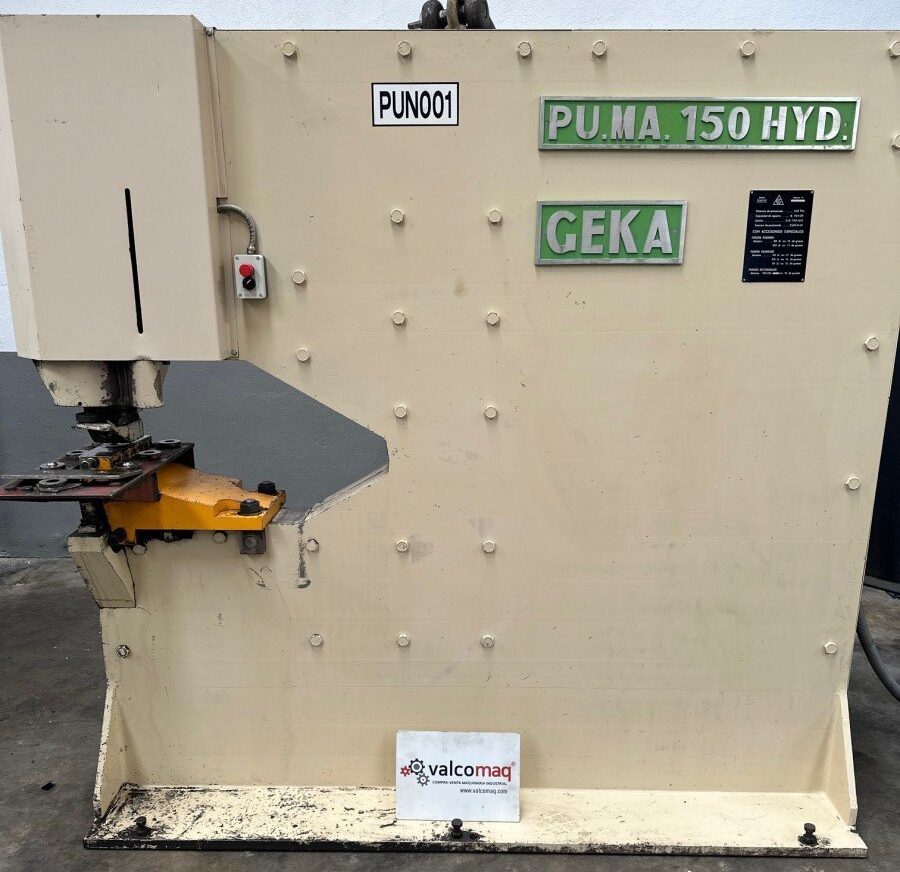
Buying a used industrial punch press can be one of the most profitable investments for a sheet metal workshop, provided the right machine is chosen. This type of equipment allows you to pierce, trim and form metal parts quickly and accurately, but not every punch press is built the same or suited to the same kind of production. In this complete guide we go through the technical factors that really matter when evaluating a second-hand punch press: punching capacity, number of stations, power, drive type and the presence of CNC control. We will also look at what to physically inspect before buying, common mistakes, indicative prices and which buyer profile fits each type of machine.
The used machinery market offers very attractive opportunities compared to buying new equipment, with savings that can exceed 50% of the catalogue price. However, a poorly inspected second-hand punch press can turn into a costly problem if the hydraulic system is worn or the turret has excessive play. That is why, before signing off on any purchase, it pays to understand the technical terminology and know exactly what questions to ask the seller.
What Is an Industrial Punch Press and What Is It Used For?
An industrial punch press is a machine tool designed to pierce, trim or form sheet metal through a punch that applies pressure onto a die, causing the material to shear or deform. It is widely used in metal fabrication, electrical cabinet manufacturing, HVAC (ducts and grilles), agricultural machinery construction, automotive and light metal structures. Compared with laser or plasma cutting, the punch press stands out for its speed on serial production runs with repetitive geometries: it can deliver hundreds of hits per minute with almost no thermal stress on the material.
There are single-station fixed punch presses (with a single tool set) and multi-station turret punch presses, which are far more versatile because they hold several punch-and-die sets that rotate automatically according to the work program. In the used industrial segment, 20, 32 or 58-station turrets are the most common, and their condition directly affects the final quality of the punched part.
What Types of Punch Presses Are Available on the Used Machinery Market?
On the used industrial machinery market you will mainly find three types: mechanical punch presses, which use a flywheel and clutch to deliver constant force; hydraulic punch presses, quieter and with better control over the force applied on each stroke, ideal for variable thicknesses; and CNC turret punch presses, fitted with numerical control that automates sheet positioning and station selection. The latter are currently the most in demand because they allow complex geometries to be programmed and repeated with very tight tolerances, typically between ±0.1 and ±0.2 mm.
There are also combination punch-and-shear machines, highly valued in small and medium workshops because a single machine can punch profiles and flat bars while also making straight cuts, saving both floor space and investment. When buying a used industrial punch press, it is essential to identify which technology fits the workshop’s production type: short runs with frequent reference changes benefit from CNC, while simple, repetitive production can work perfectly well with a well-maintained conventional mechanical machine.
How Much Punching Capacity Do You Really Need?
Punching capacity is usually expressed in tons of force (from 20 to more than 300 tons in industrial machines) and determines the maximum sheet thickness the machine can pierce without straining the system. A 30-45 ton punch press is enough for thin carbon steel sheet up to 3-4 mm, while workshops working with 6 mm thicknesses or more, or with harder stainless steel, need machines rated 60 tons and above. It is also important to check the maximum admissible punch diameter and the throat depth, which limits how far into a large sheet the machine can punch without having to reposition it.
Oversizing capacity is not always a good idea: a high-tonnage punch press consumes more energy, takes up more space and usually has higher maintenance costs. On the other hand, undersizing forces multiple passes or means certain jobs must be turned down, hurting competitiveness against other workshops. The practical recommendation is to calculate the required capacity based on the most common thickness and material in your order book, leaving a safety margin of 15-20% for production peaks.
Why Does the Number of Turret Stations Matter?
The number of turret stations defines how many tools (punch and die) the machine can hold simultaneously without needing to stop for manual tool changes. The most basic turrets have 8 or 10 stations, enough for simple jobs with few geometries, while 20, 32 or even 58-station turrets allow round, square, rectangular and special shapes to be combined in a single program run, significantly cutting downtime. On high-end CNC punch presses, some stations also feature automatic rotation (auto-index), allowing the tool to be oriented at any angle without a physical tool change.
When evaluating a used machine, it is worth checking the condition of the turret sockets, since wear from intensive use can create play that affects stroke perpendicularity and, consequently, cut quality. A good indicator is to ask the seller for a punching test on real sheet metal and verify there is no excessive burr or hole-edge deformation.
What Role Do Power and Punching Force Play?
The motor power and available punching force determine cycle speed and the ability to work with tougher materials such as stainless steel or hard aluminium alloys. On hydraulic punch presses, power is usually measured in kW of the hydraulic pump, with typical ranges from 5.5 kW for lightweight machines up to 22 kW or more for high-capacity ones. An oversized pump can deliver a higher number of strokes per minute, a decisive factor in serial production where every second of cycle time counts.
The punch stroke is also relevant, as it must be long enough to clear the maximum working thickness with margin, along with the feed speed of the sheet positioning system on CNC models, generally expressed in metres per minute. The higher this speed, the shorter the overall cycle time, an especially important figure for subcontract workshops that need to maximise daily output.
Is a CNC Punch Press Worth It Compared to a Manual One?
CNC control completely transforms a punch press’s productivity, since it automates sheet positioning through motorised X-Y axes and allows programming directly from CAD/CAM files, drastically cutting setup times and human error. Most modern CNC controllers also automatically optimise the punching sequence (nesting) to minimise movement and tool wear, something impossible to replicate manually with the same precision.
Even so, a well-maintained used manual or semi-automatic punch press remains a valid option for workshops with short runs, very simple parts or tight budgets, since its purchase and maintenance cost is considerably lower. The key is to analyse your workload: if you exceed 200-300 pieces a day with frequent reference changes, CNC quickly pays for its extra upfront cost through savings in labour and changeover time.
| Punch press type | Typical capacity | Stations | Main advantage | Workshop profile |
|---|---|---|---|---|
| Fixed-station mechanical | 20-45 tons | 1-4 | Low cost, simple maintenance | Simple, repetitive production |
| Manual hydraulic | 30-80 tons | 4-10 | Fine control of applied force | Workshops with variable thicknesses |
| CNC turret | 30-150 tons | 20-58 | Precision, versatility and automation | Medium-to-high runs with varied geometries |
| Combined punch-and-shear | 20-60 tons | 1-6 | Saves space and investment | Small and medium multi-purpose workshops |
What to Check Before Buying a Used Punch Press?
Before closing the purchase of any used punch press, it is essential to carry out a technical inspection covering the condition of the hydraulic system (hoses, seals, pump and valves), the absence of oil leaks and correct working pressure as shown on the gauge. You should also check the wear on the punches and dies included in the lot, since replacing them can involve a significant extra cost if they are heavily worn or the model has been discontinued by the original manufacturer.
On CNC models, it is worth checking the condition of the electrical cabinet, the age of the numerical control and whether software updates or electronic spare parts are still available on the market, since some discontinued brands make it hard to find replacement control boards. Finally, it is advisable to request a running test both empty and under real load, watching for vibration levels, unusual noise and repeatability accuracy over several consecutive strokes on the same point.
What Are the Most Common Mistakes When Buying a Used Punch Press?
One of the most frequent mistakes is focusing purely on price while ignoring the real cost of commissioning: transport, levelling, three-phase electrical connection, and even upgrading the workshop’s electrical panel for higher-power machines. Another common error is failing to verify the hours of use or maintenance history, since a machine with thousands of hours and no periodic servicing may have hidden wear in the turret or guiding system that only shows up after several weeks of intensive use.
It is also common to underestimate the importance of the tooling set (punches and dies) included in the deal: buying a punch press without sufficient tooling forces an additional investment that sometimes cancels out the savings made on the machine itself. Finally, many buyers skip specialist advice that could objectively assess the real condition of the equipment, leaving the decision entirely in the seller’s hands, which does not always guarantee an unbiased valuation.
How Much Does a Used Industrial Punch Press Cost?
The price of a used industrial punch press varies enormously depending on capacity, technology and age. A basic 20-30 ton mechanical punch press in good condition can be found from €3,000-6,000, while a 45-60 ton hydraulic unit with a multi-station turret usually sells for between €8,000 and €18,000. CNC turret punch presses with modern numerical control and capacities of 80 tons or more can reach €25,000 to €60,000, depending on condition, control brand and year of manufacture.
These ranges are indicative and can vary depending on the domestic or international market, spare parts availability and the overall condition of the structure and electrical system. In any case, buying through a specialist dealer who inspects and guarantees the machine’s operation significantly reduces the risk of post-purchase surprises, which is especially relevant for equipment with several years of prior service.
Which Industries Use Industrial Punch Presses the Most?
The punch press is a key tool in industries such as electrical panel and metal cabinet manufacturing, where precise holes are needed for ventilation, wiring and component mounting. It is also essential in the HVAC industry, for manufacturing ducts, grilles and diffusers, as well as in light metal structure construction, street furniture, industrial bodywork and agricultural equipment. Across all these sectors, the right combination of punching capacity, sufficient number of stations and, in many cases, CNC control determines a workshop’s competitiveness against its rivals.
In addition, many metal subcontracting workshops (so-called job shops) invest in high-capacity CNC punch presses precisely because they allow shorter lead times and a wider variety of geometries to be offered to customers without needing dedicated tooling for every part, a decisive factor in a market where production flexibility is increasingly valued by end customers.
Which Type of Punch Press Best Suits Your Workshop?
Choose a fixed-station mechanical punch press if: your production is simple, repetitive and involves few reference changes, your budget is tight and you prioritise mechanical reliability over geometric versatility. This type of machine requires less specialised maintenance and is more intuitive to operate for staff with limited CNC programming training.
Choose a manual hydraulic punch press if: you work with variable sheet thicknesses and need finer control over the force applied on each stroke, without requiring the full automation of a CNC turret. It is a well-balanced middle ground between cost and performance for medium-sized workshops.
Choose a CNC turret punch press if: your workshop handles medium-to-high runs with multiple geometries, you need to cut tool changeover times and you want to maximise daily productivity through direct programming from CAD files. The upfront investment is higher, but the return comes quickly at high production volumes.
Choose a combined punch-and-shear machine if: you have limited workshop space and need to perform both punching and straight cuts on profiles and flat bars without investing in two separate machines. It is the most efficient option for small or medium multi-purpose workshops.
Used Punch Presses at Valcomaq: A Safe Investment for Your Workshop
At Valcomaq we have specialised for more than 20 years in buying, reconditioning and selling used industrial machinery, including metal punch presses inspected and ready to work from day one. Every machine in our catalogue goes through a technical inspection process that guarantees the correct operation of the hydraulic system, the turret and, where applicable, the CNC control, giving our customers the peace of mind of investing in a reliable machine backed by real guarantees.
If you are considering adding a used industrial punch press to your workshop, we invite you to check out our used machinery catalogue, where you will find inspected equipment of different capacities and technologies. And if what you need is to sell your punch press or other industrial equipment, at Valcomaq we also buy your machine, offering a fair valuation after a technical inspection. Do not hesitate to contact us for specialist advice and to find the punch press that best suits your production needs.