


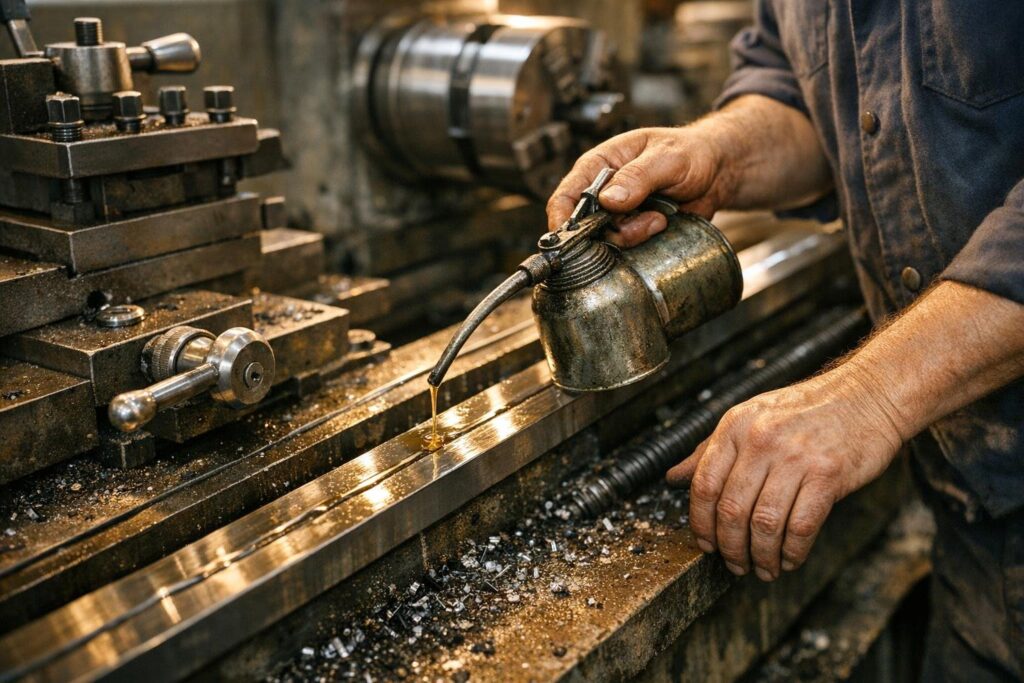
Preventive maintenance for industrial machinery is one of the factors that most influences the profitability and safety of any machine shop. A lathe, a milling machine, a radial drill or an industrial saw can accumulate thousands of working hours with barely any incidents if they receive proper lubrication, inspection and adjustment at the right time. However, when maintenance is pushed aside, breakdowns pile up, downtime skyrockets and the resale value of the equipment drops noticeably.
In this article we cover the key aspects of preventive maintenance for industrial machinery: how it differs from corrective and predictive maintenance, how to set up an effective lubrication routine, what to check periodically on lathes, milling machines, drills and saws, the most common mistakes that accelerate wear, and how to adapt the maintenance plan to the size and workload of each shop.
Why is preventive maintenance so important for industrial machinery?
An unexpected breakdown on a center lathe or a fixed-bed milling machine doesn’t just halt production: it forces you to reschedule orders, hunt for spare parts that are often discontinued and, in the worst case, replace critical components such as the main spindle or precision bearings. The cost of unplanned downtime is usually three to five times higher than that of a scheduled inspection, because it includes not only the repair but also lost production hours and, in many cases, penalties for late delivery to the end customer.
Beyond day-to-day profitability, preventive maintenance directly shapes the future value of the machine. A machine that is regularly serviced, with greased ways, properly tensioned belts and controlled oil levels, can keep working with precision for 20 or 25 years, while a neglected machine ages prematurely and loses tolerances in barely a decade. At Valcomaq we see this every day: when we buy used machinery, maintenance history is one of the criteria that carries the most weight when setting the price and deciding whether it is worth reconditioning.
What’s the difference between preventive, predictive and corrective maintenance?
Corrective maintenance is the most basic approach: action is taken only once the machine has already failed. It’s the cheapest option in the short term, but also the most expensive in the long run, because breakdowns tend to appear at the worst possible moment and drag secondary damage into other components. Preventive maintenance, on the other hand, is based on fixed schedules or operating hours: oil is changed every 2,000 hours, belts are checked every six months, ways are greased weekly, regardless of whether there are symptoms of failure. It’s the standard in most metalworking shops because it combines a reasonable cost with a drastic reduction in major breakdowns.
Predictive maintenance adds a layer of sophistication: it uses vibration analysis, thermography or oil analysis to detect wear before it turns into a breakdown. It’s common in large plants with high-value machinery, such as CNC machining centers or precision grinders, but it’s less cost-effective in small shops except on critical equipment. The most effective combination for most businesses is a solid preventive plan, reinforced with occasional predictive inspections on the machines that clock the most hours or are the most costly to replace.
Lubrication: the foundation of any preventive maintenance plan for industrial machinery
Lubrication is, by far, the preventive maintenance task with the best cost-benefit ratio. The prismatic ways of a lathe or a milling machine need low-viscosity oil, typically ISO VG 68, applied daily or through centralized lubrication systems that dose small amounts every few work cycles. Spindles and headstocks, on the other hand, usually require high-temperature lithium grease or ISO VG 220 oils in gearboxes, depending on the manufacturer’s specifications. Using the wrong lubricant, or simply failing to renew it, is one of the most common causes of premature seizing in machining equipment.
Beyond the type of lubricant, the frequency and cleanliness of the process also matter. Ways must be cleared of chips and coolant before every greasing session, because metal particles act as an abrasive if trapped under a layer of grease. As a general rule, ways and carriages should be greased daily on heavily used machines, headstock oil levels should be checked weekly, and a full oil and filter change should be carried out every 1,500-2,000 working hours, always adjusting these intervals to each manufacturer’s recommendations.
How to periodically inspect industrial lathes, milling machines and drills?
On a lathe, periodic inspection should cover the condition of the main spindle, the play in the bed ways, the tension of the drive belts and the proper functioning of the tailstock. It’s also worth checking chuck accuracy monthly and detecting any abnormal vibration at high speeds, as this usually signals bearing wear ahead of time. If you work with brands such as Gurutzpe, Pinacho or Echea, you’ll find technical manuals with specific intervals that should be followed; you can browse serviced machines with documented maintenance history in Valcomaq’s used lathe catalogue.
On milling machines and radial drills, attention should focus on the column, headstock rigidity and the spindle cooling system, especially on high-capacity equipment such as radial drills for large-diameter holes. It’s advisable to check the coolant nozzles weekly, since a blockage causes overheating of both the tool and the spindle itself, and to check the squareness between table and column monthly, a parameter that drifts with heavy use and directly affects machining accuracy.
Alignment, leveling and vibration control on machine tools
A poorly leveled machine always works at a disadvantage, no matter how well lubricated it is. Leveling is checked with 0.02 mm/m precision levels on the beds and main ways, and should be reviewed after any relocation of the equipment, change of position in the shop, or floor renovation. An unleveled lathe or milling machine generates asymmetric loads on the ways, which accelerates their wear and causes loss of tolerance that is often mistakenly attributed to normal machine wear, when it could actually be fixed with a simple recalibration.
Excessive vibration is another indicator that should never be ignored. It can originate from an unbalanced chuck, a damaged bearing, insufficient anchoring to the floor, or a cutting tool in poor condition. Proper anchoring, using leveling plates and chemical anchors into the floor, significantly reduces vibration transmission between nearby machines, which is especially relevant in shops where shears, press brakes and heavy-tonnage presses coexist alongside precision machining equipment.
What common mistakes accelerate wear on industrial machinery?
One of the most frequent mistakes is postponing lubrication or doing it irregularly, trusting that the machine will «hold up one more week». Another common failure is ignoring unusual noises or vibrations until they lead to a major breakdown, when in fact they are the most reliable warning sign any machine can give. Using contaminated or degraded coolant, forcing the machine beyond its rated capacity, or using worn cutting tools that increase the load on the spindle are practices that drastically reduce the service life of lathes, milling machines and drills.
At an organizational level, the lack of a maintenance log is a mistake that becomes costly over time: without a record of working hours, oil changes and repairs, it’s impossible to anticipate when the next service is due or to spot recurring failure patterns. It’s also common to delegate maintenance to staff without specific training, which leads to incorrect adjustments or the use of unsuitable lubricants. Investing in basic training for the operator running each machine tends to reduce incidents more effectively than any other single measure.
Recommended maintenance frequencies by machine type
| Machine type | Main task | Recommended frequency |
|---|---|---|
| Lathes | Greasing the ways, checking spindle and belts | Daily / monthly |
| Milling machines | Leveling, cooling and column rigidity | Weekly / quarterly |
| Industrial drills | Nozzle condition and table-to-column squareness | Weekly / monthly |
| Industrial saws | Blade tension, coolant and cutting guides | Daily / monthly |
| Shears and press brakes | Hydraulic oil level and blade condition | Monthly / half-yearly |
| Grinders | Wheel balancing and spindle accuracy | Monthly / yearly |
How to adapt the maintenance plan to the size of your shop?
A small shop with two or three machines can manage preventive maintenance with a simple spreadsheet or logbook, noting down greasing dates, oil changes and visual inspections. What matters isn’t the sophistication of the tool, but the discipline in sticking to the set intervals. In this context, buying used machinery with a documented maintenance history, like the equipment we offer in Valcomaq’s catalogue, considerably reduces the risk of inheriting hidden problems.
In larger plants, with dozens of machines running across several shifts, it becomes worthwhile to implement computerized maintenance management software (CMMS) that automatically schedules tasks based on usage hours, generates alerts and centralizes each machine’s history. This type of system also allows you to prioritize predictive maintenance on critical equipment, such as machining centers or heavy-tonnage presses, while keeping a standard preventive plan for the rest of the machine fleet.
Choose a basic maintenance plan if: your shop has few machines, a moderate production pace and a trusted operator who can handle daily greasing and visual checks without needing complex management tools.
Choose a structured preventive maintenance plan if: your production depends on several machines running in parallel and you can’t afford unplanned downtime, so you need fixed schedules, hour logs and a clear person responsible for each task.
Choose to add predictive maintenance if: you have high-value or hard-to-replace machinery, such as CNC centers or precision grinders, where a major breakdown would mean weeks of downtime and a very high repair cost.
Choose a specialized used machinery supplier if: you’d rather start with equipment that’s already been inspected, reconditioned and comes with a reliable maintenance history, avoiding the risk of buying a machine with hidden wear.
Well-maintained used machinery: Valcomaq’s added value
At Valcomaq we see preventive maintenance for industrial machinery not just as advice for our customers, but as part of our own working process. Every lathe, milling machine, drill or saw that joins our catalogue goes through a thorough inspection of ways, spindles, hydraulic systems and transmission components before being put up for sale, guaranteeing that it arrives at the buyer’s shop ready to work from day one, with a service life ahead that justifies the investment.
Explore our catalogue of used industrial machinery and discover fully inspected and reconditioned equipment with all the guarantees. If you’re also thinking about selling your used machinery, at Valcomaq we buy your machine after a fair valuation based on its condition and maintenance history. If you have any questions about the best maintenance plan for your shop, contact us and we’ll be happy to advise you with no obligation.