


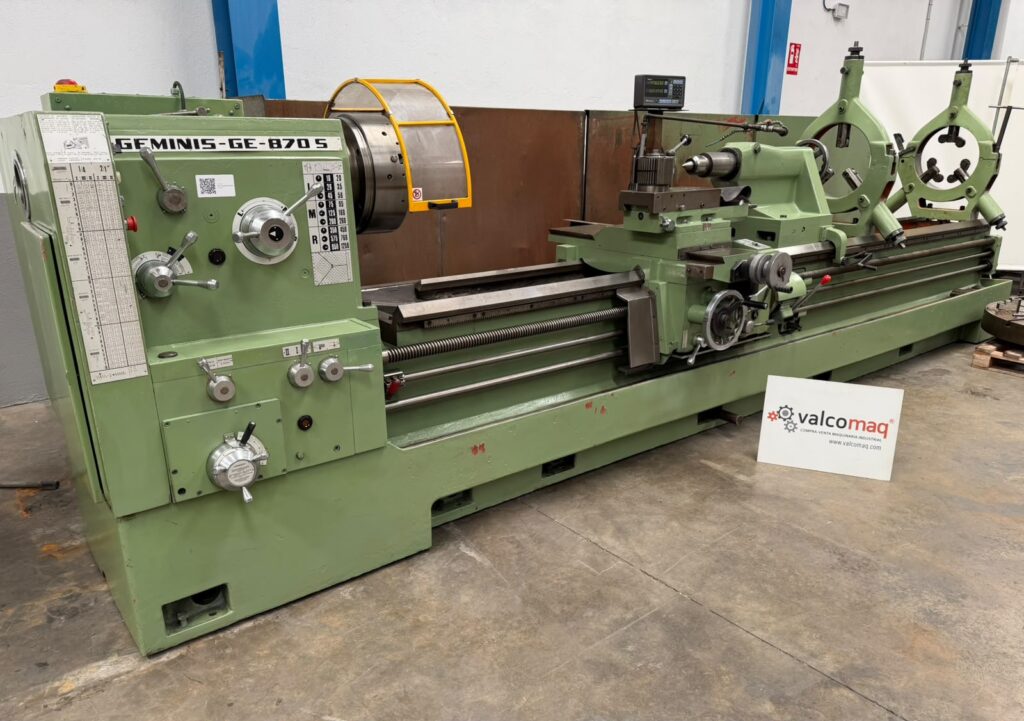
When a machine shop needs to expand its equipment fleet without blowing the budget, the used machinery market becomes the most sensible route, and within that market some brands have proven their reliability decade after decade. Used Geminis lathes are a great example of this: Spanish-built machines designed for heavy-duty turning that keep delivering precision results long after they left the factory floor. In this article we look at what defines this brand, what technical advantages it offers compared with other manufacturers found in the Valcomaq catalogue, which industrial applications suit it best, and what to check before buying a second-hand unit. We will also walk through a direct comparison with other lathe brands and a practical pricing guide so you can make an informed decision.
Throughout the text you will find concrete technical information on spindles, beds, power ratings and swing capacities, along with recommendations based on the type of shop and the type of part you need to machine. By the end, you should have a clear picture of whether a second-hand Geminis lathe is the right machine for your production or whether another option from the Valcomaq catalogue would serve you better.
What is a Geminis lathe, and what makes it different?
Geminis is a Spanish manufacturer of large-scale parallel lathes, specialised in rugged machines built for turning parts of large diameter and length. Unlike generalist manufacturers that cover light and medium ranges, Geminis has historically focused on the heavy-duty lathe segment, with hardened and ground beds capable of absorbing vibration during heavy stock-removal passes. This makes them highly valued machines in shops that work with forged parts, large-diameter shafts, or components for sectors such as wind energy, shipbuilding, or heavy equipment manufacturing.
Another distinctive feature is the structural solidity of the bed, typically made from high-quality cast iron with heat treatment, which reduces fatigue-related deformation even after years of intensive use. The most common models found on the second-hand market usually offer centre distances ranging from 1,500 mm to 4,000 mm or more, with spindle bores between 90 mm and 150 mm, designed for heavy material removal. This design philosophy explains why, even after fifteen or twenty years, a well-maintained Geminis lathe still holds very tight working tolerances.
What technical features stand out in used Geminis lathes?
Among the most relevant specifications of these machines is the swing over bed, which on the larger models can exceed 800 or 1,000 mm in diameter, allowing large-section parts to be machined without resorting to a vertical lathe. The chuck, usually between 630 mm and 1,000 mm in diameter, is paired with a Norton gearbox offering a wide range of feeds and thread pitches, which makes both fine turning and large-pitch threading of industrial shafts easier. Main motor power typically ranges from 15 kW to 37 kW depending on the model, enough to machine alloy steels without losing rpm during deep cuts.
Many second-hand units also feature reinforced fixed and travelling steady rests, long-travel tailstocks, and centralised lubrication systems that extend the life of the ways and spindle. As for controls, it is common to find both purely conventional versions with a digital position readout and versions fitted with adapted CNC for repeat work, which widens the range of shops that a single model can serve depending on its original equipment.
Rugged build and precision: the Geminis formula for demanding workshops
The combination of a rigid bed, large-diameter spindle, and reinforced clamping systems is what allows these lathes to maintain stable machining precision even under continuous three-shift operation. In practice, this translates into cylindricity and concentricity tolerances that, after a proper inspection, remain within the ranges required by sectors such as hydraulic cylinder manufacturing, transmission shafts, or capital equipment components. This robustness is also why many shops prefer to buy a used Geminis lathe rather than a new mid-range machine: the ratio between material removal capacity and purchase price tends to be very favourable.
Because these machines were designed to last for decades, the market for spare parts and compatible components remains relatively accessible, which makes long-term maintenance easier. This contrasts with other niche brands whose parts supply has become more complicated over the years, a factor worth considering when comparing alternatives within the used lathe catalogue.
How do Geminis lathes compare with other brands in the catalogue?
To better understand when it makes sense to choose a Geminis lathe over other options such as Gurutzpe, Pinacho, Cumbre, or TOS, it helps to compare their main characteristics directly. The table below summarises the general traits of each brand based on typical experience in the second-hand market.
| Brand | Typical segment | Strong point | Best use |
|---|---|---|---|
| Geminis | Heavy-duty / large capacity | Rugged bed and large swing | Large-diameter parts and short runs |
| Gurutzpe | Medium-heavy | Precision and automatic threading unit | Demanding general machining shops |
| Pinacho | Medium | Versatility and spare parts availability | SMEs with varied production |
| Cumbre | Medium-light | Compactness and ease of use | Training and maintenance workshops |
| TOS | Medium-heavy | Proven Central European reliability | Continuous industrial production |
As shown in the table, the main advantage of Geminis over brands like Pinacho or Cumbre lies in its ability to work larger, heavier parts without losing rigidity, while compared with Gurutzpe the difference tends to lie more in standard equipment than in structural robustness, since both brands share a design philosophy oriented toward heavy-duty work.
Which industrial applications suit a Geminis lathe best?
Used Geminis lathes fit best in heavy machining workshops: manufacturing and repairing shafts for agricultural or public works machinery, machining flanges and hydraulic cylinders, naval repair shops, and companies servicing power plants. They are also highly valued by subcontract workshops that occasionally receive large parts and need a machine capable of handling both severe roughing and fine finishing without switching equipment. In these environments, the swing-over-bed capacity and the rigidity of the spindle-bed assembly make all the difference compared with mid-range lathes forced to work near their capacity limits.
On the other hand, in shops dedicated to small precision parts, long runs of lightweight components, or aluminium machining for the electronics sector, investing in a lathe of this scale may not be justified, and it will be more efficient to opt for more compact models such as those in the Cumbre or Pinacho range, which offer faster part changeover and lower energy consumption for less demanding mechanical work.
Maintenance and service life of a used Geminis lathe
Preventive maintenance is decisive for the service life of any used lathe, and Geminis models are no exception. It is essential to periodically check the condition of the bed ways, inspect the play in the main spindle, and verify that the centralised lubrication system is working correctly, since a prolonged failure at this point is usually the most common cause of premature wear. It is also worth inspecting the belts or power transmission system, as well as the oil level in the Norton gearbox, to avoid overheating during continuous work shifts.
When a used Geminis lathe is purchased through a specialised supplier, this inspection process has already taken place before the sale, significantly reducing the risk of surprises after purchase. At Valcomaq, for example, every machine goes through a reconditioning process that includes geometric accuracy verification, clearance adjustment, and, when necessary, replacement of worn components before delivery to the customer.
What mistakes should you avoid when buying a used Geminis lathe?
One of the most common mistakes when assessing a used Geminis lathe is focusing solely on price without checking the actual condition of the bed, since uneven wear on the ways can lead to a loss of precision that is difficult to correct without costly regrinding. Another common error is failing to check the condition of the main spindle and its axial play, aspects that directly affect surface finish quality on precision parts. It is also wise to be cautious of machines with no documented maintenance history, especially if they have been idle for long periods without adequate corrosion protection.
Finally, it is advisable to check the availability of original or compatible spare parts before finalising the purchase, as well as to request a functional test under real load whenever possible. Buying the machine through a supplier specialised in used industrial machinery, one that offers warranties and has already carried out a full technical inspection, is the safest way to avoid these risks.
How much does a used Geminis lathe cost?
The price of a used Geminis lathe varies considerably depending on the year of manufacture, the centre distance, the condition of the machine, and whether or not it includes CNC control. As a general reference, a conventional mid-size model with a centre distance between 2,000 and 3,000 mm and in good overall condition usually falls within a mid-range price bracket within the used heavy lathe market, while larger-capacity units, with swings over 1,000 mm or equipped with a digital readout and additional accessories such as reinforced steady rests, sit in the upper price bracket. Models with adapted CNC, thanks to their versatility for series production, tend to command a higher price than purely conventional units, although they remain notably more affordable than a new CNC lathe of equivalent capacity.
In any case, the final price should always be assessed alongside the cost of reconditioning included, transport and installation, and the warranties offered by the seller, factors that can make a noticeable difference to the total cost of ownership in the medium term.
Which Geminis lathe suits your workshop?
Choose a Geminis lathe if: your production includes large-diameter or long parts, you need to work alloy steels with heavy stock-removal passes, and you value an extremely rigid bed capable of maintaining precision over years of intensive use, even in shops running continuous shifts.
Choose a Gurutzpe lathe if: in addition to heavy-duty capacity you need a standard automatic threading unit and an advanced digital readout, and your shop regularly combines precision machining with medium-to-large parts.
Choose a Pinacho lathe if: your production is varied, you frequently work medium-size parts, and you prioritise spare parts availability and a lower acquisition cost over maximum load capacity.
Choose a Cumbre lathe if: your shop is mainly focused on maintenance, repair, or training, and you are looking for a compact, easy-to-operate machine with low energy consumption for jobs that do not require large swing capacities.
Used Geminis lathes: a smart choice within the Valcomaq catalogue
Used Geminis lathes represent one of the best ratios between heavy machining capacity and purchase price within the used industrial machinery market. Their rugged bed, large swing capacity, and availability in both conventional and CNC versions make them a solid alternative for shops that need to work large parts without taking on the cost of a new machine. As we have seen throughout this article, the key is to carefully check the condition of each unit, compare it with other brands in the catalogue based on real production needs, and always buy through a supplier that guarantees prior reconditioning of the equipment.
If you are considering adding a Geminis lathe or another brand to your workshop, you can browse the updated catalogue of used lathes from Valcomaq, where you will find fully inspected machines ready to work. And if what you need is to sell your used industrial machinery, you can also visit our machinery purchase section and contact us for a fair, no-obligation valuation.