

Even though CNC machining has replaced many conventional machines today, the industrial planer and shaper remain essential tools in repair shops, large-part fabrication and precision work on flat surfaces. Buying one of these machines second-hand can mean substantial savings compared to new equipment, but it also carries risks if you don’t fully understand what you’re purchasing. In this article we go over what really separates a planer from a shaper, what machining capacities you should consider based on your production needs, and which mechanical points to check before signing off on the purchase. We’ll also cover indicative prices, common mistakes and which buyer profile best fits each type of machine.
If you’re considering expanding your machine fleet or replacing an outdated unit, this guide will help you make an informed decision and negotiate with technical confidence against the seller.
What’s the difference between an industrial planer and a shaper?
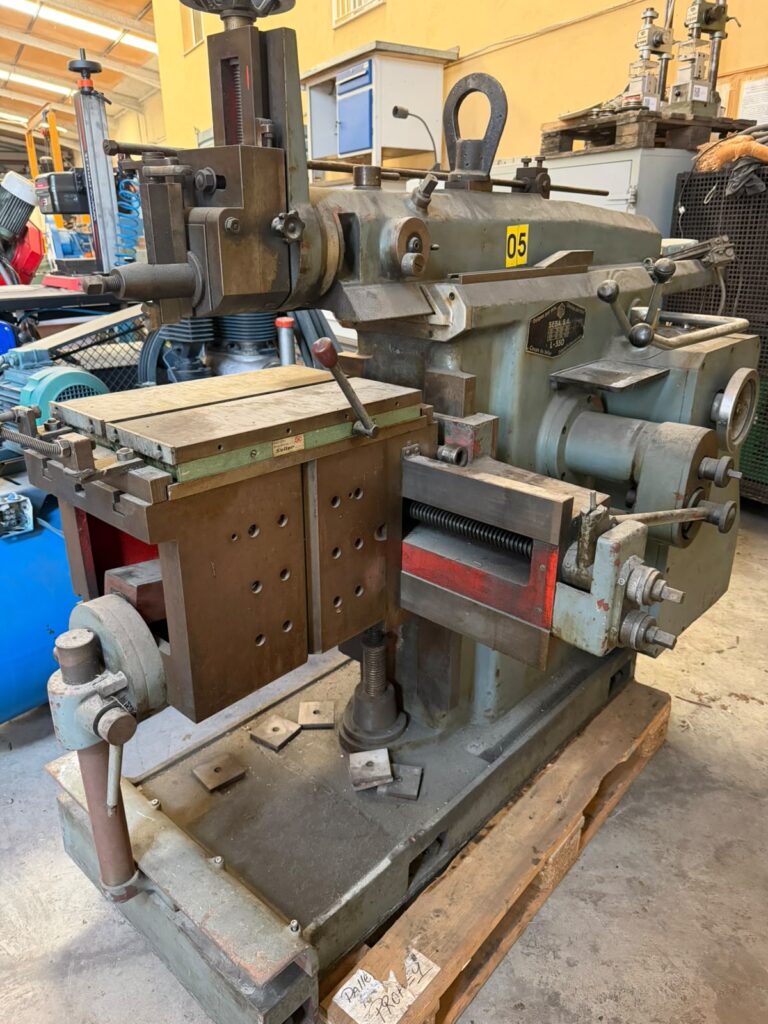
Confusion between the two machines is common because they share the same reciprocating machining principle, but their kinematics are opposite. On a planer, the workpiece sits on a bed or table that moves back and forth beneath a fixed tool, while on a shaper it’s the tool (mounted on the ram) that performs the reciprocating motion over a fixed workpiece. This difference directly affects the size of part each machine can handle: planers typically work with large, heavy pieces — machine beds, ways, base plates — while shapers are designed for medium or small parts requiring precision on keyways, slots or small flat surfaces.
Another important distinction is cutting power. Industrial planers, since they move much greater masses, usually feature more powerful motors and reinforced cast-iron beds to absorb vibration during deep roughing passes. Shapers, on the other hand, prioritize ram precision and fine stroke control, making them common in tool and die shops and repair workshops where unitary parts with tight tolerances are machined.
How does machining work on an industrial planer?
The work cycle of an industrial planer is based on a cutting stroke and an idle return stroke, generally faster than the cutting stroke to optimize cycle times. The worktable slides along precisely machined prismatic or V-way guides on the bed, and the tool head — fixed in height but with cross and even vertical feed on more complete models — allows for facing, slotting and machining of long surfaces, in many cases exceeding 2000 or even 4000 mm of usable stroke.
The power of the main motor, the rigidity of the bed and the tool feed system (mechanical or hydraulic) determine the actual metal removal capacity. On used machines it’s common to find mechanical drives with multi-speed gearboxes, though models with variable-speed drives also exist, allowing stroke speed to be adjusted according to material and required finish — a feature highly valued when working large castings or carbon steel parts.
What machining capacities should you consider before buying?
Before settling on a specific machine, it’s essential to translate your production needs into comparable technical parameters. Stroke length (the maximum travel of the table or ram) defines the maximum part size you can machine lengthwise, while table width and clearance under the tool head limit the cross and height dimensions. These three figures, together with installed power, are what you should always compare across different used-machine offers, beyond brand or year of manufacture.
It’s also worth checking the number of available feed rates, the presence of workholding systems (clamps, T-slots, vices), and whether the machine includes any coolant or chip extraction system — particularly relevant for extended machining of grey cast iron, which generates large amounts of abrasive dust. A machine well equipped in these respects reduces downtime and improves operator safety.
| Criterion | Industrial planer | Industrial shaper |
|---|---|---|
| Cutting motion | Table/workpiece reciprocates, tool fixed | Ram/tool reciprocates, workpiece fixed |
| Typical part size | Large and heavy (beds, plates) | Medium or small (tooling, die work) |
| Typical stroke | 1500 – 6000 mm | 150 – 900 mm |
| Installed power | Medium-high (7.5 – 30 kW) | Low-medium (1.5 – 5.5 kW) |
| Main use | Facing and slotting of large surfaces | Keyways, internal slots, fine fitting |
What should you check in the mechanical condition before buying a used unit?
Buying used machinery demands a thorough technical inspection, since many of these machines have been running for decades. The first thing to check is the condition of the bed ways and slides: uneven wear, play or galling marks indicate poor maintenance and foreshadow costly repairs. You should also check the play in the ram or the crank mechanism that generates the reciprocating motion, since excessive wear in these components causes vibration and loss of precision in the surface finish.
It’s equally important to start the machine and check operation at every stroke speed, listening for any unusual noise in the gearbox or main motor. Check the condition of the electrical system, limit switches, and drive belts or chains, and if possible, ask for a demonstration with actual chip removal on a test part. A reputable reconditioned-machinery dealer, as with Valcomaq’s catalogue, should be able to show you the machine running before the sale, along with an inspection report.
Which industrial sectors benefit most from these machines?
Planers remain highly valued in heavy machinery repair shops, foundries and shipyards, where large surfaces need to be rectified or machined that don’t fit any other type of machine without resorting to much more expensive large-bed milling machines. They’re also common in manufacturing ways for other machine tools, beds and precision structures. Shapers, on the other hand, find their niche in tool and die, jig and prototyping shops, where unitary or low-volume parts are machined that require internal slots, blind keyways or flat surfaces that are hard to reach with other machines.
In both cases, these are machines that complement a shop’s conventional and CNC machining fleet, covering occasional operations that would otherwise require outsourcing work to third parties, with the cost and lead times that involves.
What are the most common mistakes when buying a used planer or shaper?
One of the most frequent mistakes is focusing only on price and year of manufacture, ignoring the actual condition of the ways and drive mechanism, which are the most expensive elements to repair. Another common mistake is not checking spare parts availability or the seller’s technical support: many of these machines were built decades ago, and certain electrical or mechanical components can be hard to find if the machine hasn’t been properly reconditioned.
It’s also common to underestimate the space and foundation requirements. A long-stroke planer can need several additional linear meters beyond the table’s travel, and its heavy weight requires a floor with sufficient load capacity. Failing to verify these aspects before purchase can force costly modifications to the facility or even rule out the originally planned location.
How much does a used industrial planer or shaper cost?
The price of a used industrial planer varies enormously depending on table stroke, power and overall condition. Small and medium models, with strokes between 1500 and 2500 mm, typically fall in the range of 3,000 to 8,000 euros if reconditioned and tested. Large-format planers, with strokes exceeding 4000 mm and high power ratings, can exceed 15,000 or 20,000 euros depending on brand, bed condition and whether they include accessories such as special work-holding steadies or chip extraction systems.
Shapers, being smaller and less powerful machines, have a more affordable price range, between 1,500 and 5,000 euros depending on ram stroke and overall condition. In both cases, buying through a specialist who inspects and reconditions the machine before sale usually involves a higher upfront cost compared to buying directly from a private seller, but it drastically reduces the risk of early breakdowns and unplanned production stoppages.
Which buyer profile suits each type of machine?
Choose an industrial planer if: your shop regularly works with large, heavy parts, such as machine beds, base plates, long ways or metal structures that require precise facing over extensive surfaces. It’s also the right choice if you need to complement your milling fleet with a machine capable of machining lengths beyond the capacity of a conventional milling machine, without taking on the cost of a large-format moving-bed machine.
Choose an industrial shaper if: your activity centers on tooling, die work or unitary parts of medium and small size, where you need to machine keyways, internal slots or flat surfaces that are hard to reach with other machines. The shaper is especially useful in repair and industrial maintenance shops that need fast, flexible solutions for one-off parts, without needing to program a CNC machining center.
Choose buying used and reconditioned if: you want to reduce upfront investment without sacrificing reliability, prioritizing a supplier that guarantees mechanical inspection, operational testing and after-sales support over buying directly from a private seller with no warranty.
Choose expanding your fleet with both machines if: your workload regularly combines large and small parts, since having both a planer and a shaper lets you cover a wider range of operations without depending on third parties or outsourcing.
What questions should you ask the seller before closing the deal?
Before finalizing the purchase, it’s worth asking about the machine’s maintenance history, whether it’s been repaired recently and which components have been replaced. It’s also advisable to ask about actual power consumption, supply voltage (220V, 380V three-phase) and whether the machine comes with original manuals or wiring diagrams — something especially valuable on equipment several decades old, where finding technical documentation can be difficult.
Another point to clarify is transport and installation: ask whether the seller includes delivery to your shop, whether they have the means to load and unload a heavy machine, and whether they offer commissioning at the buyer’s facility. These logistical details, often overlooked, can add a significant extra cost if not negotiated in advance.
Used planers and shapers at Valcomaq: an investment with guarantees
At Valcomaq we understand that every workshop has different machining needs, which is why we work with a catalogue of inspected, ready-to-use second-hand industrial machinery, suited to both small businesses and large corporations. Our team checks every machine before putting it up for sale, verifying its mechanical, electrical and precision condition, so you can bring it into production with full confidence from day one.
If you’re looking for a used industrial planer or a reliable shaper to complete your machine fleet, we invite you to browse our used machinery catalogue and discover our available options at valcomaq.com. And if you have a machine you no longer use, remember that at Valcomaq we also buy your used industrial machinery, offering a fair valuation after inspection. Don’t hesitate to contact us for specialized advice and to find the machine that best fits your workshop’s needs.