


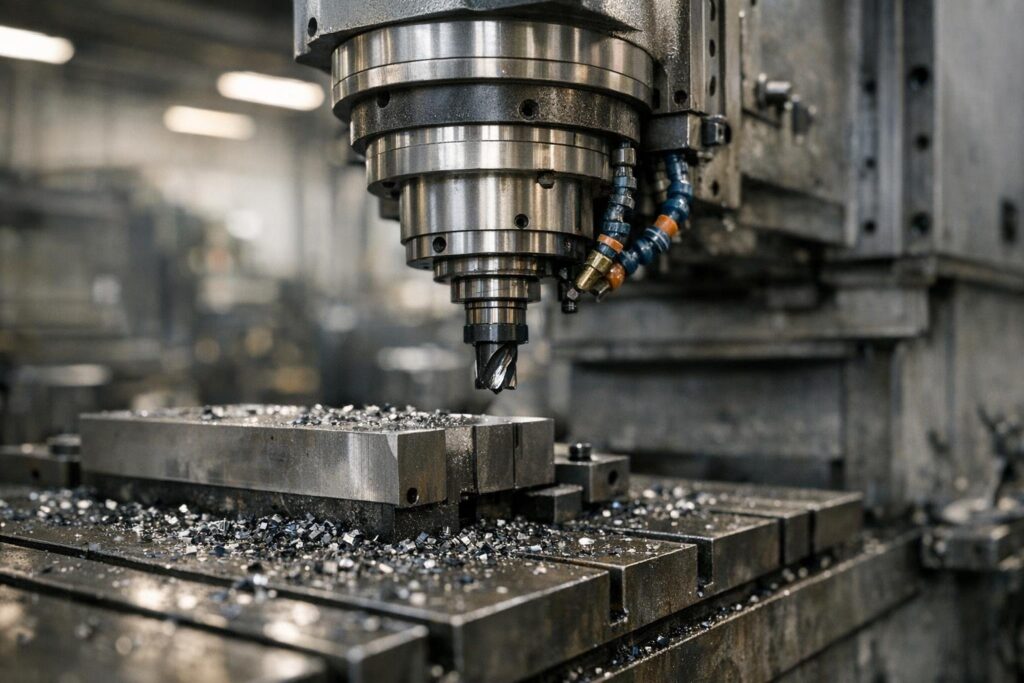
Buying a used industrial milling machine is one of the most cost-effective decisions a machine shop can make, provided the purchase is guided by real technical criteria. The second-hand machinery market offers robust equipment, often overbuilt compared to today’s requirements, at a fraction of the price of a new machine. However, not all milling machines are created equal, and not every configuration suits the same type of work. In this complete guide we cover the types of milling machines available on the used market, the power and spindle specs you need depending on your production, how to check the real condition of a machine before signing the purchase, the most common mistakes buyers make when acquiring a used unit, and the ballpark prices you can expect to find.
Throughout the article we’ll also look at which applications suit each configuration depending on the industry, answer the most frequent questions from first-time buyers of a reconditioned milling machine, and help you decide which machine profile best fits your shop, whether it’s a small repair workshop or a medium-batch machining plant.
What is an industrial milling machine, and why buy one second-hand?
An industrial milling machine is a machine tool that removes material using a rotating, multi-edge cutting tool (the milling cutter) to machine flat surfaces, slots, profiles, gears or complex geometries. Unlike a lathe, where the workpiece rotates and the tool stays fixed, in a milling machine it’s the tool that rotates while the workpiece moves across the table along several axes. There are fixed-bed configurations, universal milling machines and CNC (computer numerical control) milling machines, each designed for a different type of production.
Choosing a used industrial milling machine gives you access to oversized cast-iron beds, large-diameter spindles and structures far more rigid than many entry-level new machines, often for 40-60% less. Brands such as Zayer, Lagun, CME, Fexac or MRF have spent decades building equipment designed to run for 20 or 30 years without losing precision, as long as it has received proper maintenance. Buying second-hand also reduces environmental impact by extending the working life of machines that would otherwise end up scrapped.
What types of milling machines are available on the used market?
The fixed-bed milling machine is the most common option in general machining shops. Its column and bed form a rigid single block that provides excellent stability for heavy roughing and precision finishing on medium to large parts. These machines typically feature tables between 1,000 and 3,000 mm long, universal heads and, in many cases, digital readouts or CNC control retrofitted at a later stage. This is the type of machine you’ll find, for example, in the Zayer KF 3000 fixed-bed milling machine, fitted with Heidenhain CNC.
The universal milling machine, on the other hand, stands out for the versatility of its head, which can be angled on several planes to machine helical grooves, gears or inclined surfaces without repositioning the part. It’s a common sight in industrial maintenance and toolmaking shops. Finally, the CNC milling machine features numerical control on two, three or more axes, allowing complex geometries to be programmed, batches to be repeated with very tight tolerances, and reducing reliance on the operator’s manual skill. On the used market you can find reconditioned CNC units with Heidenhain, Fagor or Fanuc controls at very competitive prices compared with an equivalent new machine.
What power and spindle specs does your production need?
The power of the main motor determines the material removal rate and, therefore, the type of material and machining volume the milling machine can handle without straining. For light work in aluminum or low-hardness steel, 5 to 10 kW is usually enough. For heavy machining in carbon steel or cast iron, look for units of 15 kW or more, with robust gearboxes able to maintain torque at low RPM. The spindle diameter and taper (ISO 40, ISO 50 or larger) is equally important: a larger-diameter spindle can hold bigger tools and offers greater rigidity against vibration, which is critical during deep roughing passes.
You should also assess the travel of the X, Y and Z axes, which defines the maximum part size that can be machined without repositioning, and the feed rate, expressed in mm/min, which directly affects productivity. A milling machine with generous travels but an underpowered motor will be of little use for roughing, while a very powerful machine with short travel will limit the type of part you can produce. It’s important to cross-check these three factors -power, spindle and travel- against the actual parts your shop will be producing before making the purchase.
How do you check the real condition before buying?
Before closing the purchase of any used industrial milling machine, it’s essential to inspect the ways and slides, checking for excessive play or uneven wear, since machining accuracy depends directly on their condition. The main spindle should also be checked for unusual noise, vibration or axial play when run at different speeds with no load. A serious professional seller, as is the case at Valcomaq, inspects and reconditions these components before putting the machine up for sale, replacing bearings, seals and worn parts.
Another critical point is the condition of the electrical cabinet and control systems: on CNC machines you need to verify that the control unit starts up correctly, that the machine parameters haven’t been lost, and that the servomotors respond accurately. It’s also worth requesting the maintenance history, checking oil levels and the state of the centralized lubrication system, and running a real test cut on a sample part to verify surface finish and tolerances before the machine is shipped to your shop.
| Milling machine type | Rigidity & precision | Versatility | Typical application | Approximate price |
|---|---|---|---|---|
| Fixed-bed | Very high | Medium | General machining and large parts | €8,000 – €25,000 |
| Universal | High | Very high | Toolmaking, maintenance, gears | €6,000 – €18,000 |
| CNC | High | Medium-high (programmable) | Medium batches, complex geometries | €15,000 – €60,000 |
What are the most common mistakes when buying a used milling machine?
One of the most frequent mistakes is focusing solely on price without considering the total cost of ownership: a very cheap milling machine with a worn spindle or an outdated electrical system can end up costing more in repairs than it saved upfront. Another common error is buying without seeing the machine running in real conditions, relying only on photos or the seller’s word, without checking machining accuracy or the state of the ways under load.
It’s also a common mistake to size the machine incorrectly for the shop’s actual workload: buying an oversized, overpowered milling machine for small parts drives up power consumption and floor space, while falling short on travel or power forces you to outsource work the machine can’t handle. Finally, many buyers forget to check the availability of spare parts and manufacturer support, which is especially relevant for CNC milling machines with older controls that can complicate long-term maintenance.
What applications does each type of milling machine have by industry?
In the automotive and metal components sector, three-or-more-axis CNC milling machines are the most sought after for their ability to produce batches of parts with very tight tolerances and guaranteed repeatability. In industrial repair and maintenance workshops, on the other hand, the universal milling machine remains irreplaceable thanks to its flexibility for making one-off parts, repairing worn components or cutting keyways and gears on demand.
Shops working in heavy fabrication and structural steel tend to opt for large fixed-bed milling machines, capable of machining flanges, base plates or large structures with X-axis travel exceeding 2,000 mm. Vocational training centers, meanwhile, particularly value used universal milling machines for their excellent value for money and because they allow students to learn the fundamentals of manual machining before moving on to numerical control.
What maintenance does a used industrial milling machine require?
Once installed in the shop, a used milling machine needs a preventive maintenance routine similar to that of a new machine: periodic lubrication of the ways and spindle, checking coolant levels, cleaning chips off the bed, and a quarterly check of belt tension if the transmission isn’t direct-drive. On CNC units, it’s worth backing up programs and machine parameters regularly, as well as checking the condition of the control’s memory backup batteries.
Proper maintenance not only extends the machine’s working life but also keeps machining accuracy within the tolerances required for demanding jobs. At Valcomaq, every milling machine we put up for sale goes through an inspection and setup process that includes way adjustment, spindle checks, electrical verification and a test cut, so the buyer receives a machine ready to produce from day one.
Choose a fixed-bed milling machine if: your production focuses on medium to large parts that require high rigidity and stability, you mainly work with heavy roughing in steel or cast iron, and you want a robust machine with contained long-term maintenance costs.
Choose a universal milling machine if: your shop handles very varied jobs, produces one-off or repair parts, occasionally needs to machine helical grooves or gears, and values head versatility over batch production.
Choose a CNC milling machine if: you produce medium to large batches with complex geometries, need repeatability and very tight tolerances, and have staff trained to program and maintain numerical control, whether Heidenhain, Fagor or Fanuc.
Choose a unit reconditioned by a specialist if: you don’t have the time or technical knowledge to check the condition of the ways, spindle and electrical system yourself, and you’d rather have a machine with a warranty and after-sales support than risk buying directly from a private seller.
Used milling machines at Valcomaq: a safe investment for your shop
At Valcomaq we’ve spent more than 20 years selecting, inspecting and reconditioning second-hand industrial machinery, including fixed-bed, universal and CNC milling machines from brands such as Zayer, Lagun, CME, Fexac or MRF. Every unit goes through a full mechanical and electrical check before being listed for sale, so it arrives at your shop ready to work from day one, backed by a specialist team that can advise you based on your real production needs.
If you’re considering adding a used industrial milling machine to your shop, we invite you to explore Valcomaq’s used machinery catalog, where you’ll find fully inspected equipment with all the guarantees. If you also have a machine you no longer use, at Valcomaq we buy your industrial machinery at competitive prices. For any technical question about power, spindle specs or the condition of a specific milling machine, please contact us through our contact page and we’ll be happy to advise you with no obligation.