

Buying a used industrial saw is one of the most cost-effective decisions a machine shop, metalworking workshop or structural steel company can make. The right saw shortens cutting times, improves part finish and prevents production downtime caused by breakdowns. However, the used machinery market includes very different types of equipment, ranging from manual band saws to fully automated CNC saws. In this complete guide we cover the types of industrial saw available on the second-hand market, how to calculate the cutting capacity you actually need, what power and speed you should demand, and the most common mistakes buyers make when purchasing a used saw. By the end, you will know exactly what to look for and what to avoid.
At Valcomaq we work every day with industrial saws from brands such as Mep, Sabi and FAT, inspecting and reconditioning every machine before putting it up for sale. That hands-on experience allows us to give you objective, marketing-free criteria so your investment makes sense in the medium and long term.
What types of used industrial saws are available?
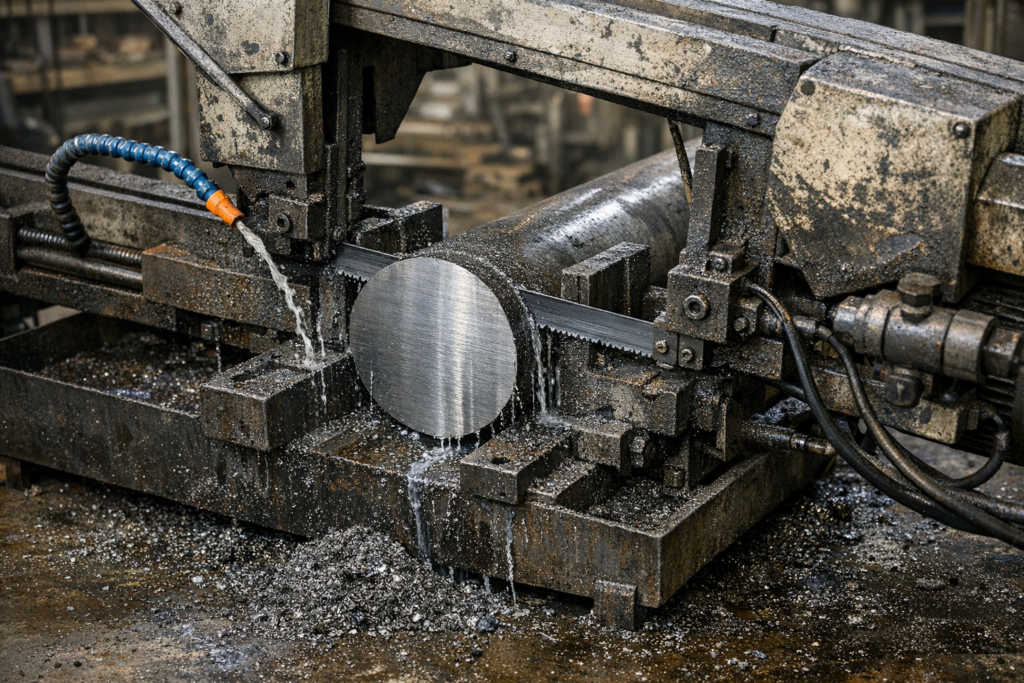
The used machinery market mainly offers three families of saws: manual band saws, semi-automatic saws and automatic CNC saws. Manual saws are the simplest: the operator lowers the head and controls the cutting pressure, which makes them ideal for workshops with low output or highly varied parts. Semi-automatic saws feature a hydraulically regulated feed system, so the cut is made at a constant pressure without continuous operator intervention, resulting in more uniform cuts and less blade wear.
Automatic CNC saws, such as the Sabi PBS models with numerical control, allow you to program cutting lengths, miter angles and complete part series without any manual intervention between cuts. This type of saw is common in workshops with medium-to-high output that need repeatability and traceability. There are also circular saws and reciprocating saws, less common on the used market but highly valued for cutting thin-wall profiles or precision tubing, where a band blade does not always deliver the same finish.
How much cutting capacity do you really need?
Cutting capacity, together with power, is the most important technical specification when choosing an industrial saw. It is usually expressed as the maximum cutting diameter for round stock (for example, Ø 250 mm or Ø 330 mm) and as maximum dimensions for rectangular stock. A common mistake is buying a saw that cuts exactly the diameter needed today, with no margin for slightly larger parts in the future. It is advisable to leave a 15-20% margin over the largest part you typically machine, so you are not caught short on a special order.
You should also assess miter-cutting capacity, i.e. the ability to cut at 45 or 60 degrees without losing diameter range. Many used semi-automatic saws, such as the MEP Shark 330 HH, hold up to Ø280 mm in straight cuts and reduce that figure slightly when mitering. If your production includes structural profiles for metal fabrication or shipbuilding, this detail can be decisive when ruling out a model that looks fine on power but is limited in cutting geometry.
How much power and cutting speed does your production need?
Motor power determines the saw’s ability to maintain feed rate on hard materials without straining the blade or generating excessive vibration. Industrial band saws typically feature motors ranging from 1.5 kW on lightweight models to 5-7 kW on high-capacity saws designed for cutting alloy steel or stainless steel. Insufficient power leads to burnt blades, crooked cuts and accelerated tooth wear, while excessive power without proper feed control can easily snap the band.
Cutting speed, expressed in meters per minute, should be variable on any saw working with different materials. Models with a speed variator, common on automatic CNC saws such as the Sabi PBS 250A, let you adjust the range typically between 20 and 100 m/min depending on whether you are cutting carbon steel, aluminium or stainless steel. Buying a saw without a variator severely limits its versatility, forcing you to always work at the same speed regardless of material, with the resulting premature wear on carbide tips and blades.
Band saw, semi-automatic saw or CNC saw: which one should you choose for your workshop?
The choice between a manual band saw, a semi-automatic saw or a CNC saw depends directly on part volume and job repeatability. A workshop that cuts one-off parts of highly varied dimensions, such as repair shops or industrial maintenance facilities, gets little benefit from a CNC saw and finds the manual or semi-automatic saw a more affordable, flexible solution. On the other hand, a workshop producing long runs of the same length — structural profiles, automotive tubing or calibrated bars — quickly recovers the added cost of an automatic saw with dimension programming.
Another factor to consider is available labor. Automatic saws reduce the need for an operator dedicated exclusively to the machine, since once the cutting series is programmed the saw can run virtually unattended while the operator handles other tasks. This is especially relevant in workshops facing a shortage of skilled staff, where every operator hour is costly and automating the cutting process frees up production capacity.
| Saw type | Typical capacity | Recommended output | Main advantage |
|---|---|---|---|
| Manual band saw | Up to Ø200-250 mm | Low, varied parts | Low purchase cost |
| Semi-automatic saw | Up to Ø280-330 mm | Medium, short-to-medium runs | Uniform cuts, less wear |
| Automatic CNC saw | Up to Ø250-400 mm depending on model | High, long repetitive runs | Dimension and series programming |
| Disc saw | Thin-wall profiles | Medium, precision cutting | Very clean finish |
What should you check before buying a used industrial saw?
Before closing the purchase of any used industrial saw, several critical points deserve attention. The first is the condition of the band guides and rollers, since their wear causes off-track cuts and vibration that directly affect final accuracy. The second is the hydraulic head-lowering system: oil leaks, unusual noises or an uneven descent usually indicate that the pump or cylinders will need maintenance in the short term, a cost you should factor into price negotiations.
It is also essential to check the condition of the main motor, the speed variator if fitted, and the coolant system, which prevents the blade from overheating during long cuts. On CNC saws, verify that the screen and software respond correctly, that programming manuals are available, and that the manufacturer or seller can guarantee availability of electronic spare parts — an aspect that can become complicated on machines over ten years old if the model has been discontinued.
What are the most common mistakes when buying a used industrial saw?
One of the most frequent mistakes is focusing only on the sale price without calculating total cost of ownership. A cheap saw with a worn band, damaged guides or a motor at its limit can end up costing more in repairs during the first year than a slightly pricier but properly inspected unit. Another common mistake is failing to check the real age of fast-wearing components, such as blades, guide rollers and workpiece clamps, which are usually replaced frequently and whose condition offers reliable clues about the machine’s overall maintenance history.
It is also a frequent mistake to buy a saw without checking cut squareness, i.e. the perpendicularity between the blade and the part’s support surface. A deviation of just a few degrees may seem insignificant, but on long parts it results in clearly defective cuts that need reworking on another machine, adding extra cost. Finally, many buyers skip a real cutting test with material similar to what they will actually work with, relying instead on a visual inspection that does not reveal vibration issues, excessive noise or power loss under load.
How much does a used industrial saw cost?
The price of a used industrial saw varies enormously depending on type, brand, year of manufacture and overall condition. A basic manual band saw with medium capacity can be found for a few thousand euros, while a semi-automatic saw with good cutting capacity and a mid-range motor sits in an intermediate price bracket. Automatic CNC saws, especially recent models fitted with a variator and touchscreen, represent the highest investment within the used segment, although they remain notably cheaper than an equivalent new machine.
A factor that heavily influences final price is pre-sale reconditioning. A fully inspected saw, with a new blade, adjusted guides and a checked hydraulic system, costs somewhat more than a machine sold «as is», but drastically reduces the risk of immediate downtime after purchase. At Valcomaq, for example, we inspect every saw before offering it for sale, so buyers know exactly the real condition of the equipment and can plan its start-up with no surprises.
Which saw best fits your type of workshop?
Choose a manual band saw if: your workshop handles highly varied parts in size and material, daily cutting volume is low to moderate, and you want maximum flexibility with the lowest initial investment. It is the ideal choice for repair shops, industrial maintenance facilities or small metalworking businesses with no fixed production run.
Choose a semi-automatic saw if: you need repeated cuts with consistent accuracy but do not yet justify investing in numerical control, and your output sits at a medium volume with short-to-medium series. The regulated feed system noticeably improves finish quality compared with manual cutting without significantly raising equipment cost.
Choose an automatic CNC saw if: your workshop produces long, repetitive runs, you need dimensional traceability, and you want to free up the operator for other tasks while the machine cuts unattended. It is the best option for workshops supplying the automotive industry, structural steel fabrication or series component manufacturing.
Choose a disc saw if: your production focuses on thin-wall profiles, precision tubing or parts where the cut finish must be especially clean and burr-free, something a band blade does not always achieve with the same quality.
Used industrial saws at Valcomaq: a safe investment for your workshop
Choosing the right used industrial saw is not just about comparing prices — it means understanding what type of cutting your production really needs, what capacity and power are enough today and in the medium term, and what technical points to check before signing the purchase. A suitable, well-maintained saw can keep delivering excellent performance for many years, and buying it used lets you access reference brands such as Mep, Sabi or FAT at a fraction of the cost of an equivalent new machine.
If you are unsure which model best fits your workshop, at Valcomaq we inspect every machine before putting it up for sale and advise you based on your production volume and material type. Explore our catalog of used industrial machinery and check out our available saws, and if you need to sell your current equipment, remember that we also buy your machine after a full inspection. If you have any technical or commercial questions, contact us and we will help you find the used industrial saw that best fits your production needs.