

When a machining workshop or a structural steel plant needs to cut profiles, tubes or solid bars with guaranteed results, the choice of industrial saw makes the difference between smooth production and constant downtime caused by misalignment. Within the second-hand machinery catalogue, the used Mep industrial saw has earned a prominent place thanks to its heavy-duty construction and the cutting precision it retains even after years of intensive use. In this article we take an in-depth look at what sets Mep saws apart, how they compare to other catalogue brands such as FAT and Sabi, what to check before buying one second-hand, and which types of workshops they suit best. If you are considering adding a reconditioned band or disc saw to your production line, here you will find all the technical information you need before making a decision.
Throughout the article we will cover specific models, cutting capacities, build materials and maintenance criteria, along with a direct comparison between manufacturers so you can identify which machine best matches your workload and the type of material you cut regularly.
What sets used Mep saws apart?
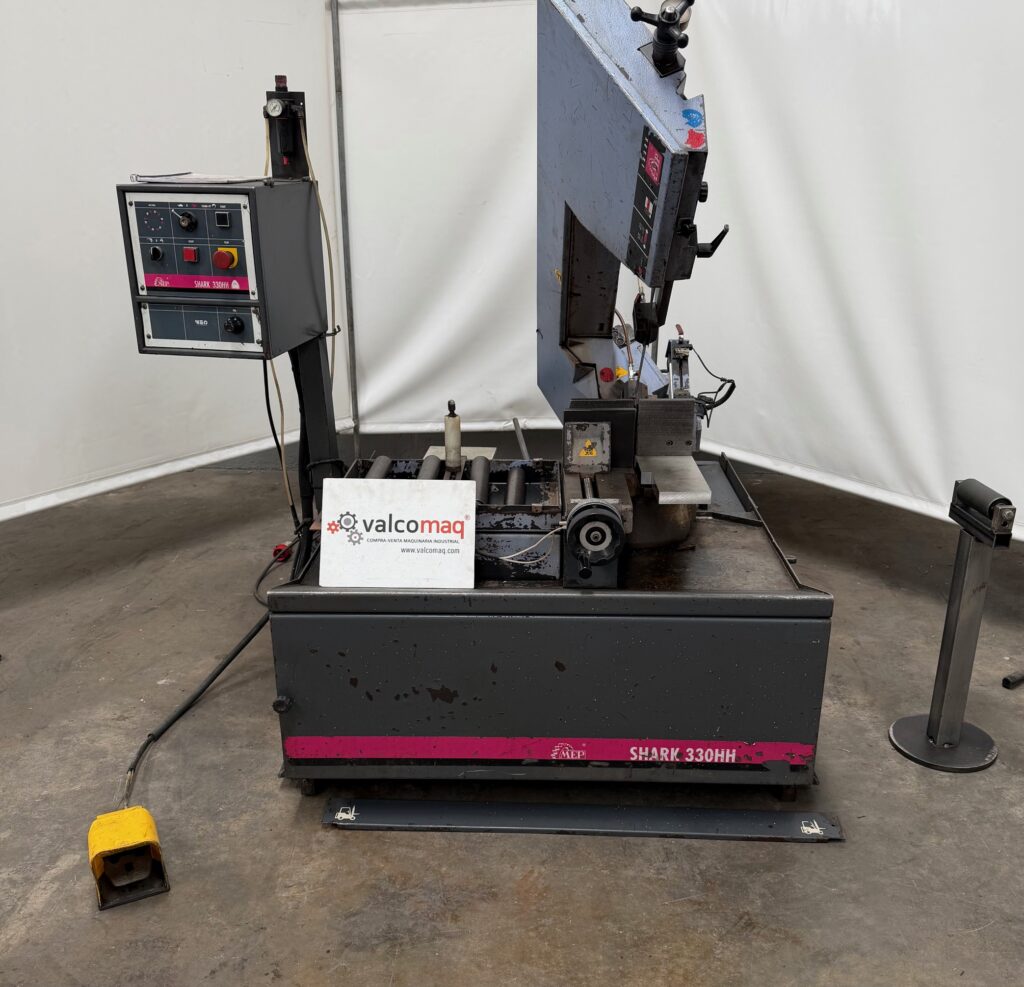
Mep is an Italian manufacturer with decades of experience developing horizontal and semi-automatic band saws for metal cutting in machining workshops, industrial locksmiths and steel distribution plants. Its machines are characterised by a heavy-duty cast-iron bed that absorbs vibration during cutting, a gravity-fed or hydraulic feed system depending on the model, and a bearing-guided saw arm that ensures straight cuts even on large-section profiles. Models such as the MEP Shark 330 HH, commonly available in the used saw catalogue, can cut diameters of up to 280 mm with a 3320 mm blade and cutting speeds ranging from 40 to 80 metres per minute, making them versatile for both carbon steel and stainless steel with the right settings.
Another distinctive feature of used Mep saws is the ease of maintaining their mechanical components, since many models use standardised parts that are still manufactured or have equivalents readily available on the industrial spare parts market. This considerably reduces the cost of keeping a fifteen- or twenty-year-old machine operational, which is not always the case with more closed, proprietary brands. In addition, the blade tensioning system is usually manual or semi-automatic with a pressure indicator, making it easy to set the correct tension for each type of material and preventing premature blade breakage.
How robust and precise is a used Mep saw?
The robustness of a second-hand Mep saw is mainly down to the weight and thickness of its bed, cast from high-density grey iron, which acts as a natural damper against the vibrations generated when cutting hard materials. This feature is especially valued in workshops working with alloy steels or forged parts, where machine stability directly determines the surface finish of the cut and the service life of the blade. Compared to lighter-duty saws, Mep structures maintain acceptable cut-squareness tolerances even after years of three-shift operation.
As for precision, models fitted with CNC or numerical control, such as certain variants in the Mep range with programmable length stops, allow exact repeat cuts on long production runs without needing to readjust the stop each time. This is crucial for subcontract workshops manufacturing batches of identical parts for metalworking or structural steel clients. A well-serviced used Mep saw, with a properly calibrated blade guide and bearings in good condition, can deliver cutting precision comparable to a new mid-range machine, at a significantly lower investment.
Mep vs FAT vs Sabi: what are the real differences?
Within the used industrial saw catalogue, three brands consistently stand out: Mep, FAT and Sabi. Although all three perform similar metal-cutting functions, there are important differences in construction, automation and recommended use that are worth knowing before deciding. FAT is generally known for its mechanical simplicity and low maintenance cost, making it ideal for workshops with tight budgets and less demanding cutting needs. Sabi, meanwhile, has focused in recent years on incorporating state-of-the-art CNC controls, as seen in models such as the Sabi PBS 250A, aimed at workshops seeking full automation of the cutting process.
Mep sits in a very interesting middle ground: it offers the mechanical robustness required for cutting hard materials along with semi-automation options that speed up production without demanding the investment level of a fully CNC saw. This positioning makes it a well-balanced option for workshops that need daily reliability without depending on complex programming. The table below summarises the main differences between the three brands to help you compare based on your workshop’s profile.
| Brand | Robustness | Automation | Maintenance cost | Recommended workshop profile |
|---|---|---|---|---|
| Mep | High, heavy cast-iron bed | Semi-automatic and CNC on some models | Low-medium, accessible spare parts | Machining and structural steel workshops with intensive daily cutting |
| FAT | Medium, simple construction | Basic manual or semi-automatic | Very low | Small workshops with irregular production |
| Sabi | High, reinforced bed | Advanced CNC with touchscreen | Medium-high due to electronics | Long production runs requiring high repeatability |
Which workshops best suit a used Mep saw?
Second-hand Mep saws are best suited to general machining workshops that need to prep bars and profiles before moving them onto a lathe or milling machine, as well as structural steel companies that continuously cut large-section rolled profiles. Their ability to hold a stable cut on medium- and large-diameter materials, combined with a purchase cost lower than that of a new machine, makes them a sound investment for industrial SMEs looking to optimise their production flow without compromising cut quality.
They are also highly valued by steel distributors and raw material warehouses that need to cut round, square or rectangular bar stock to length in large volumes for their customers. In these environments, mechanical reliability and spare parts availability matter more than electronic sophistication, which is why a well-maintained Mep saw can perform for years with relatively simple upkeep. On the other hand, workshops requiring very long runs with constant program changes may be better served by models with more advanced CNC control.
Which used Mep models are most in demand?
Among the Mep saw models most frequently found on the second-hand market are the mid-range semi-automatic horizontal series, similar in concept to the aforementioned Shark 330 HH, as well as higher-capacity variants designed for cutting large structural profiles. These machines usually feature hydraulic clamping systems, which secure the workpiece during the cut and prevent deviations on irregular-section materials. Blade length and motor power vary by model, but they generally fall within ranges suited to mid-sized workshops processing between 20 and 100 cuts per day.
When searching for a used Mep saw, it’s worth checking the year of manufacture, the condition of the guide blade and whether the machine has documented records of regular servicing. Many machines from this manufacturer, when properly reconditioned by a specialist supplier, deliver performance practically on par with a new machine, with the added benefit of a noticeably lower purchase price and a much faster return on investment for the buyer.
What should you check before buying a second-hand Mep saw?
Before closing the purchase of a used industrial saw, it is essential to inspect several critical points that determine both the safety and future precision of the machine. First, check the condition of the blade guides and the bearings on the cutting arm, since wear here causes angled cuts and excessive vibration. It’s also worth checking the hydraulic feed system to ensure there are no leaks or pressure drops that could slow down the cutting cycle. The main motor should start without unusual noise and maintain a stable speed under load, as fluctuations in revolutions usually point to underlying electrical or mechanical problems.
Another important point is verifying the condition of the bed and the workpiece clamping base, checking for cracks or deformation caused by past impacts or overloads. If the machine includes coolant-based cooling, it’s advisable to check the pumps and circuits to avoid surprises after start-up. Finally, whenever possible, it’s a good idea to request a real cutting test on a workpiece representative of the material typically processed in your workshop, so you can assess first-hand the precision and surface finish the machine delivers.
How can you extend the service life of a reconditioned Mep saw?
Preventive maintenance is key to keeping a used industrial saw performing well for many more years of service. For Mep machines, it’s recommended to regularly check blade tension, adjusting it according to the material being cut, and to replace the band before tooth wear starts causing vibration or uneven cuts. Lubrication of the linear guides and the arm bearings should follow the manufacturer’s schedule, avoiding both excess and insufficient grease, both of which are harmful to component life.
It’s also important to keep the cooling system clean, as the build-up of metal chips in the coolant tank reduces cooling efficiency and accelerates blade wear. A good habit is to keep a log of working hours and consumable changes, which helps anticipate breakdowns and plan maintenance stops during periods of lower production demand, minimising the impact on daily workshop operations.
How much does a used Mep saw cost?
The price of a second-hand Mep industrial saw varies depending on age, condition, cutting capacity and whether the machine includes additional automation features such as programmable feed or numerical control. In general, mid-range semi-automatic models, reconditioned and backed by a specialist supplier’s warranty, are priced considerably lower than an equivalent new machine, offering savings that can exceed 40 to 50 percent depending on the model and original condition. This economic factor, combined with the brand’s long-standing reliability, explains why many workshops choose a used Mep saw as their first investment in industrial cutting or as an addition to their existing equipment fleet.
It’s important to bear in mind that the final price should always include a technical inspection, transport and installation, and in many cases a warranty period covering the main components. Buying from a supplier that reconditions its own equipment, rather than purchasing directly from private sellers without guarantees, significantly reduces the risk of costly surprises after start-up.
Choose a used Mep saw if: your workshop needs to continuously cut medium- or large-section profiles and bars, you value mechanical robustness over electronic sophistication, and you want a machine with accessible spare parts and low long-term maintenance costs.
Choose a FAT saw if: your cutting volume is low or irregular, you have a very tight budget, and you prioritise mechanical simplicity over any form of advanced automation.
Choose a Sabi saw if: your production requires long runs with high repeatability, you need CNC programming with a touchscreen, and you’re willing to take on somewhat more demanding electronic maintenance in exchange for greater automation.
Used industrial saws at Valcomaq: a safe bet for your workshop
At Valcomaq we understand that choosing the right saw is a strategic decision for any machining or structural steel workshop. That’s why we work only with equipment inspected and serviced by our technical team, ensuring that every machine, whether Mep, FAT or Sabi, arrives at your facility ready to produce from day one. Our more than twenty years of experience buying and selling industrial machinery allow us to give you objective advice on which model best fits your type of production, your budget and your workshop’s technical requirements.
If you’re considering adding a used Mep industrial saw to your production line, we invite you to explore the used industrial saws catalogue available at Valcomaq, where you’ll find inspected equipment from the leading brands in the sector. Our team can also help you compare options within the used industrial machinery category based on your specific cutting needs. If you have any questions about which model to choose, what to check before buying, or if you have a machine you’d like to sell, contact us and we’ll provide personalised advice with no obligation.